
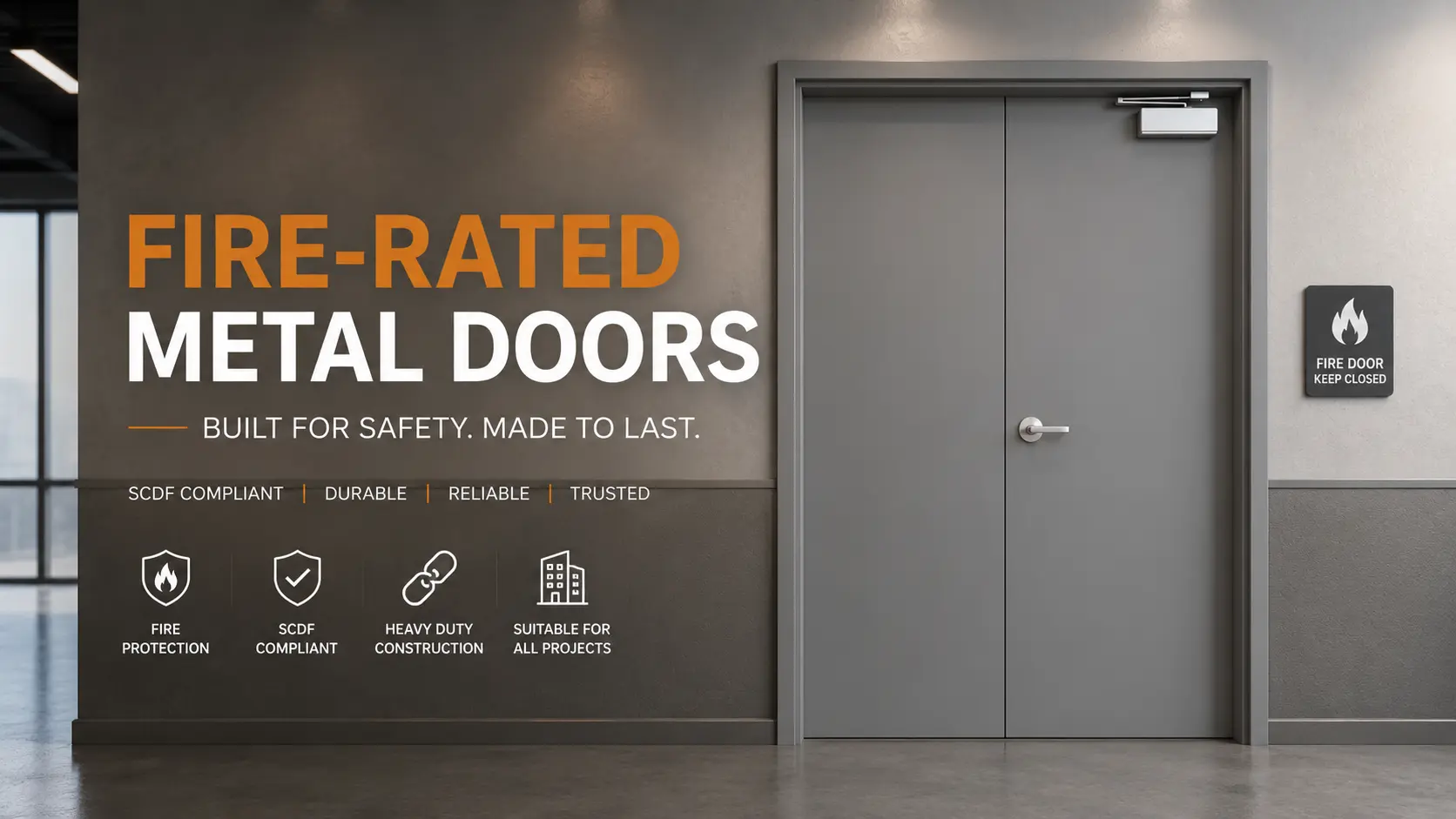
Fire-Rated Metal Doors in Singapore: A Complete Guide for Contractors, Architects & Renovation Projects
- What Is a Fire-Rated Metal Door?
- Types of Metal Doors in Singapore Projects
- Materials & Construction Specifications
- BTO and HDB Considerations
- Commercial & Industrial Applications
- Installation Guidance for Contractors
- Maintenance Requirements
- FAQ
Metal doors have become one of the most specified building components across Singapore's commercial, industrial, and residential sectors. From BTO flat entrances to high-rise office lobbies and industrial warehouses, the demand for durable, fire-rated metal door solutions continues to grow alongside Singapore's construction and renovation industry.
What Is a Fire-Rated Metal Door?
A fire-rated metal door is a door assembly engineered to resist the passage of fire and smoke for a defined period. In Singapore, fire-rated doors are governed by the Singapore Civil Defence Force (SCDF) and the Code of Practice for Fire Precautions in Buildings. Compliance is mandatory across a broad range of project types.
Common Fire-Rating Classifications
For most commercial buildings and industrial facilities in Singapore, a minimum FD60 or FD120 rating is commonly specified by the Qualified Person (QP) in the fire safety design report.
Types of Metal Doors Used in Singapore Projects
Single-Leaf Steel Doors
The most widely used configuration for staircase lobbies, plant rooms, back-of-house corridors, and service areas. Compact footprint and straightforward to install.
Double-Leaf Steel Doors
Preferred where larger clear opening widths are needed — loading bays, hospital corridors, factory floors, and main entrances in commercial buildings.
Galvanised & Powder-Coated Doors
For humid or coastal environments — common in Singapore — galvanised steel substrates with powder-coat finishes significantly extend the door's service life.
Acoustic & Smoke-Sealed Doors
Intumescent strips and smoke seals integrated into the door frame and leaf to prevent smoke passage — a critical life-safety feature separate from thermal resistance.
Materials & Construction Specifications
| Component | Specification |
|---|---|
| Door Skin | Cold-rolled steel (CRS), 1.2mm – 1.6mm thickness |
| Frame Material | Mild steel or galvanised steel sections, factory-welded corners |
| Core Infill | Mineral wool or vermiculite — primary fire-resisting material |
| Stiffeners | Internal steel ribs or honeycomb structures to prevent warping |
| Intumescent Strips | Embedded or surface-applied; expand under heat to block fire & smoke |
| Finish Options | Powder coat (full RAL range), galvanised, laminate wrap |
Hardware & Ironmongery Requirements
Fire-rated metal doors require hardware that is tested and certified as part of the complete door assembly. Non-compliant hardware can invalidate the fire rating.
- Door closers — overhead or concealed floor spring types
- Panic hardware / push bars — mandatory for commercial escape routes
- Three-point locking systems — plant rooms and secure areas
- Certified hinges — butt, pivot, or continuous, rated to match door classification
- Intumescent glazing beads — if vision panels are incorporated
BTO and HDB Considerations
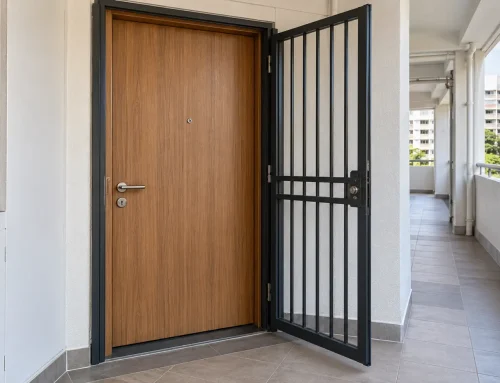
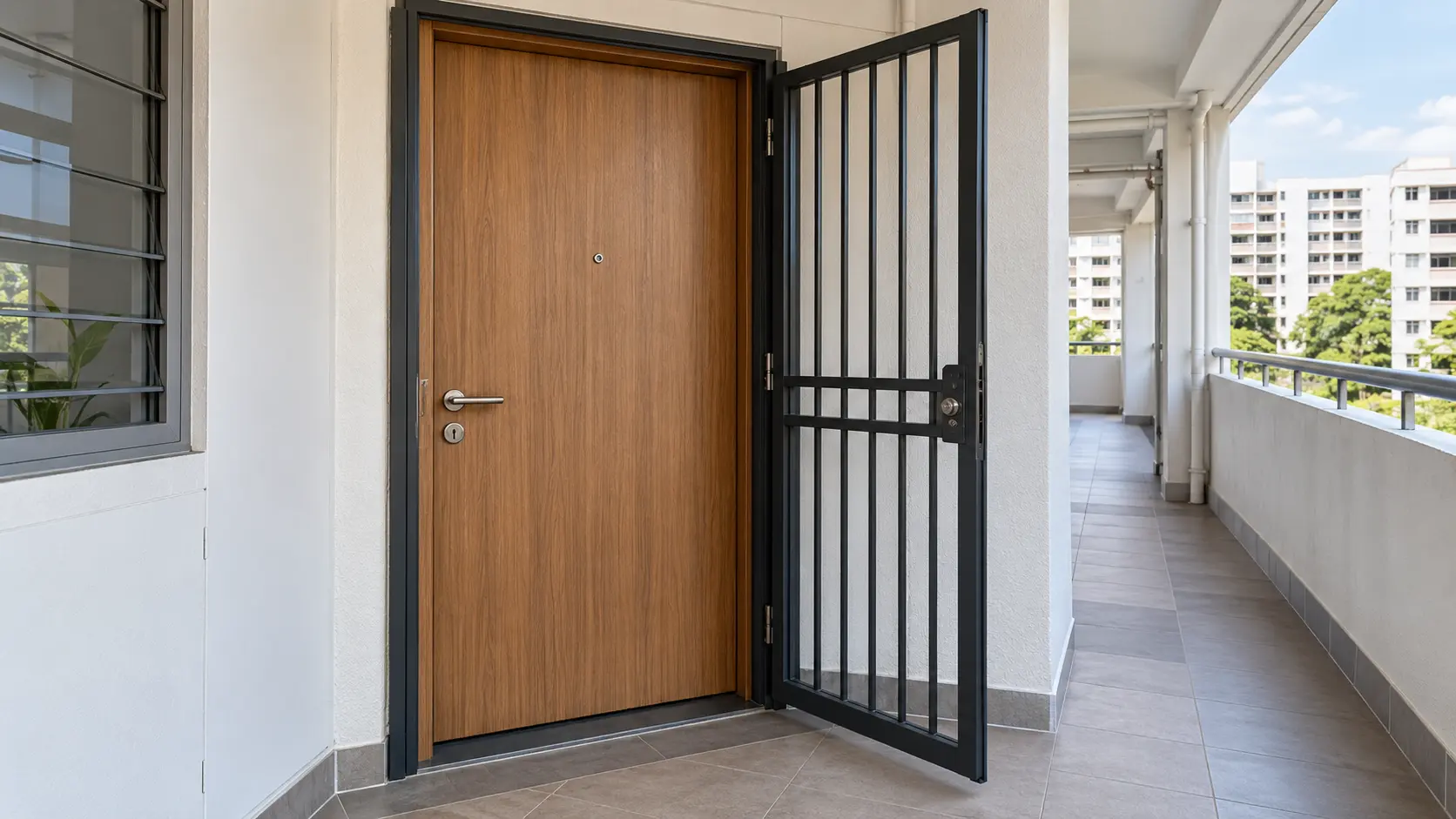
For BTO flat owners and renovation contractors working on HDB units, the front entrance door is subject to specific requirements. HDB typically supplies a fire-rated door as part of the BTO flat's standard specification.
Any door replacement in an HDB unit must meet the equivalent or higher fire-rating classification and be approved by HDB or the relevant Qualified Person. Surface treatments such as laminate wraps or paint finishes must not obstruct intumescent seals.
Common HDB Renovation Scenarios
- Upgrading existing metal doors under the Home Improvement Programme (HIP)
- Replacing damaged or warped doors in older commercial and industrial units
- Retrofitting smoke seals as part of compliance upgrades
- Installing new metal door sets during A&A (Additions and Alterations) works
- Changing door swing direction to meet fire escape route requirements
Commercial & Industrial Applications
In commercial fit-outs, architects and M&E consultants commonly specify fire-rated metal doors at staircase enclosures, electrical and mechanical rooms, kitchen and F&B compartments, and retail shop fronts in shopping malls.
Industrial metal doors in warehouses and manufacturing plants frequently combine fire rating with high-traffic resistance, large clear openings for forklift movement, and vision panels for improved sightlines in high-movement zones.
Installation Guidance for Contractors
Pre-Installation Checklist
Width, height, and depth must match the door schedule. Confirm wall construction type — brick, RC, lightweight block, or drywall — as each requires different fixing methods.
Plumb, level, and square frames before grouting. All frames in RC or brick walls should be grouted solid to maintain the fire-rated assembly integrity.
Perimeter gaps must be within tolerances specified in the fire-test certificate — typically 3–4mm maximum. Closers must be adjusted so the door self-closes and latches without manual assistance.
All intumescent strips must be correctly positioned and undamaged before commissioning. Glazed vision panel assemblies must use intumescent glazing beads and fire-rated glass.
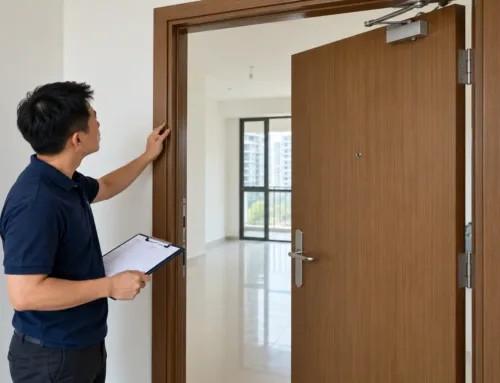
Maintain product data sheets, test certificates, site photos, and as-built door schedules. Commercial projects require formal QP or SCDF inspection before TOP/CSC can be issued.
Maintenance of Fire-Rated Metal Doors
Fire doors are life-safety equipment. Regular maintenance is a regulatory and practical necessity under SCDF's Fire Safety Act.
Leave A Comment