

Timber Door Manufacturing in Singapore: Inside Hong Rui's Quality Process
Timber door manufacturing in Singapore involves selecting a core material (solid timber, particleboard or composite/engineered core), pressing facing materials such as veneer or high-pressure laminate (HPL) onto the core, sealing the edges, machining for hardware, and running dimensional and surface-quality checks before delivery. For fire-rated or certified applications, the finished door leaf is also matched to a tested door set and, where relevant, verified against recognised certification schemes such as the Singapore Green Building Product (SGBP) scheme.
- A timber door's performance depends more on its core construction than on its surface finish alone.
- Composite or engineered cores are commonly specified where dimensional stability and consistent density matter, such as high-traffic or humid areas.
- Fire-rating status is project-specific — it depends on the tested door set (leaf, frame and hardware together), not the timber species alone.
- HDB and BTO door requirements vary by unit layout and approved fire-safety provisions, so project teams should confirm requirements with HDB rather than assume a blanket rule.
- Third-party product certification, such as SGBP ratings, can help project teams compare environmental and quality claims on a like-for-like basis.
- What Is a Manufactured Timber Door?
- How a Timber Door Is Constructed
- Core, Facing and Finish: Material Options
- The Manufacturing and Quality-Control Process
- Certification and Testing Benchmarks
- Where Timber Doors Are Used in Singapore
- HDB and BTO Considerations
- Contractor, Architect and Designer Coordination
- Measurements, Frame and Hardware Compatibility
- Installation and Common Mistakes
- Maintenance, Inspection and Replacement
- Questions to Ask Before Specification
- FAQ
Specifying a timber door sounds straightforward until a project team compares two doors that look identical on a sample board but perform very differently on site. The difference usually comes down to what happens before the door ever reaches the project — how the core is built, how the facing is pressed on, and how consistently the manufacturer checks each leaf before it leaves the factory. This article walks through that process, using Hong Rui's own production steps as a working example, so that contractors, architects, interior designers and property teams have a clearer basis for evaluating timber door suppliers in Singapore.
What Is a Manufactured Timber Door?
A manufactured timber door is a factory-produced door leaf built from an engineered core rather than a single solid plank of wood. The core is faced with a decorative or functional surface — such as wood veneer, laminate or high-pressure laminate (HPL) — and edge-sealed before hardware preparation. This construction method is standard across most residential and commercial projects in Singapore because it offers more consistent dimensional stability than solid-plank timber in a tropical, humid climate.
The term "timber door" in the Singapore market generally covers a range of core types and finishes, so two doors both described as "timber doors" can differ significantly in weight, sound performance, moisture resistance and fire behaviour. Understanding the core construction is therefore more useful than judging a door by its surface appearance alone.
How a Timber Door Is Constructed
Most manufactured timber doors share a similar layered structure:
- Core: the structural centre of the door, which determines weight, density, sound insulation and, in tested door sets, contribution to fire performance.
- Stiles and rails: the timber framing around the perimeter of the core, which anchors hinges, locksets and closers.
- Facing: the decorative or functional surface layer bonded to the core under heat and pressure.
- Edge banding: a sealed strip along the door's edges that protects the core from moisture ingress and impact damage.

Common Core Types
Core type is the single biggest factor separating a basic timber door from a project-grade one. The table below summarises the core types most commonly specified in Singapore projects.
| Core Type | General Characteristics | Typical Use Case |
|---|---|---|
| Solid timber core | Higher material cost, natural grain, more sensitive to humidity swings if not properly seasoned | Feature doors, low-traffic residential entrances |
| Particleboard/chipboard core | Economical, lighter, moderate dimensional stability | Internal doors in cost-sensitive residential projects |
| Composite/engineered core | Manufactured for consistent density and improved dimensional stability; commonly paired with HPL facing | High-traffic residential, commercial and institutional doors |
| Honeycomb core | Lightweight, lower cost, generally lower acoustic and impact performance | Low-traffic internal partitions, storage rooms |
As an example of a composite-core product, Hong Rui manufactures its PyroMeister timber door range on a composite core faced with high-pressure laminate. This construction approach is chosen specifically for applications where dimensional consistency and surface durability matter more than the cost savings of a lighter core.
Core, Facing and Finish: Material Options
Beyond the core, project teams typically evaluate three further material decisions:
- Timber species (for veneered doors): affects grain appearance and, to a lesser extent, weight and hardness.
- Facing material: wood veneer offers a natural finish but requires more careful maintenance; high-pressure laminate (HPL) offers a more scratch- and moisture-resistant surface suited to high-traffic or semi-exposed locations.
- Edge and lipping material: PVC, ABS or matching laminate edging protects the core from moisture at the door's most vulnerable point — its edges.
None of these options is universally "better." The right combination depends on the location of the door, expected traffic, exposure to moisture, and whether the door needs to be matched to a tested fire-rated door set.
The Manufacturing and Quality-Control Process
The steps below outline a typical factory sequence for a manufactured timber door in Singapore. Individual manufacturers may sequence steps differently, but the underlying checkpoints are broadly similar across the industry.
- Raw material selection and moisture conditioning: core boards and timber components are checked for moisture content before use, since improperly conditioned material can warp after installation in Singapore's humidity.
- Core fabrication: the core is cut, and where composite construction is used, layered and bonded to the required density and thickness.
- Hot-press lamination: the facing material (veneer or HPL) is bonded to the core under controlled heat and pressure to achieve consistent adhesion across the full door leaf.
- Sizing and squaring: the pressed leaf is trimmed to final dimensions and checked for squareness, since an out-of-square leaf will bind against the frame after installation.
- Edge banding and sealing: edges are sealed to protect the core from moisture, particularly important at the bottom edge of the door.
- Hardware pre-machining: hinge recesses, lock cases and, where specified, digital lock cut-outs are machined to the project's hardware schedule.
- Surface finishing: final coating, edge polishing or laminate quality checks are carried out.
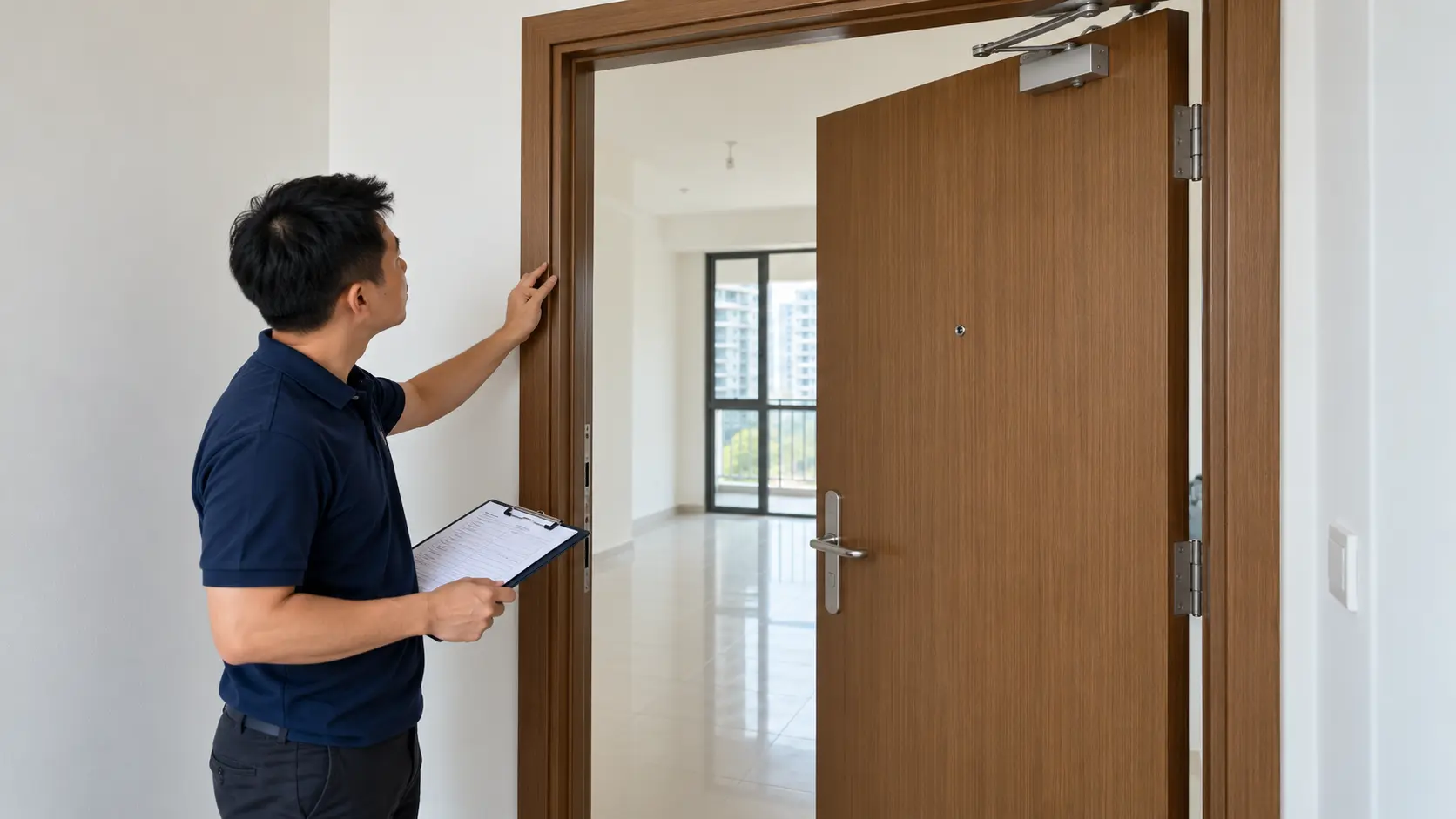
- Quality inspection: completed leaves are checked for dimensional accuracy, surface defects, warping and edge-seal integrity before being approved for delivery.
- Packing and delivery coordination: doors are packed to prevent transport damage and scheduled against the project's installation sequence.
Certification and Testing Benchmarks
Because "quality" is difficult to judge from a showroom sample alone, project teams increasingly ask for third-party certification as a point of comparison. One relevant scheme in Singapore is the Singapore Green Building Product (SGBP) certification administered by the Singapore Green Building Council (SGBC), which rates products on a tiered basis (Good, Very Good, Excellent, Leader) based on ticks awarded against the scheme's evaluation criteria.
As a concrete example, Hong Rui's PyroMeister timber door (model PyroM-120-STC-45, composite core with high-pressure laminate facing) holds an SGBP certificate rated Excellent, 3-Tick. This type of certificate is product- and model-specific, has a defined validity period, and can be verified through the SGBC product directory — which is a more reliable way to check a claim than relying on marketing copy alone.
Include a short "Regulations and technical information last checked" note where this article references SCDF, HDB or BCA requirements, and confirm current requirements directly with the relevant authority before finalising a project specification, since requirements can be updated.
Where Timber Doors Are Used in Singapore
Manufactured timber doors are specified across a wide range of building types, though the priorities differ by context:
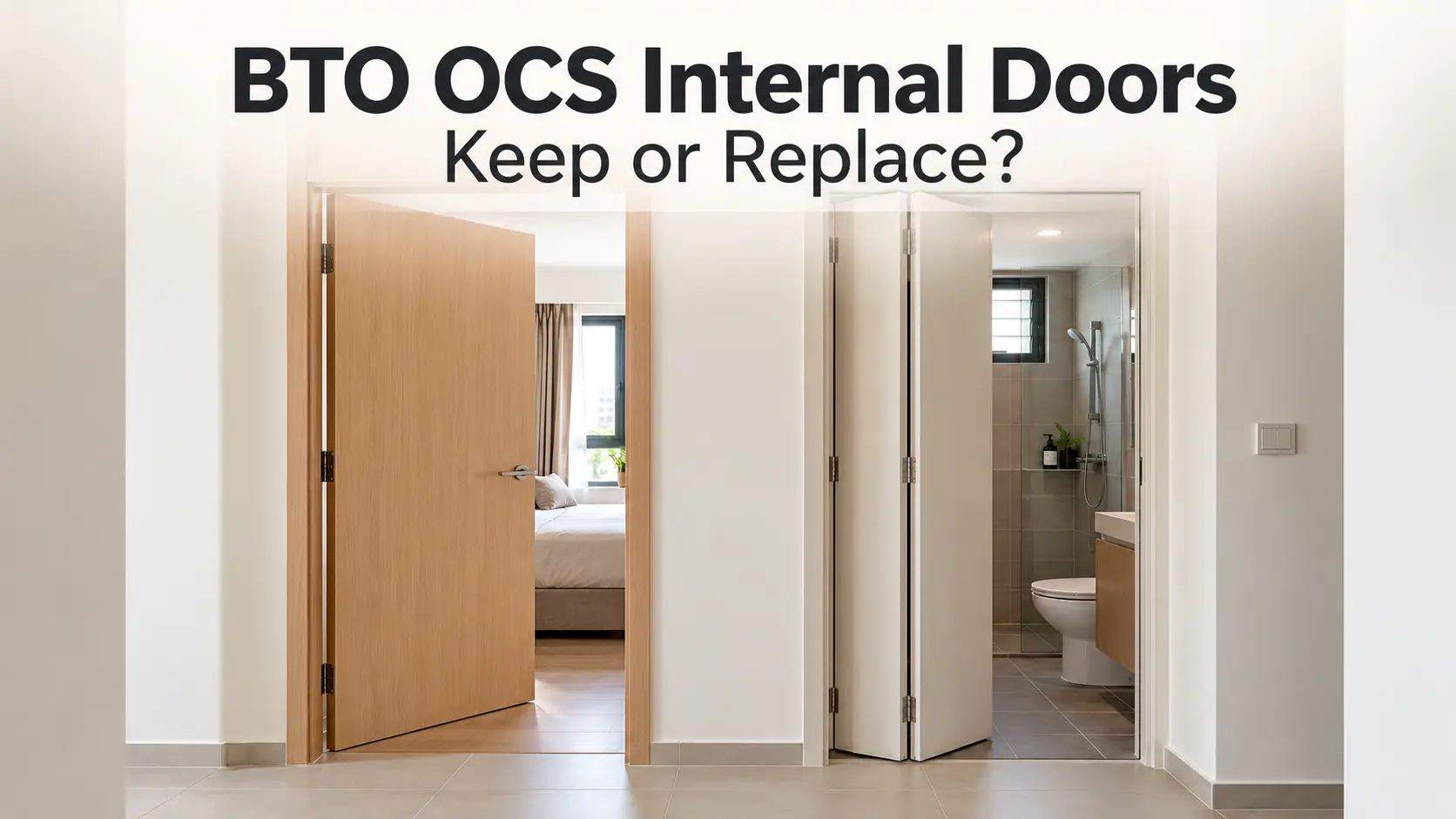
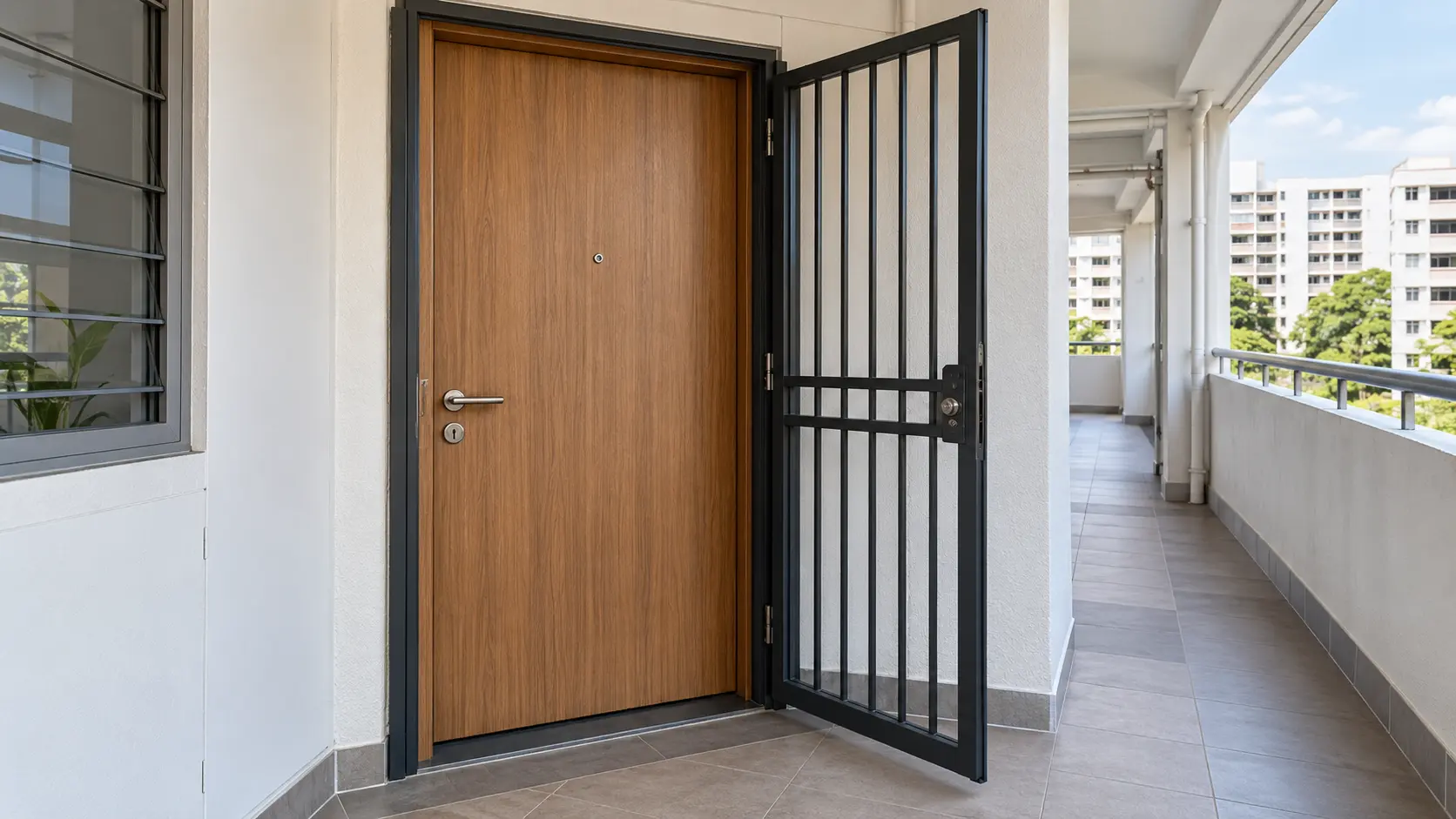
- HDB and BTO flats: internal doors (bedroom, bathroom, storeroom) and, depending on the unit's approved layout, main entrance doors.
- Condominiums and landed property: internal doors, feature entrance doors and utility doors, often specified with veneer finishes for aesthetic consistency.
- Commercial property, offices and retail: higher-traffic internal doors, often specified with HPL facing for durability.
- Hotels: guestroom doors, which frequently require fire-rated door sets in addition to acoustic performance.
- Hospitals, schools and institutional buildings: doors specified with a stronger emphasis on durability, ease of cleaning and, in specific areas, fire compartmentation requirements.
- Industrial facilities: internal partition and office doors within a broader facility, generally with less emphasis on decorative finish.
Not every context applies to every project — a facilities manager sourcing internal office doors, for example, is unlikely to need the same specification considerations as an architect detailing a hotel guestroom corridor.
HDB and BTO Considerations
Door requirements for HDB and BTO flats can vary depending on the unit's layout, the block's approved fire-safety provisions, and the specific location of the door within the unit. It would not be accurate to state that every HDB or BTO door must be fire-rated — this depends on the specific approval for that block and unit type. Homeowners and renovation contractors planning door replacement should:
- Check the original approved specification for the unit, where available.
- Confirm with HDB or the appointed renovation contractor whether any door in the unit is part of a fire-safety provision before replacing it.
- Avoid assuming that a like-for-like replacement is automatically compliant — the replacement door should match the performance of the original approved door where a regulatory requirement applies.
Contractor, Architect and Designer Coordination
On most projects, the timber door manufacturer works alongside several other parties, and misalignment between them is a common source of delay:
- Architects and QPs typically set the door schedule, fire-rating requirements (if any) and overall design intent.
- Contractors coordinate the opening sizes, frame installation sequence and site readiness.
- Interior designers usually drive finish selection — veneer species, laminate colour or hardware finish — within the performance constraints set earlier in the process.
Sharing the door schedule with the manufacturer early, including opening direction, hardware type and any fire-rating requirement, reduces the risk of remanufacturing a leaf after site measurement.
Measurements, Frame and Hardware Compatibility
A few technical details are worth confirming before ordering:
- Door leaf and frame dimensions: site-measured openings, not drawing dimensions, should be used for final production wherever possible.
- Opening direction: left-hand or right-hand swing, and whether the door needs to swing inward or outward for fire-egress purposes.
- Hardware compatibility: lockset backset, hinge type and closer specification should be confirmed against the door core, since some cores require reinforcement for heavier hardware.
- Digital-lock compatibility: digital locks often require a specific core reinforcement zone and door thickness; this should be confirmed with the manufacturer before machining, not after installation.
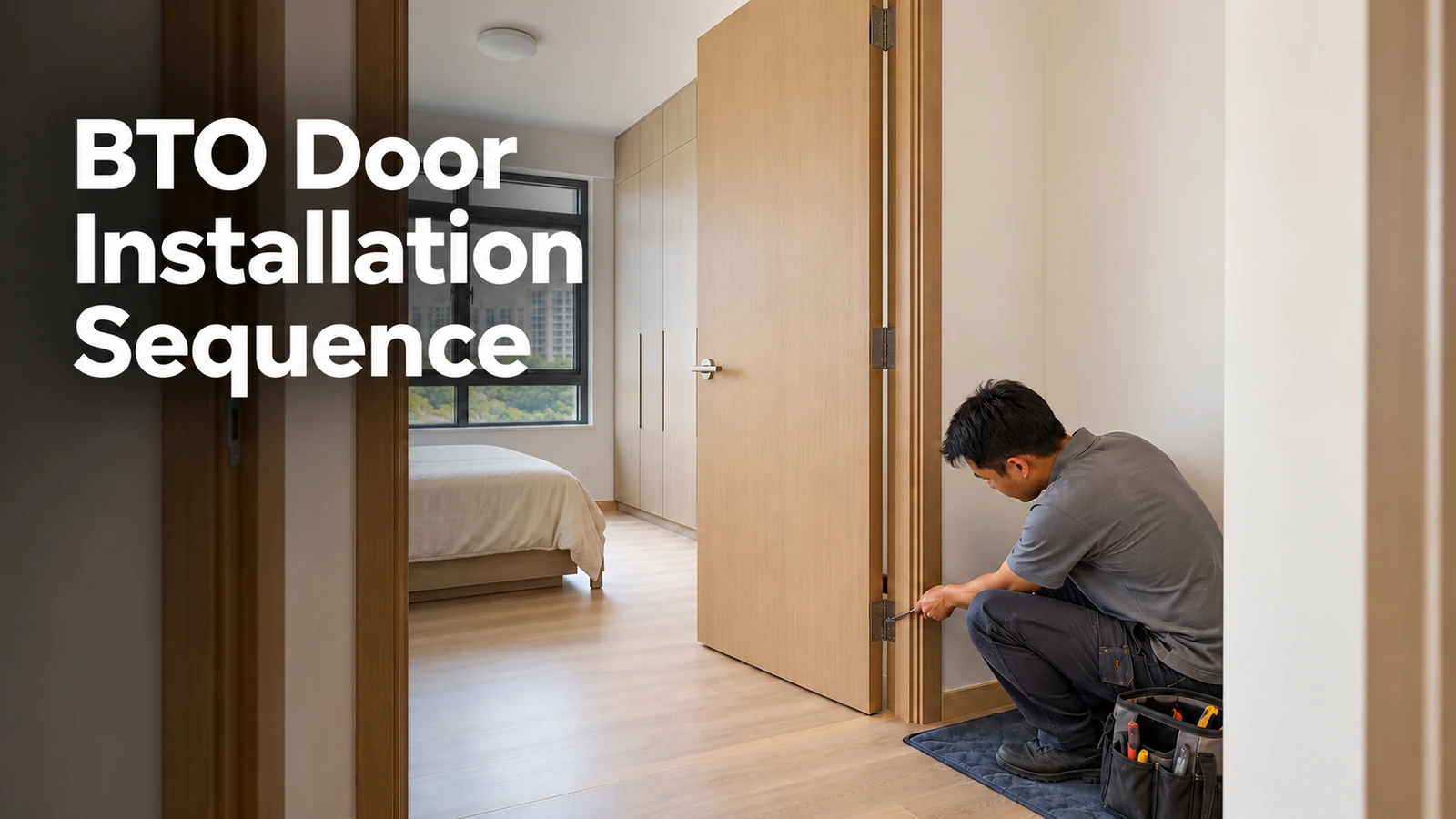
Installation and Common Mistakes
Several recurring issues affect timber door installation on Singapore projects:
- Ordering from drawing dimensions instead of site measurements, leading to gaps or binding at the frame.
- Installing doors before wet trades (plastering, screeding) are complete, exposing the door to excess ambient moisture during curing.
- Cutting or drilling a fire-rated door leaf on site without manufacturer approval, which can affect the tested performance of the door set.
- Mismatched hardware, such as fitting a heavier lockset than the core was reinforced for.
- Inadequate edge sealing after site trimming, leaving the core exposed to moisture at a cut edge.
Maintenance, Inspection and Replacement
Routine inspection helps catch issues before they require a full door replacement.
- Check edge seals and lipping for swelling, especially at the bottom edge near wet areas.
- Inspect hinges and closers for sagging, which can indicate hardware wear or core loosening.
- Look for surface delamination at the facing-to-core bond line.
- Confirm the door still closes flush against the frame without excessive gaps.
- For fire-rated doors, check that intumescent seals and self-closing hardware remain intact and unmodified.
| Inspection Area | Recommended Frequency | What to Look For |
|---|---|---|
| Edge seals / lipping | Annually, or after any water exposure | Swelling, discolouration, gaps |
| Hardware (hinges, closers, locks) | Annually | Sagging, loose fixings, difficulty closing |
| Facing surface | Every 1–2 years | Delamination, cracking, colour fading |
| Fire door components (where applicable) | As required by the building's fire-safety maintenance schedule | Intact seals, unmodified leaf, functioning self-closer |
Replacement is generally worth considering when the core has visibly delaminated, when repeated hardware failure suggests the core can no longer hold fixings securely, or when a fire-rated door has been modified in a way that cannot be restored to its tested configuration.
Questions to Ask Before Specification
- What core type is used, and is it consistent across all leaves in this order?
- Is the door part of a tested fire-rated door set, and if so, what configuration was tested?
- Does the product hold any third-party certification, and can it be verified independently?
- What is the manufacturer's quality-inspection process before delivery?
- Is the core reinforced for the specified hardware, including digital locks?
- What is the expected lead time between site measurement and delivery?
Frequently Asked Questions
What is the difference between a solid timber door and a composite-core timber door?
A solid timber door uses a single timber core, while a composite-core door uses an engineered core built for consistent density and dimensional stability. Composite cores are generally preferred for high-traffic or humidity-exposed applications because they are less prone to warping than inconsistently seasoned solid timber.
Do all HDB main doors need to be fire-rated?
Not necessarily. Fire-rating requirements for HDB units depend on the block's approved fire-safety provisions and the unit's layout, so this should be confirmed with HDB rather than assumed. Some units may have fire-rating requirements for specific doors while others do not.
What does an SGBP certification tell me about a timber door?
An SGBP (Singapore Green Building Product) certificate indicates that a specific product model has been evaluated against the scheme's criteria and awarded a rating tier, such as Excellent. It is product-specific and time-bound, and can typically be verified through the certifying body's product directory rather than taken at face value from marketing material.
Can a fire-rated timber door be trimmed or drilled on site?
Fire-rated doors are tested as a complete set, so unauthorised cutting, drilling or trimming on site can affect their tested performance. Any modification should be checked against the manufacturer's approved tolerances before proceeding.
How do I know if my timber door needs replacement or just repair?
Surface scratches or minor hardware wear can usually be repaired. Visible core delamination, persistent warping, or hardware that repeatedly loosens despite reinforcement are stronger indicators that replacement is more appropriate than repair.
Are digital locks compatible with all timber doors?
Not automatically. Digital locks often require a specific reinforced zone within the door core and a minimum door thickness. This should be confirmed with the door manufacturer before the door is machined, rather than after installation.
What is the typical lead time for manufactured timber doors in Singapore?
Lead times vary by manufacturer, order volume and finish complexity, and are best confirmed directly with the supplier based on the specific project's door schedule and site-measurement timeline.
Who should verify fire-rating and building-code requirements for a project?
The project's qualified person (architect or engineer) typically coordinates fire-safety requirements with the relevant authorities. For Singapore projects, this generally involves reference to SCDF and BCA requirements, alongside HDB requirements for public housing projects specifically.
Conclusion
Timber doors in Singapore span a wide range of core constructions, facing materials and performance levels, and the right specification depends on where the door will be used, how much traffic it will see, and whether it forms part of a fire-rated or otherwise regulated door set. A manufacturer's internal quality-control process — from raw-material moisture checks through to final dimensional inspection — has a direct bearing on how the door performs over its service life, and third-party certification can offer a useful, verifiable reference point when comparing suppliers. Because requirements can vary by project, building type and approving authority, project-specific requirements should always be confirmed with the relevant authority or manufacturer before specification is finalised.
Project teams can review Hong Rui's timber door range and specifications to compare available core types, finishes and certification details for their next project.

Leave A Comment