HDB & BTO DoorsUpdated 12 Oct 2026
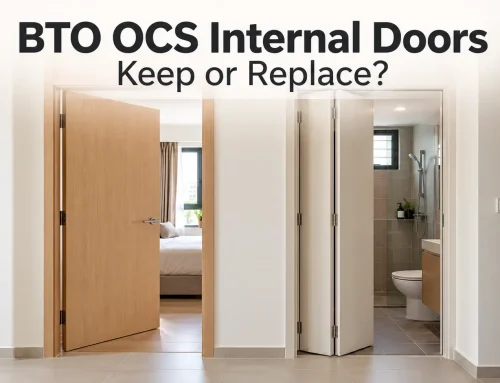
HDB HIP door replacement is an optional improvement offered to eligible flats under HDB’s Home Improvement Programme. Residents can opt for a new main door and grille gate. HDB determines, using SCDF’s Fire Code, whether a flat requires a fire-rated or non-fire-rated main door. An HFAD is installed as part of the associated fire-safety work when residents opt for the fire-rated door replacement. This guide is for homeowners, residents’ committees, renovation contractors and interior designers who want to understand the difference between the two door types, what to inspect at handover, and what should not be altered afterwards.
Quick Answer
Under HIP, eligible households can opt for main door and grille gate replacement. HDB determines, based on SCDF’s Fire Code, whether a flat requires a fire-rated or non-fire-rated main door. Flats that require a fire-rated door can opt for it, and an HFAD is installed as part of that fire-safety work. Flats that do not require one are offered the non-fire-rated door.
Key Takeaways
- The fire-rated or non-fire-rated decision is made per flat by HDB using the SCDF Fire Code. It is not a style preference.
- HDB describes the main door as the fire safety barrier and the gate as a safety barrier, so the two parts do different jobs.
- A door closer on a fire-rated door must not be removed. Check it, along with hinges and gate bolts, at handover and periodically.
- Confirm your own flat’s door type and any post-HIP modification, such as a digital lock, with HDB before drilling or cutting.
How HDB HIP door replacement works for the main door and gate
The Home Improvement Programme is HDB’s programme for ageing-related maintenance inside flats. HDB’s HIP page states that it was introduced in 2007 for flats built up to 1986 that had not undergone the Main Upgrading Programme, and MyNiceHome notes that it was extended in 2018 to flats built between 1987 and 1997. A block proceeds only if at least 75% of eligible Singapore Citizen households vote in favour.
For doors, the HIP scope covers a new entrance door, described by HDB as a decorative timber or laminated timber door with enhanced resistance to scratches, and a new grille gate. HDB also lists a handrail at main entrances with steps and an HFAD in the living room among the newer items.
Compliance note: HDB’s HIP Guidebook (March 2025) states that design features and specifications may change without notice. Treat this article as general guidance and confirm details for your own precinct with HDB.
Who decides between a fire-rated and non-fire-rated door?
HDB decides, flat by flat, based on SCDF’s Fire Code. Residents whose flats require a fire-rated door can opt for it. If a flat does not require one, HDB offers the non-fire-rated door under HIP.
The distinction matters because HDB’s home care guide describes the main entrance door as a fire safety barrier and the gate as a safety barrier. In a parliamentary reply on block-wide fire alarms, the Minister for Home Affairs explained that HDB blocks are designed so that each flat is a fire compartment, which limits the spread of fire (see MHA’s reply).
It helps to separate four kinds of statement when you read about HIP doors:
| Type of statement | Example in this topic | Where to confirm |
|---|---|---|
| Regulatory requirement | Whether a flat requires a fire-rated door under the Fire Code | HDB, SCDF |
| Project specification | Door finish, gate type, hardware in the HIP package | HIP Guidebook for the precinct |
| Manufacturer recommendation | Approved hardware, installation method and servicing for a specific door | Door manufacturer’s documents |
| General maintenance guidance | Periodic checks of hinges, closers and bolts | HDB home care guide, general good practice |
Fire-rated vs non-fire-rated main door compared
The table sets out what HDB has published. Where HDB has not stated something, the table says so rather than assuming.
| Aspect | Fire-rated main door | Non-fire-rated main door |
|---|---|---|
| When it applies under HIP | Offered where HDB determines the flat requires one under the Fire Code | Offered where the flat does not require a fire-rated door |
| Purpose | Acts as the flat’s fire safety barrier, helping keep fire and smoke within the unit | General entrance door; HDB does not describe it as a fire barrier |
| Door closer | HDB states the closer is fitted and must not be removed | Not stated in the sources reviewed; check the HIP specification |
| HFAD pairing | HDB’s package pairs it with an HFAD | An HFAD is not paired with this door option; it may be provided separately under applicable EASE improvements |
| Everyday care | Keep the closer working, and avoid altering the door leaf or frame without checking | Normal checks of hinges, lock and finish |
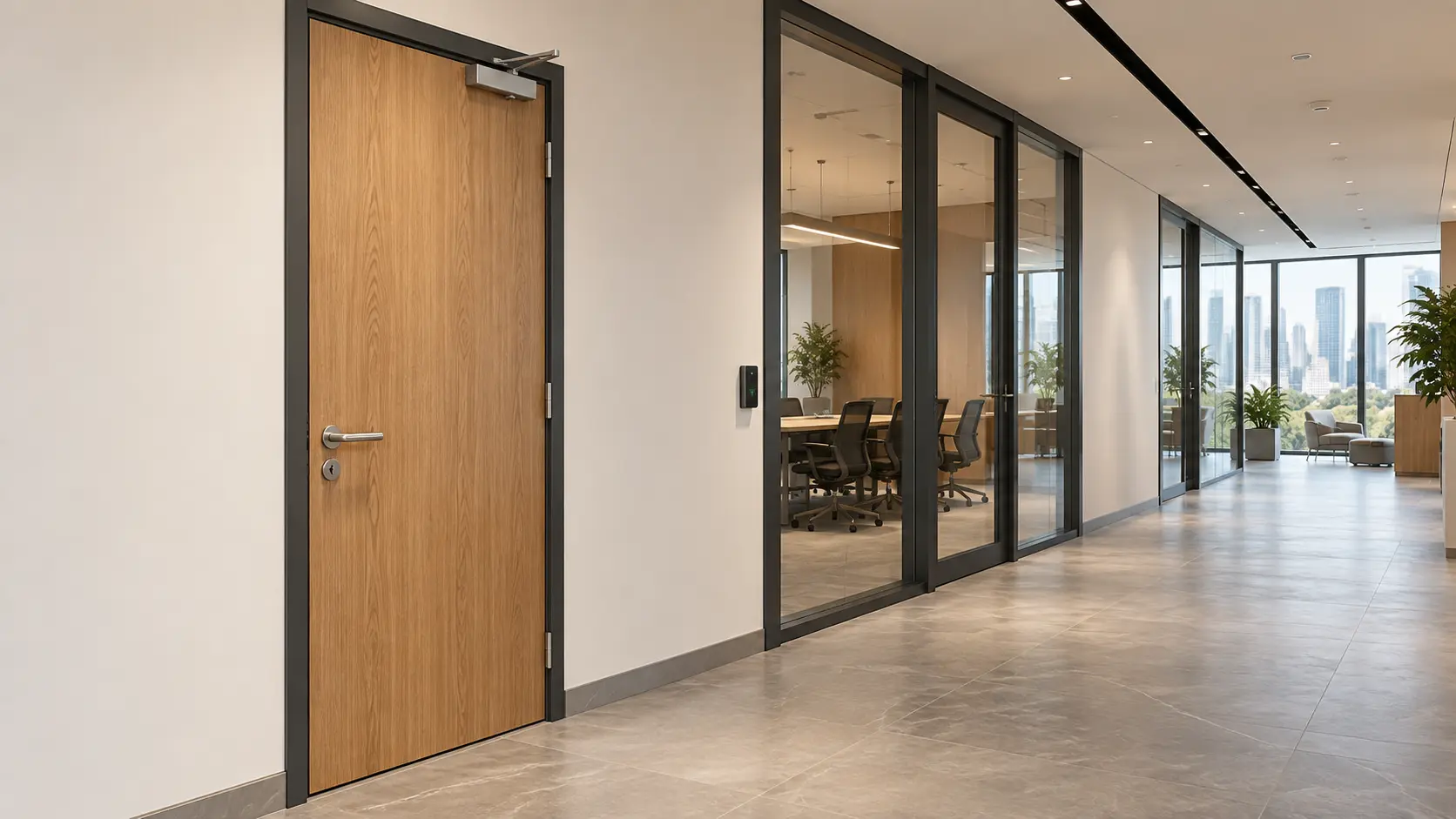
Where your flat is not in a HIP precinct, or the door belongs to a commercial, institutional or industrial building, fire-door requirements follow that building’s approved fire-safety provisions, not HIP. A fire-rated door for a school, hospital or office is specified per project, so the HIP rules above should not be applied to it. Teams working on those projects can see fire-rated timber door options for the general product category.
What the Home Fire Alarm Device (HFAD) does
An HFAD is an automatic smoke or heat detector that sounds an alarm to give occupants early warning of a fire, according to SCDF. SCDF states installation is mandatory for new residential premises, and for existing residential premises carrying out fire safety works where plans were submitted on or after 1 June 2018. It is not mandatory for existing premises not carrying out such works, though SCDF encourages it.
When a household opts for the applicable fire-rated door replacement under HIP, an HFAD is installed as part of the associated fire-safety work. HDB also lists an HFAD in the living room under EASE improvements and notes that an executive maisonette is offered two devices to comply with the Fire Code. HDB’s MyNiceHome guidance says the device can be tested using the Test/Reset button on its front, and that maintenance details are in the user manual left in the flat.
The HIP grille gate
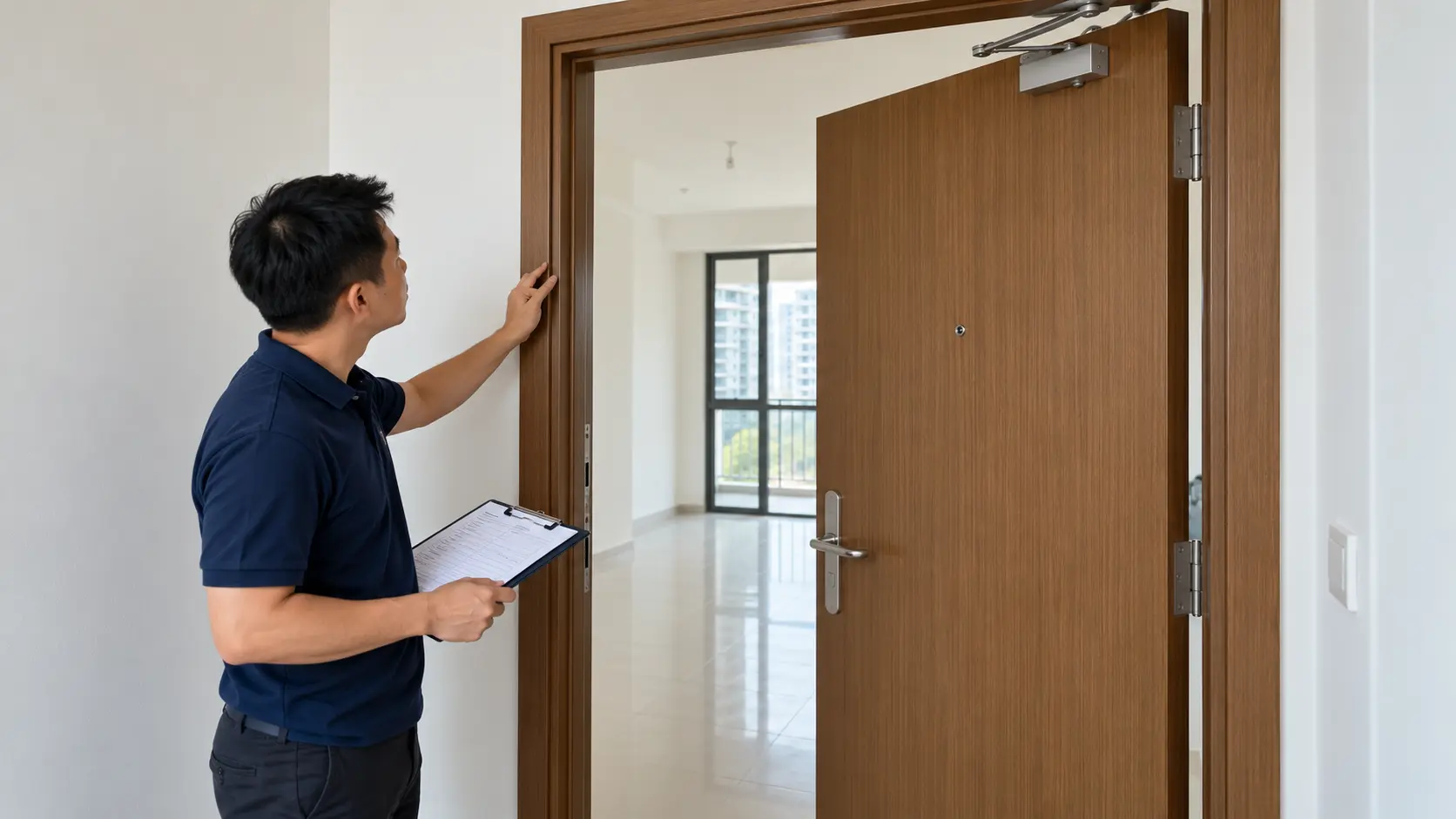
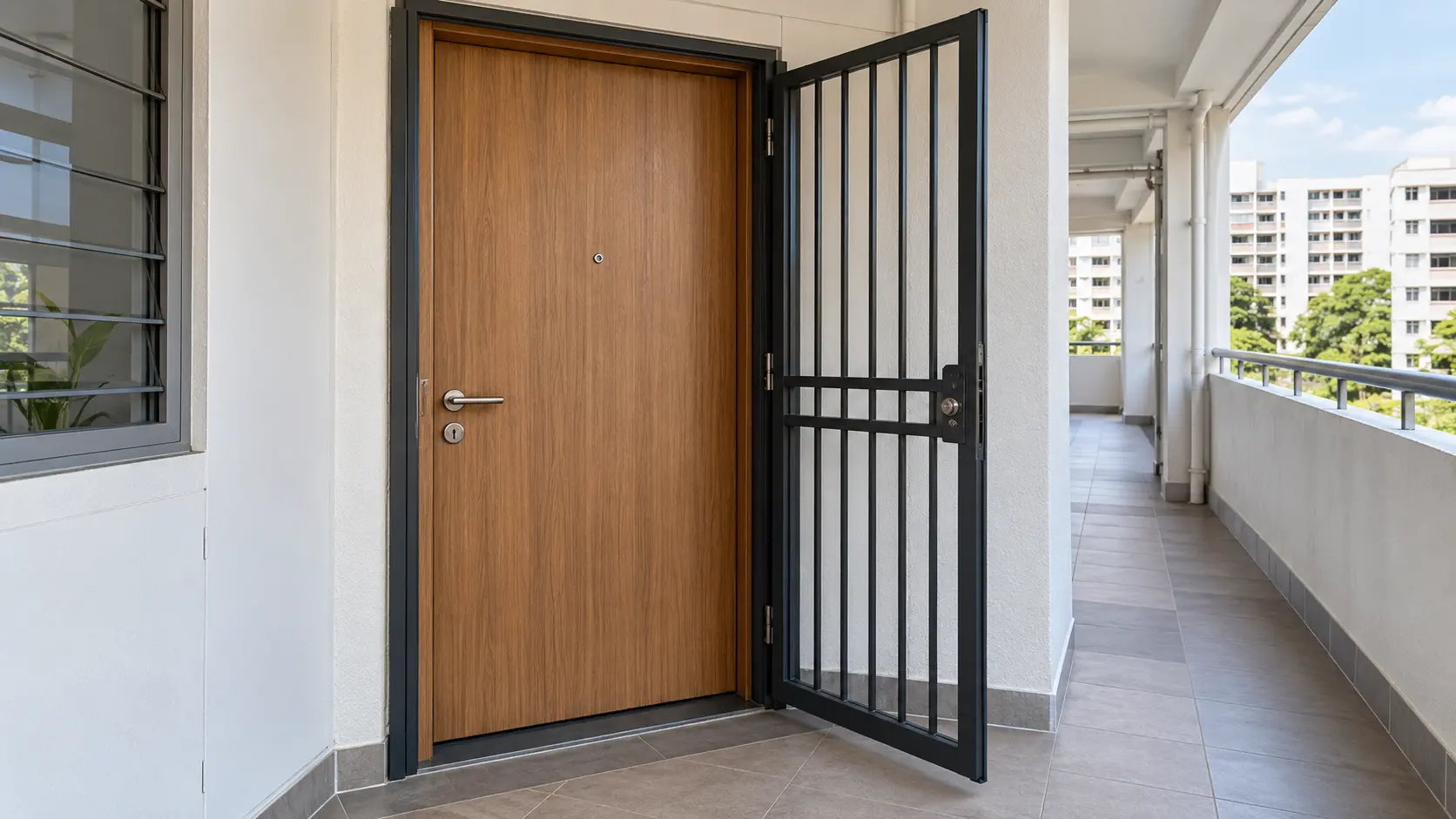
HDB lists two gate options: a wrought iron grille gate, or a mild steel entrance gate with an interior thumb-turn knob. HDB describes the gate as a safety barrier rather than the fire barrier, so its checks differ from the door’s. For handover, confirm the thumb-turn operates smoothly from inside, the bolt slots fully, and the gate swings without catching the door or frame.
Readers comparing materials for other gate projects can read about metal gate options for HDB and BTO homes.
Handover inspection checklist
The checklist below combines HDB’s published maintenance points with general good practice. Items marked “general” are not HDB requirements.
Before replacement
- Confirm from HDB or HIP documents whether your flat has been assigned a fire-rated or non-fire-rated door.
- Clear the entrance area, and note any existing items near the door and gate that may be disturbed (general).
- Photograph the existing door, gate and frame condition for reference (general).
On handover
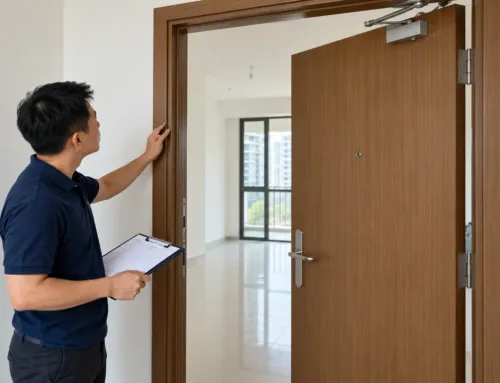
- Door opens and closes without rubbing the frame or floor.
- For a fire-rated door, the door closer is present and the door closes by itself.
- Hinge screws are tight, especially the top hinge.
- Gate bolt and thumb-turn operate smoothly, and the gate does not clash with the door swing.
- The HFAD is in place, and its Test/Reset button produces the test signal.
- Check for scratches, dents, uneven clearances, rubbing or failure to close. Ask the HIP team to assess clearances against the installed door system’s specification, and report defects through the HIP channels HDB provides.
Door closer, hinge and bolt maintenance
HDB’s gate and door guide offers simple fixes for everyday faults. The table summarises them and keeps HDB’s advice separate from general practice.
| Component | Typical symptom | What HDB suggests |
|---|---|---|
| Door closer | Closes too fast, or does not shut by itself | Check speed control alignment and tighten screws; replace if fluid is leaking and the door cannot close on its own |
| Door hinges | Door difficult to open or close | Tighten loosened hinge screws, especially the top hinge |
| Gate bolt | Bolt will not slot or retract | Clear rubbish from the bolt hole, lubricate if tight, and repair or replace the flush bolt if worn |
| HFAD | Unsure if working | Press Test/Reset and refer to the user manual |
For deeper servicing guidance, such as hinge replacement or closer adjustment on other projects, see commercial door maintenance guide.
Common mistakes and misconceptions
- “Every HDB door must be fire-rated.” HDB’s wording is that it determines the requirement per flat under the Fire Code, so avoid assuming.
- Removing the door closer because the door slams. HDB states the closer on a fire-rated door must not be removed. Adjust or repair it instead.
- Treating the gate as a fire barrier. HDB describes the gate as a safety barrier and the main door as the fire safety barrier.
- Assuming a closer proves the door is fire-rated. Confirm with HDB documents instead.
- Drilling or cutting before checking. Lock installation, peepholes or signage fixings may affect a door’s construction. Ask first.
Illustrative scenario: a renovation contractor receives a work order for a flat that recently went through HIP. Before quoting a digital lock or a door repaint, the contractor checks the HIP documents for the door type, asks HDB about modification limits, and records the condition of the closer. This avoids damaging a component that may be safety-relevant.
After HIP: renovation and digital lock considerations
HDB’s HIP guidance tells residents who want a digital door lock to ask the supplier for certification meeting SCDF’s fire-safety requirements. SCDF states that, from 1 March 2024, a digital lock installed on a fire-rated door must be certified for fire resistance, either with the door or individually. Check the Certificate of Conformity (CoC) for the exact lock model and confirm that its fire rating is at least equal to the door’s. The installation must follow the applicable certification and manufacturer’s instructions; check compatibility before drilling or cutting.
For certification documents and retrofit checks, read our guide to digital locks on fire-rated doors.
For door measurements, opening direction and frame coordination on non-HIP projects, a door measurement guide for renovation projects may help.
Questions to ask before changing anything
- Has my flat been assigned a fire-rated or non-fire-rated main door?
- Is the door closer part of my door, and how should it be adjusted?
- Does HDB allow the lock, peephole or fixing I plan to install?
- Who is responsible for defects found after HIP handover?
- Where can I find the HIP package specification for my precinct?
FAQ
Is a fire-rated main door compulsory under HDB HIP?
Not as a blanket rule. HDB says it first determines whether each flat requires a fire-rated or non-fire-rated main door, based on SCDF’s Fire Code. Flats that require one can opt for a fire-rated door, while flats that do not are offered the non-fire-rated door. HDB also lists the main door among optional improvements, which it describes as not compulsory. Check your precinct’s HIP details with HDB, because packages and specifications can change.
Which HDB flats are eligible for HIP?
Eligibility depends on HDB’s selection of precincts and a block vote. HDB introduced HIP in 2007 for flats built up to 1986 that had not undergone the Main Upgrading Programme, and it was extended in 2018 to flats built between 1987 and 1997. HIP proceeds only if at least 75% of eligible Singapore Citizen households in the block vote in favour. HDB publishes shortlisted precincts, so check the current list.
What is an HFAD and is it mandatory?
A Home Fire Alarm Device (HFAD) is an automatic smoke or heat detector that sounds an alarm to give occupants early warning of a fire. SCDF states it is mandatory for new residential premises and for existing residential premises carrying out fire safety works, with plans submitted on or after 1 June 2018. It is not mandatory for existing homes that are not carrying out such works, although SCDF encourages installation.
Can I remove or adjust the door closer on a fire-rated door?
You should not remove it. HDB states that every fire-rated main door in an HDB flat has a door closer, which must not be removed because it keeps the door shut during a fire. If the door closes too fast or will not shut by itself, HDB suggests checking the speed control alignment and screws, and replacing the closer if fluid is leaking and the door cannot close on its own.
How can I tell if my flat has a fire-rated main door?
The most reliable way is to check your HIP or flat documents and confirm with HDB. A door closer is a useful clue but not proof, because HDB only states that fire-rated entrance doors are fitted with one, not that every door with a closer is fire-rated. Do not rely on appearance, thickness or weight alone, and avoid assuming either way before altering the door.
Can a digital lock be installed on a HIP main door?
A compatible digital lock may be installed, subject to the door’s requirements and the certified installation configuration. For a fire-rated door, SCDF requires digital locks installed from 1 March 2024 to be certified for fire resistance. Ask for the exact model’s Certificate of Conformity and check that the lock’s fire rating is at least equal to the door’s. Confirm compatibility and the installation method before drilling.
What type of gate does HIP provide?
HDB lists a new grille gate as part of HIP, either a wrought iron grille gate or a mild steel entrance gate with an interior thumb-turn knob. HDB describes the gate as a safety barrier and the main door as the fire safety barrier. Finish, design and hardware details are set in HDB’s HIP package for the precinct, so refer to the guidebook for your project.
Conclusion
HDB HIP offers optional main door and grille gate replacement, with HDB deciding per flat whether the door is fire-rated or non-fire-rated under SCDF’s Fire Code. The fire-rated option is paired with an HFAD, and the closer on a fire-rated door must stay in place. Key practical points are to confirm the door type, inspect closers, hinges and bolts at handover, and verify any post-HIP modification with HDB. Requirements and packages can change, so check your project’s details with official sources.
Project teams can review HongRui’s door and gate manufacturing services to compare available materials, applications and installation considerations.
Related HongRui Blog Guides
References
- Housing & Development Board: Home Improvement Programme (HIP)
- Housing & Development Board: Your Guide to the Home Improvement Programme (March 2025)
- Housing & Development Board: Home Care Guide, Gate and Door
- Singapore Civil Defence Force: Digital Locksets on Fire-rated Doors
- Singapore Civil Defence Force: Home Fire Alarm Device (HFAD)
- Ministry of Home Affairs: HDB Block-Wide Fire Alarms (parliamentary reply, 15 October 2025)
- MyNiceHome: Guide to HIP for HDB Flats
- MyNiceHome: HFAD guidance
Regulations and technical information last checked: 7 October 2026.