
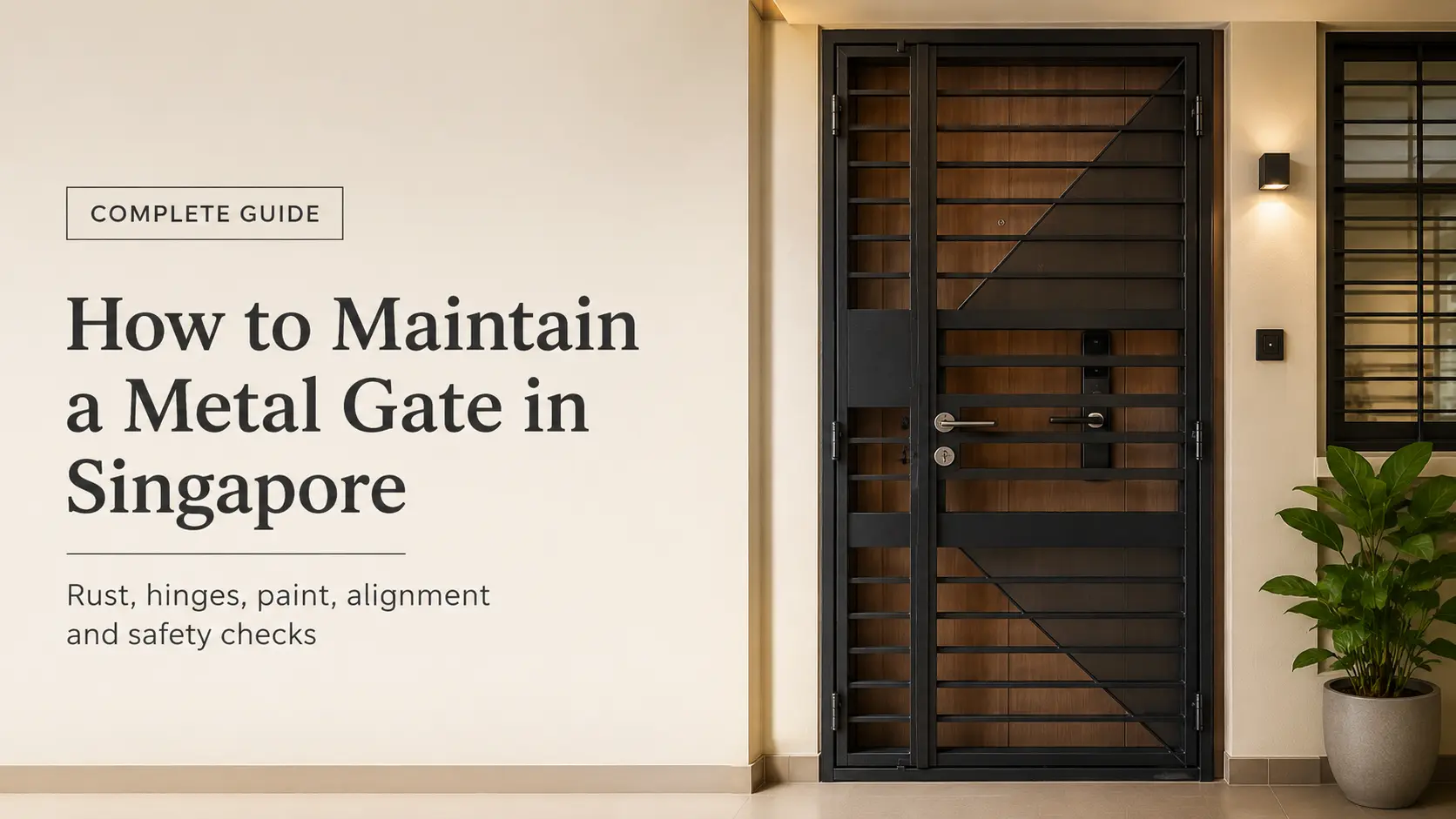
How to Maintain a Metal Gate in Singapore: Rust, Hinges, Paint, Alignment and Safety Checks
A metal gate is exposed to Singapore's climate every day, including humidity, rain, and in some locations, coastal air. Contractors, facility managers and homeowners often ask how to keep a metal gate functioning smoothly and looking presentable without needing early replacement. This article outlines practical maintenance steps for rust prevention, hinge care, paint upkeep, alignment correction and safety checks, along with common warning signs that indicate a gate may need professional attention.
This guide is intended for HDB and BTO homeowners, landed property owners, facility managers, renovation contractors and project consultants who are responsible for the upkeep of metal gates in residential, commercial or institutional settings.
Key Takeaways
- Inspect metal gates every three to six months, or more frequently in coastal or high-humidity locations.
- Surface rust can often be treated early, but structural rust usually requires professional assessment.
- Hinges, bolts and locking hardware need periodic lubrication and tightening to prevent sagging.
- Alignment issues are often linked to hinge wear, ground settlement or frame movement rather than the gate panel itself.
- Regulatory or fire-safety requirements for gates vary by building type and should be confirmed with the relevant authority or project specification rather than assumed.
Table of Contents
- Why Metal Gate Maintenance Matters in Singapore
- Rust Prevention and Treatment
- Hinge Care and Lubrication
- Paint and Coating Maintenance
- Alignment Issues and Correction
- Safety Checks for Metal Gates
- Suggested Maintenance Schedule
- Common Maintenance Mistakes
- When Repair Is Not Enough: Replacement Considerations
- Frequently Asked Questions
Why Metal Gate Maintenance Matters in Singapore
Singapore's tropical climate, with high humidity and frequent rainfall throughout the year, accelerates corrosion and wear on unprotected or poorly maintained metal surfaces. Gates located near the coast, in industrial areas, or in exposed common corridors of HDB blocks may experience faster deterioration than gates in sheltered locations. Regular maintenance helps preserve the gate's structural integrity, appearance and smooth operation, and can reduce the likelihood of premature replacement.
Maintenance needs also differ by gate type. A mild steel gate with a painted finish behaves differently from a stainless steel or powder-coated aluminium gate. Understanding the base material and coating helps determine the correct maintenance approach.
Rust Prevention and Treatment
Rust is one of the most common issues affecting metal gates in Singapore. It typically begins where the protective coating has been scratched, chipped or worn away, exposing bare metal to moisture.
Early Signs of Rust
- Small orange or brown spots on the surface
- Bubbling or flaking paint
- Rough or pitted texture where the coating has worn thin
- Rust streaks below welds, joints or screw fixings
Treating Surface Rust
- Clean the affected area with a soft brush or cloth to remove loose debris.
- Gently sand away loose rust using fine-grit sandpaper, taking care not to damage surrounding intact coating.
- Apply a rust-inhibiting primer suitable for the gate's metal type.
- Finish with a matching topcoat once the primer has cured.
Stainless steel gates are more resistant to rust than mild steel gates, but they are not entirely immune, particularly in areas with salt air exposure or where surface contamination has occurred during fabrication or installation. Manufacturer guidance should be followed for the specific grade of stainless steel used.
Hinge Care and Lubrication
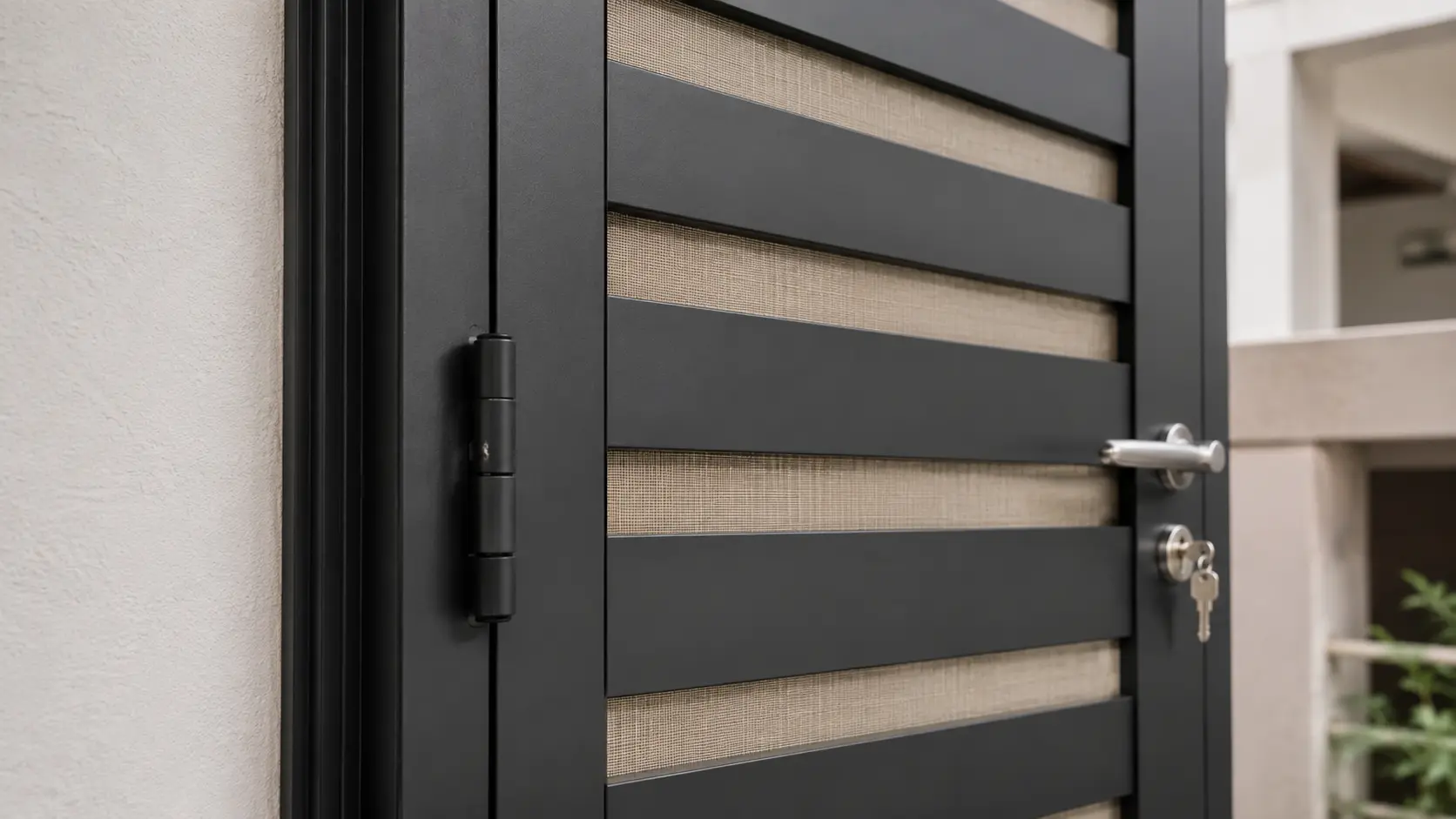
Hinges bear the full weight of the gate panel and are among the first components to show wear. Squeaking, stiffness or visible play in the hinge pin are common early indicators.
Routine Hinge Maintenance
- Apply a small amount of suitable lubricant, such as silicone-based or lithium-based grease, to hinge pins every few months.
- Wipe away excess lubricant to avoid attracting dust and grit, which can accelerate wear.
- Check that hinge screws or bolts are tightened, as vibration and repeated use can loosen fixings over time.
- Inspect welded hinge points for cracking, particularly on heavier gates.
| Symptom | Likely Cause | Suggested Action |
|---|---|---|
| Squeaking when opening or closing | Dry or worn hinge pin | Clean and re-lubricate hinge |
| Gate sags at the free end | Worn hinge, loose fixing, or frame movement | Inspect hinge and frame; tighten or replace as needed |
| Visible play or wobble in hinge pin | Worn bushing or pin | Professional assessment for hinge replacement |
| Gate difficult to lift or swing | Corrosion inside hinge barrel | Rust treatment and lubrication, or hinge replacement |
Paint and Coating Maintenance
The paint or coating on a metal gate is its primary defence against moisture and corrosion. Maintaining this layer extends the life of the underlying metal.
General Paint Care
- Wash the gate periodically with mild soap and water to remove dust, salt residue and pollutants.
- Avoid abrasive cleaning tools that can scratch the coating.
- Touch up small chips or scratches promptly before rust develops underneath.
- Use paint or coating products compatible with the original finish, as mismatched products may not adhere properly or may cause discolouration.
Powder-coated gates generally require less frequent repainting than conventionally painted gates, but damaged powder coating cannot always be touched up in the same way as liquid paint, and professional advice may be needed for larger repairs.
Alignment Issues and Correction
A gate that no longer closes flush, drags along the ground, or leaves a visible gap at the top or bottom is usually showing signs of misalignment. This is rarely caused by the gate panel warping on its own; it is more often linked to the supporting structure.
Common Causes of Misalignment
- Hinge wear or loosening over time
- Settlement or movement of the gate post or wall footing
- Loose or corroded fixing bolts at the frame
- Impact damage from vehicles, trolleys or heavy items
Basic Alignment Checks
- Check whether the gap between the gate and frame is even along the full height.
- Confirm that hinge fixings are tight and not corroded.
- Check the gate post or wall for visible cracking, tilting or movement.
- Test that the gate closes and latches without needing to be lifted or forced.
Minor alignment issues can sometimes be corrected by adjusting hinge fixings or shimming. Where the issue is linked to post or footing movement, a contractor should assess whether structural repair is needed before further adjustment is attempted.
Safety Checks for Metal Gates
Beyond appearance and smooth operation, periodic safety checks help identify issues that could pose a risk to users, particularly for larger sliding or swing gates, motorised gates, or gates used in common areas of residential or commercial buildings.
- Check that the gate cannot swing or slide unexpectedly when unlatched.
- Inspect locking mechanisms and digital-lock compatibility where applicable, ensuring fittings are securely mounted.
- For motorised gates, confirm that safety sensors and auto-reverse functions are operating correctly, and refer to the motor manufacturer's maintenance schedule.
- Check for sharp edges, exposed screws or protruding fixings that could cause injury.
- Ensure the gate does not obstruct designated fire escape routes or emergency access where applicable.
Suggested Maintenance Schedule
| Frequency | Maintenance Task |
|---|---|
| Monthly | Visual check for new rust spots, loose fittings or unusual noise |
| Every 3–6 months | Clean surface, lubricate hinges, tighten bolts and fixings |
| Every 6–12 months | Touch up paint or coating, check alignment, inspect locking hardware |
| Annually or as needed | Professional inspection for structural rust, hinge replacement or frame movement |
This schedule is a general guide. Gates in coastal areas, industrial environments or high-traffic common areas may require more frequent attention, while sheltered landed-property gates may need less frequent intervention. Project specifications for commercial or institutional buildings may also set out specific maintenance intervals.
Common Maintenance Mistakes
- Painting over rust without removing loose material first, which traps moisture underneath the new coating.
- Using the wrong type of lubricant, which can attract dust or degrade certain coatings.
- Ignoring small alignment issues until the gate no longer closes properly.
- Delaying repairs to hinges or fixings, which increases strain on the remaining hardware.
- Assuming all gates require identical maintenance regardless of material or coating type.
When Repair Is Not Enough: Replacement Considerations
Not every issue can be resolved through maintenance. Gates may need replacement, or significant component replacement, when structural rust has compromised load-bearing sections, when the frame or posts have shifted significantly, or when repeated hinge failure suggests the gate's weight exceeds what the current hardware can support. A contractor can assess whether targeted repair, such as replacing hinges or a section of framing, is sufficient, or whether full replacement offers better long-term value for the property.
Frequently Asked Questions
How often should a metal gate be cleaned in Singapore?
Cleaning every one to three months is generally sufficient for most residential metal gates, though gates in coastal or heavily polluted areas may benefit from more frequent washing. Regular cleaning removes salt residue, dust and pollutants that can accelerate corrosion if left on the surface for extended periods.
Can rust on a metal gate be fully removed at home?
Surface rust can often be treated at home using sanding, a rust-inhibiting primer and matching topcoat. However, rust that has penetrated structural joints, welds or hinge areas may affect the gate's integrity and generally requires assessment by a qualified contractor rather than a DIY approach.
Why does my gate drag on the ground even after adjusting the hinges?
Dragging that persists after hinge adjustment often points to a deeper issue, such as movement in the gate post, footing settlement or a warped frame. In these cases, adjusting the gate panel alone will not resolve the problem, and the supporting structure should be inspected.
Is stainless steel maintenance-free in Singapore's climate?
No, stainless steel is more corrosion-resistant than mild steel but is not entirely maintenance-free. Regular cleaning helps remove surface contaminants, and gates in coastal or industrial areas may still develop discolouration or light surface corrosion over time depending on the steel grade used.
How do I know if my gate hinges need replacing rather than lubricating?
If lubrication does not resolve squeaking or stiffness, or if there is visible play, wobble or corrosion inside the hinge barrel, this usually indicates wear that lubrication alone cannot fix. A contractor can assess whether the hinge pin, bushing or the full hinge assembly needs replacement.
Do HDB gates have specific maintenance or fire-safety requirements?
Requirements can vary depending on the specific block, common area layout and approved fire-safety provisions, so they should not be assumed to be identical across all HDB properties. Residents and contractors should verify specific requirements with HDB or the Singapore Civil Defence Force where the gate is located near common corridors or escape routes.
What is the best type of paint for touching up a metal gate?
The most suitable product depends on the gate's existing coating type, such as enamel, powder coating or epoxy-based paint. Using a compatible primer and topcoat matched to the original finish generally produces better adhesion and appearance than an unrelated product, so checking the original specification or manufacturer guidance is recommended.
How long does a well-maintained metal gate typically last?
Lifespan varies significantly depending on material, coating quality, exposure conditions and maintenance consistency, so no fixed figure applies to every gate. Gates that receive regular cleaning, timely rust treatment and hinge care generally remain functional and presentable for longer than gates left unmaintained in similar conditions.
Conclusion
Maintaining a metal gate in Singapore involves attention to several interconnected factors: rust prevention, hinge care, coating upkeep, alignment and safety. Because humidity and rainfall are constant throughout the year, gates left unchecked can deteriorate faster than expected, while gates on a consistent maintenance routine tend to remain functional and presentable for longer. Since materials, coatings and site conditions vary from project to project, it is worth checking project-specific requirements and manufacturer guidance rather than applying a single maintenance approach to every gate.



Leave A Comment