
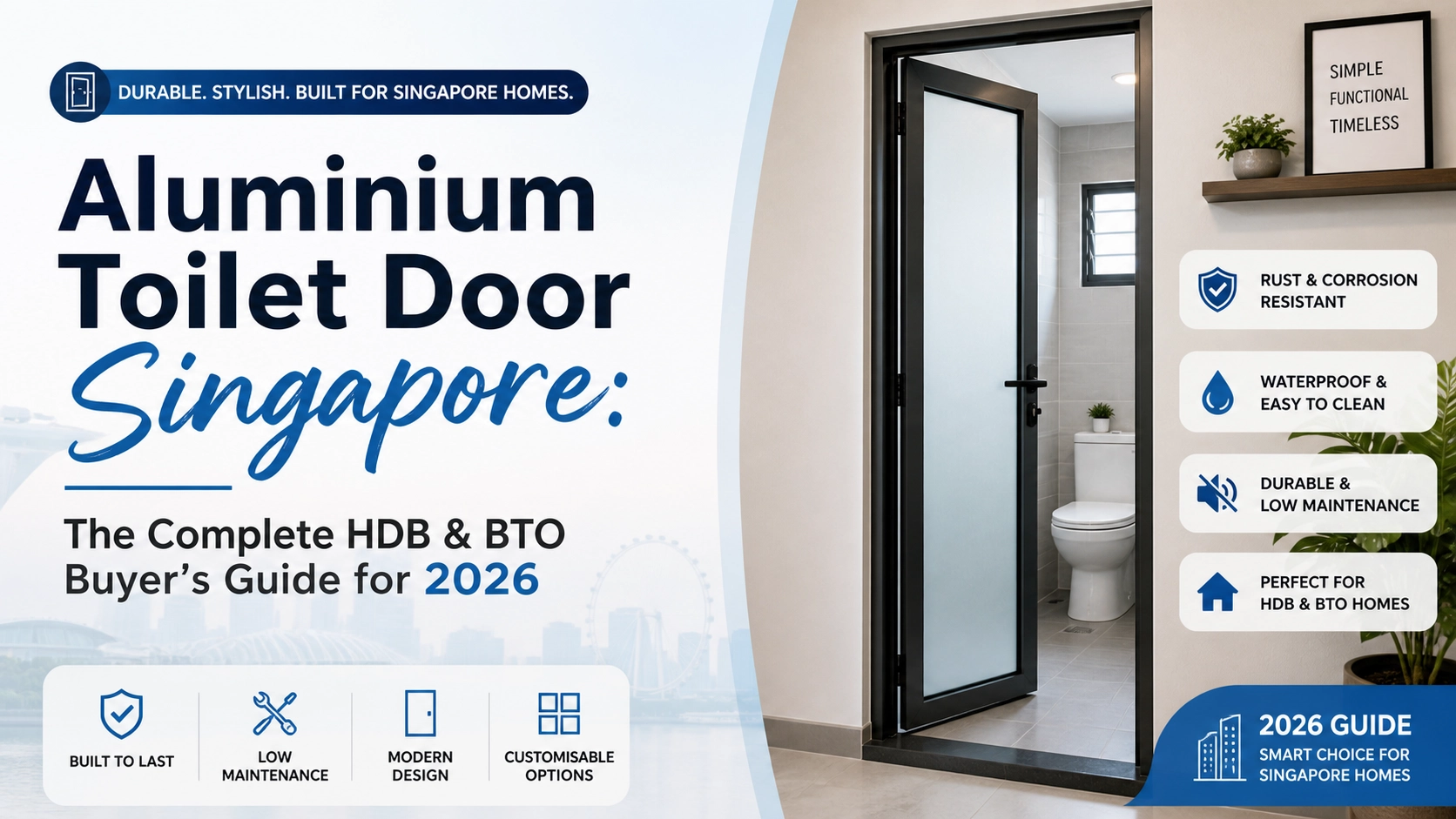
Aluminium Toilet Door Singapore:
The Complete HDB & BTO Buyer's Guide for 2026
Bifold or slide & swing? Frosted glass or acrylic panel? What size fits your HDB bathroom? What lasts in Singapore's humidity? This guide answers every question homeowners, renovation contractors, and interior designers ask before specifying an aluminium toilet door — and the five costly mistakes to avoid before ordering.
Why Aluminium Is the Right Material for Singapore Bathrooms
Singapore's bathroom environment is uniquely demanding. High daily humidity, repeated exposure to steam and direct water splash, and the constant cycle of wet-and-dry conditions make the bathroom the single most challenging space in an HDB flat for any door material.
Timber toilet doors — once common in older HDB flats — absorb moisture over time. They swell, warp, peel, and eventually cannot close properly. PVC-only doors are affordable but lack rigidity for long-term reliable operation. Steel doors corrode in humid conditions without significant surface protection.
Aluminium solves all of these problems. It is why virtually every HDB and BTO toilet door replacement in Singapore today uses an aluminium frame as the structural core. Here is what makes aluminium the dominant choice:
- Completely waterproof — Aluminium does not absorb water. The frame will not swell, soften, or degrade from moisture exposure regardless of how humid or wet the bathroom becomes.
- Rust and corrosion resistant — Unlike steel, aluminium does not rust. It forms a natural oxide layer that prevents corrosion — critical in a bathroom environment where metal exposure to moisture is constant.
- Anti-rot and termite-resistant — No organic material, so termites have nothing to attack. No rot risk from sustained moisture contact at the bottom of the frame.
- Lightweight — Easier to operate daily, and reduces stress on hinges and tracks over time compared to heavier materials.
- Dimensionally stable — Aluminium does not expand or contract significantly with temperature and humidity changes, meaning your door continues to open and close smoothly for years after installation.
- Low maintenance — A damp cloth is all that is needed to clean an aluminium frame. No painting, sealing, or surface treatment is required after installation.
- Wide design flexibility — Aluminium frames accept a large variety of panel materials and colours, making it easy to coordinate your toilet door with the overall bathroom aesthetic.
The 4 Main Aluminium Toilet Door Types: Which Suits Your Bathroom?
Not all aluminium toilet doors work the same way. The mechanism — how the door opens and closes — is one of the most important decisions you will make, because it determines how much space the door requires to operate and how well it fits your specific bathroom layout. Here are the four main types used in Singapore HDB and BTO bathrooms today.
The bifold door folds in half as it opens — like two panels hinging at the centre — running along a top and bottom track. It provides the widest usable opening of all space-saving toilet door types, and is the single most installed toilet door in Singapore HDB bathrooms. The classic bottom-track version is the most affordable; top-hung variants (no bottom track) are increasingly preferred for elderly-friendly and trip-hazard-free installations.
- No swing clearance needed
- Widest opening of all types
- Highly affordable
- Largest panel design selection
- Fast to install
- Bottom track collects dust/debris
- Slight trip hazard (bottom track)
- Less airtight than swing doors
- Can shift with air pressure
Best for: Most HDB and BTO bathrooms — especially compact spaces where a swing door would clash with fittings or the vanity.
The slide & swing mechanism first slides the door horizontally a short distance along the frame, then swings it open. This dramatically reduces the clearance needed compared to a full swing door. It requires a small amount of wall space beside the door frame for the initial slide movement. Popular for bathrooms where a bifold's folded width would protrude into the bathroom entrance area.
- Minimal swing clearance
- Smooth, elegant operation
- Looks more like a standard door
- Good for elderly users
- No floor track obstruction
- Needs side wall space to slide
- Narrower opening vs bifold
- Slightly higher than basic bifold
Best for: Bathrooms where wall space beside the frame is available but full swing clearance is not. Particularly good for master bathrooms in newer BTO layouts.
The swing door opens on hinges — the same mechanism as bedroom and main doors. Aluminium composite panels make it fully waterproof and suitable for bathroom environments. Unlike timber swing doors, there is no risk of warping or moisture damage. However, it requires the most clearance space of all types — either into the bathroom or outward into the corridor or bedroom — making it unsuitable for compact HDB bathrooms.
- Most familiar operation
- Most airtight seal
- No tracks to maintain
- Suitable for large bathrooms
- Requires full swing clearance
- Not ideal for small HDB bathrooms
- Less space-efficient
Best for: Larger bathrooms in 5-room or executive HDB flats, condominiums, or landed properties where swing clearance is not a constraint.
A contemporary evolution of the swing door: an ultra-slim aluminium frame (typically 16mm profile, compared to the standard 50mm) with a tempered glass panel — frosted or fluted. The result is an elegant, minimalist bathroom entrance that admits natural light and contributes to a boutique-hotel feel. Glass bifold variants are also emerging as a premium segment in 2026.
- Premium, designer aesthetic
- Maximises natural light
- Tempered glass — safe on breakage
- Pairs with fluted glass interiors
- Higher investment than acrylic types
- Requires swing clearance
- Glass needs regular wiping
Best for: Master bathrooms in premium renovations, condominium units, or BTO flat owners investing in a full designer bathroom scheme.
Larger bathroom with swing clearance? → Aluminium Swing or Ultra Slim Glass Door.
Elderly residents or young children? → Top-hung Bifold (no bottom track trip hazard) or Slide & Swing (smooth, low-force operation).
Panel Options: Acrylic, Frosted Glass, Fluted Glass, Louvre & PVC
The aluminium frame is the structural backbone — but the panel material is what you see every day. Panel choice affects the aesthetics, the amount of natural light entering the bathroom, the level of privacy, and the maintenance requirements of the door. Here is a clear comparison of every panel option available for aluminium toilet doors in Singapore.
| Panel Material | Privacy | Natural Light | Maintenance | Best For | Trending in 2026? |
|---|---|---|---|---|---|
| Acrylic (solid colour or pattern) | ✓✓ Full | ✕ None | ✓ Wipe clean | Most HDB bathrooms — widest design range | ✓ Evergreen |
| Frosted Tempered Glass | ✓ Good | ✓✓ Excellent | ◑ Regular wipe needed | Master bathrooms, modern renovations | ✓ Popular |
| Fluted Tempered Glass | ✓ Good | ✓✓ Excellent | ◑ Regular wipe needed | Designer bathrooms matching fluted interior theme | ✓✓ Top Trend 2026 |
| Louvre Slats | ✕ Limited (angled slats) | ✓ Good airflow | ◑ Dust between slats | Bathrooms relying on natural ventilation (no exhaust fan) | ◑ Functional niche |
| PVC Panel | ✓✓ Full | ✕ None | ✓ Easy clean | Budget renovations, quick replacements | ✕ Declining |
| Marble Print Acrylic | ✓✓ Full | ✕ None | ✓ Wipe clean | Coordinating with marble tile bathrooms | ✓ Growing |
The 2026 panel trend: fluted glass
Fluted glass — the ribbed, vertical-channel glass that has become the defining material of Singapore's 2026 interior design wave — is now extending from kitchen cabinets and wardrobe panels into bathroom doors. Homeowners renovating their bathrooms as part of a full BTO renovation are choosing fluted glass panels for the toilet door to maintain a cohesive design language throughout the home. If your bathroom already features fluted glass shower screens or cabinet panels, a fluted glass toilet door completes the scheme.
Standard HDB Toilet Door Sizes — And Why You Must Still Measure
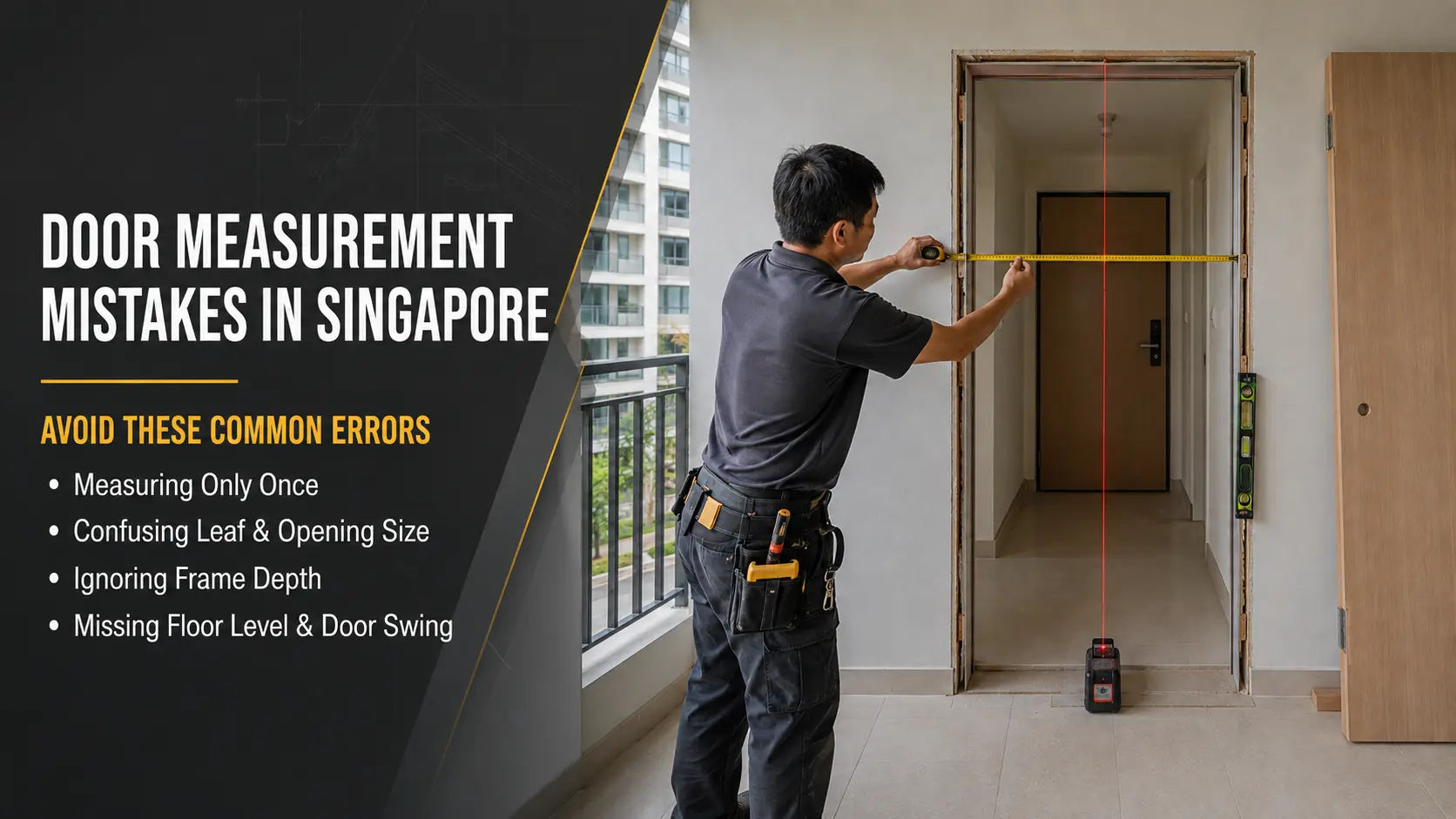
There is a common misconception among homeowners and even some contractors that HDB toilet doors are fully standardised. In reality, while general size ranges exist, significant variation occurs across different flat types, flat ages, and even between units in the same block. Ordering without an on-site measurement is one of the most common and avoidable replacement mistakes.
General size reference for Singapore HDB toilet doors
750mm
What on-site measurement checks
HDB frame openings are rarely perfectly uniform from top to bottom. Measuring at three points ensures the door is fabricated to the actual opening, not an assumed average.
Height is confirmed after the final floor tile, vinyl, or screed is in place to account for any floor level change during renovation.
Slide & swing doors require a specific amount of clear wall space beside the frame opening for the initial sliding movement. This is verified on-site before the mechanism type is confirmed.
The installer checks whether the existing door frame needs to be retained, modified, or replaced — which affects the fabrication specification and any additional work required.
The bottom track of a bifold door requires a clean, level floor surface. Any height variation, debris traps, or level differences are identified during measurement and addressed before installation.
5 Common Toilet Door Replacement Mistakes Singapore Homeowners Make
Based on years of supplying and installing toilet doors across Singapore's HDB estates, these are the five most frequent and avoidable mistakes that lead to poor results, additional costs, or repeat replacements.
A beautiful slide & swing door ordered without confirming adequate wall space beside the frame will not function correctly on installation day. Always confirm mechanism suitability against your specific bathroom dimensions before ordering. What works in a showroom may not work in your bathroom.
Door height must be confirmed after the final floor finish is installed. Tile grout, vinyl underlays, and screed all add height to the floor. Doors ordered before flooring is complete frequently scrape, drag, or fail to close flush with the frame after the floor level rises.
Only tempered (safety) glass should be used in bathroom doors. If standard annealed glass breaks — from a fall, slamming, or accidental impact — it shatters into large, dangerous shards. Tempered glass breaks into small, blunt-edged fragments that are far less likely to cause serious injury. Always verify the glass specification before ordering.
Bifold and slide & swing doors rely on rollers moving along tracks. Dust, hair, and soap residue accumulate in the bottom track over time, causing friction and accelerating roller wear. A simple monthly brush-out and light silicone spray lubrication of the track extends roller life significantly and prevents the "stiff" or "jamming" door that many homeowners assume means the door needs replacing — when in most cases it just needs cleaning.
HDB requires all renovation works to be carried out by contractors on the Directory of Renovation Contractors (DRC). Beyond compliance, unregistered contractors frequently lack the experience to correctly install bottom tracks level, align bifold panels evenly, or ensure smooth slide & swing mechanism operation from day one. Incorrect installation causes premature wear and may void any manufacturer warranty on the door components.
Maintenance Guide: How to Keep Your Aluminium Toilet Door Lasting 15+ Years
One of the key advantages of an aluminium toilet door is how little maintenance it requires compared to timber alternatives. But "low maintenance" is not the same as "zero maintenance." A small amount of regular attention — taking less than five minutes a month — is what separates a door that lasts 20 years from one that develops problems after five.
Monthly maintenance — 5 minutes per month
- Brush out the bottom track — Use a stiff brush or old toothbrush to clear hair, dust, and soap residue from the bottom track of bifold and slide & swing doors. This is the single most important maintenance step for preventing roller wear.
- Wipe the frame — Damp cloth wipe of the aluminium frame, top and sides. No chemical cleaners required — warm water is sufficient.
- Check the rollers — Open and close the door fully a few times. It should move smoothly without resistance. Any stiffness at this stage is the track, not the rollers — clean before assuming the rollers need replacement.
Every 6 months
- Lubricate the track — Apply a light spray of silicone-based lubricant (not oil-based, which attracts dust) to the top and bottom tracks. Work the door back and forth to distribute. This keeps rollers running smoothly and quietly.
- Check hinge screws (swing doors) — Tighten any loose hinge screws. Loose hinges cause misalignment that stresses the frame and damages the door over time.
- Inspect the panel for chips or cracks — Small chips in acrylic panels or hairline cracks in glass panels are best caught early. Cracked glass should be replaced promptly as a safety measure.
Signs it is time to replace, not repair
- The door is more than 10–12 years old and rollers have failed multiple times — replacement is more economical than repeated servicing
- The aluminium frame is physically bent or distorted from an impact — structural integrity is compromised
- The panel is cracked (glass) or heavily yellowed and brittle (older acrylic) — panel-only replacement is possible in some cases if the frame is still sound
- The door no longer closes flush and the gap is allowing significant moisture or odour escape despite adjustment
How to Choose an Aluminium Toilet Door Manufacturer in Singapore
Singapore's toilet door market includes in-house manufacturers, resellers sourcing from third-party factories, and budget online-only operators. The right choice depends on your quality expectations, customisation needs, and how much post-installation support matters to you.
Only contractors on HDB's Directory of Renovation Contractors (DRC) may legally carry out installation works in HDB flats. This is a non-negotiable baseline, not a nice-to-have.
In-house manufacturing means direct quality control, accurate lead times, and the ability to handle non-standard sizes without additional cost or delays. Resellers are dependent on third-party factories for quality and turnaround.
Any reputable toilet door supplier will conduct a site measurement before finalising the order. Avoid suppliers who quote and confirm without measuring — door fit problems are almost guaranteed without this step.
Acrylic panel colours and finishes — especially whites, greys, and marble prints — look significantly different on a screen versus a physical sample. Ask to view actual samples in person before finalising your panel selection.
Quality bifold rollers are rated by the number of open-close cycles they are tested to withstand. A PSB-tested roller system rated to 100,000+ cycles provides a meaningful durability guarantee. Cheap rollers in budget doors are the number one cause of premature stiffness and failure.
If you are renovating your full bathroom, or replacing both the toilet door and another door in the same project, sourcing from a manufacturer who also supplies metal gates, main doors, and bedroom doors reduces coordination effort and ensures finish consistency across products.
Frequently Asked Questions
Looking for an Aluminium Toilet Door for Your HDB or BTO Flat?
HongRui Construction manufactures and installs aluminium toilet doors for HDB, BTO, condominium, and commercial projects across Singapore. Custom sizes, panel options, and project-scale supply available.
Enquire About Toilet Door SupplyOr call us at +65 6988 8833 — trade and bulk project enquiries welcome.




Leave A Comment