
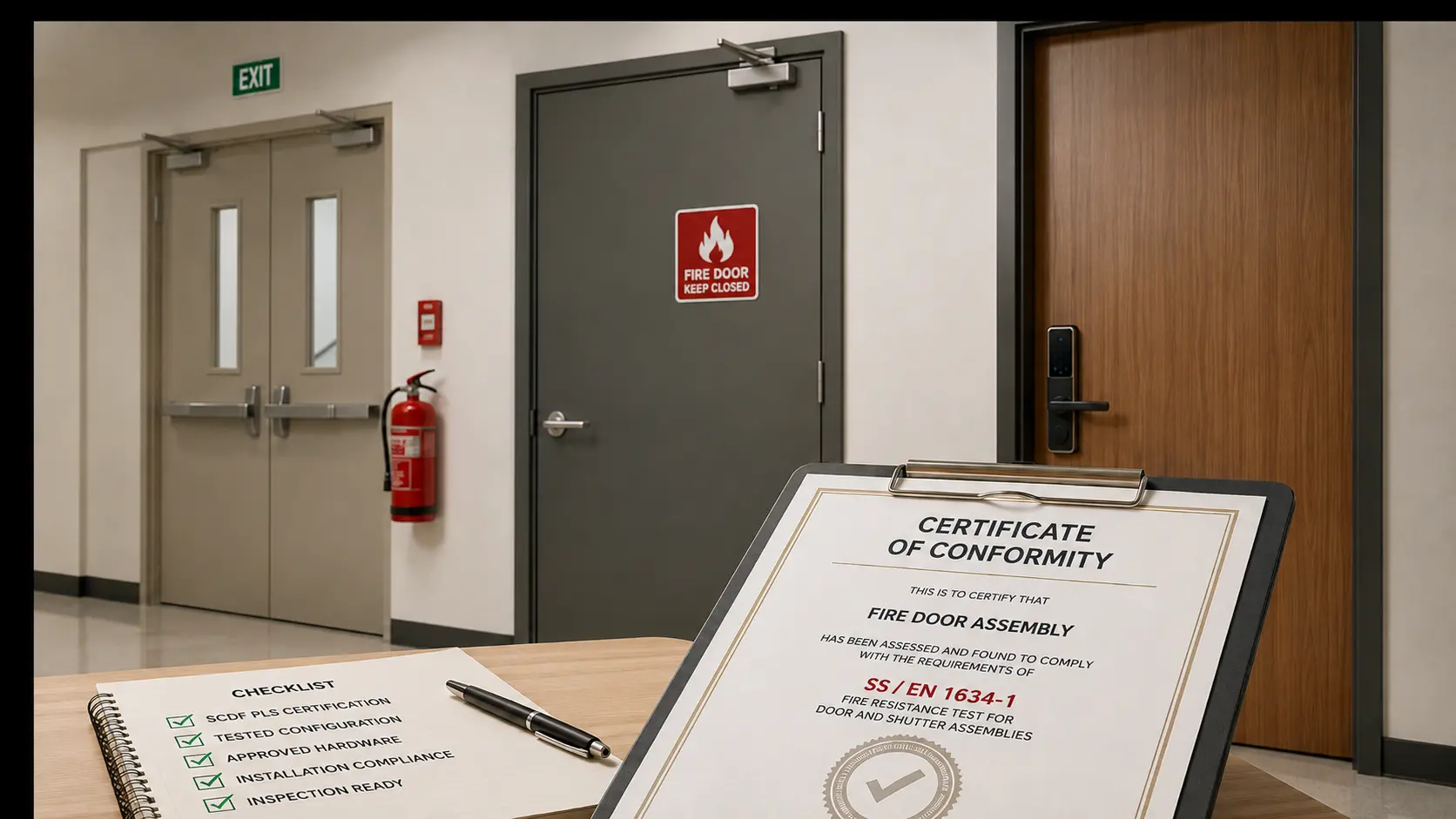
Why Certifications Matter When Choosing a Door Manufacturer in Singapore
Quick answer: A door manufacturer's certifications indicate whether their products have been tested and listed to recognised standards, such as SCDF's Product Listing Scheme for fire doors or SS/EN fire-resistance standards. For HDB, commercial and institutional projects, checking these credentials before procurement helps confirm that a door assembly can be lawfully installed and will be accepted during inspection, rather than relying on the manufacturer's own claims alone.
Key Takeaways
- In Singapore, fire-rated door certification is issued under SCDF's Product Listing Scheme (PLS), by Certification Bodies accredited by the Singapore Accreditation Council (SAC).
- A Certificate of Conformity (CoC) applies to a specific tested configuration — door leaf, frame, hardware and wall type — not to a manufacturer's entire product range.
- Certification requirements differ for HDB main doors, commercial fire compartments, and non-fire-rated doors, so it is worth clarifying which category applies to your project.
- Digital locks and hardware fitted to fire doors have their own certification requirements, separate from the door itself.
- Always verify certification status directly through the manufacturer's CoC or the Certification Body's product directory rather than relying on marketing claims.
Table of Contents
- What "Certification" Actually Means for Doors in Singapore
- Types of Certification and Standards Relevant to Doors
- Why It Matters for HDB and BTO Projects
- Why It Matters for Commercial and Institutional Projects
- How to Verify a Manufacturer's Certification
- Contractor and Architect Coordination Considerations
- Certification Types at a Glance
- Common Mistakes When Assessing Certifications
- Checklist Before Specifying a Door Manufacturer
- Frequently Asked Questions
What "Certification" Actually Means for Doors in Singapore
When project teams talk about a "certified" door manufacturer, they are usually referring to one of two things: the manufacturer's factory-level quality accreditation, or product-specific certification for a particular door assembly. These are not the same, and the distinction matters when specifying doors for a real project.
For fire-rated doors, the relevant framework is the Product Listing Scheme (PLS) administered under SCDF's Fire Code. Regulated fire safety products, including fire doors and related hardware, are certified by Certification Bodies (CBs) that are themselves accredited by the Singapore Accreditation Council (SAC). Where a fire door and its components meet the required testing and certification requirements, the manufacturer is issued a Certificate of Conformity (CoC) for that specific product configuration.
A CoC is tied to a defined scope — the tested door leaf, frame type, wall construction, size range and hardware — rather than to the manufacturer as a whole. This means a supplier can be a genuine CoC holder for one door configuration while a different configuration from the same catalogue may not be covered unless it falls within the certificate's tested scope.
Types of Certification and Standards Relevant to Doors
Several categories of certification and standards may apply depending on the door type and application. Project teams should treat these as distinct requirements rather than interchangeable terms.
SCDF Product Listing Scheme (PLS) and Certificate of Conformity
Fire doors and associated regulated hardware — such as door closers, locksets and panic exit devices — fall under the PLS. Certified products are recorded in a product directory maintained by the relevant Certification Body, allowing the CoC to be checked against the actual product supplied.
Test Standards: SS 332, EN 1634-1, BS 476
Fire resistance testing for doors in Singapore is generally referenced against Singapore Standard SS 332 or the European standard EN 1634-1, which defines fire resistance testing methods for doors, shutters and associated hardware. Older assemblies or imported products may also reference BS 476 Part 22. Certificates issued under recognised overseas bodies — such as Warrington Certifire, Intertek, BM Trada or Efectis — may be accepted where the certifying body is appropriately accredited and the standard is one recognised under Singapore's fire code, though project teams should confirm this with their Qualified Person before relying on an overseas certificate.
SAC Accreditation of Certification Bodies
The Singapore Accreditation Council accredits the Certification Bodies that, in turn, certify individual products. A manufacturer's CoC is only as credible as the accreditation of the CB that issued it. SAC-accredited CBs operate under ISO/IEC 17065 and are listed in the SAC directory, which project teams can use to confirm that a given CB is genuinely authorised to issue CoCs for fire safety products.
Digital Lock and Hardware Certification
Since 1 March 2024, any digital lockset installed on a fire door must itself be certified for fire resistance, either as part of the original door set's CoC or through an individually issued CoC for retrofitting. This is a separate certification requirement from the door leaf itself, and it is a frequent point of confusion during renovation projects.
Non-Fire-Rated Product Standards
For doors that are not part of a fire-safety provision — such as some internal partition doors, decorative doors or certain gate types — certification requirements are typically lighter and may relate instead to material quality, weathering performance, or general Singapore Standards rather than the PLS.
Why It Matters for HDB and BTO Projects
Not every HDB or BTO unit requires a fire-rated main door — the requirement generally applies where the flat's main entrance forms part of a fire compartmentation or escape-route provision, such as units near lift lobbies, common corridors or exit staircases. Where this applies, the entire door assembly, including the leaf, frame and hardware, needs to meet the fire resistance duration specified for that location, commonly a minimum of 30 minutes.
For homeowners and renovation contractors, this means a door manufacturer's certification is not a marketing detail — it is what determines whether the installed door can pass inspection, remain valid during a resale check, or satisfy the requirements of the Housing & Development Board and SCDF for that specific flat type and location. Because requirements can vary by block layout and unit position, it's advisable to confirm the specific requirement for a given unit with HDB or the appointed Qualified Person rather than assuming a blanket rule applies.
![[DESCRIPTIVE ALT TEXT — e.g. close-up of SCDF certification label on HDB fire door edge]](https://hongrui.sg/wp-content/uploads/2026/07/Stylish-modern-door-with-certification-label.webp)
Why It Matters for Commercial and Institutional Projects
Commercial, institutional and industrial projects — offices, retail units, hotels, hospitals, schools and industrial facilities — typically involve a Qualified Person (Fire Safety) who specifies fire ratings for each door location as part of the approved fire safety plan submitted to SCDF or BCA. Contractors and door manufacturers are then expected to supply products matching that specification, supported by a valid CoC.
In these settings, certification errors carry a higher operational cost: non-conforming doors identified during a fire safety audit can delay Temporary Occupation Permit or Certificate of Statutory Completion approval, and doors installed without matching certification may need to be replaced. Facility managers responsible for ongoing compliance also rely on certification labels and CoC records during annual fire safety inspections and subsequent addition-and-alteration works.
For hospitality, healthcare and education projects specifically, door specification often intersects with additional considerations such as acoustic performance, hygiene requirements or durability under high traffic — but these are project specifications and manufacturer recommendations rather than certification requirements in themselves, and should be treated as a separate layer of evaluation.
How to Verify a Manufacturer's Certification
Certification claims are only useful if they can be verified against the actual product being supplied. A practical verification process includes:
- Request the CoC document. Ask the manufacturer or supplier for the Certificate of Conformity covering the specific door model, size range, frame type and wall construction intended for your project.
- Check the certifying body. Confirm the Certification Body listed on the CoC is SAC-accredited, or accredited under a recognised overseas scheme where applicable.
- Match the scope. Confirm the door size, frame material, wall type and any hardware (locks, closers, vision panels) fall within the CoC's tested scope — a certificate tested for a timber frame in a brick wall does not automatically extend to the same door leaf in a steel frame set into a reinforced concrete wall.
- Look for the serial label. Certified fire doors carry a permanent certification label, usually near the hinge edge or top rail, which should correspond to the CoC's serial number.
- Cross-check the product directory. Most Certification Bodies maintain an online directory of certified products, which can be used to confirm the CoC's current validity.
Contractor and Architect Coordination Considerations
Certification requirements typically flow through several stages of a project, and coordination gaps between these stages are a common source of compliance issues at inspection:
- Specification stage: The Qualified Person (Fire Safety) determines the required fire rating for each door location and records it in the door schedule.
- Procurement stage: The main contractor or subcontractor sources doors from a manufacturer whose CoC matches the specified rating and configuration.
- Installation stage: The installer ensures the frame, hardware and self-closing device match what is listed on the CoC — substituting a "similar" closer or lock without confirming certification can invalidate the assembly's compliance.
- Handover and maintenance stage: CoC documentation and serial labels are retained for future fire safety inspections and any subsequent renovation works affecting the door or surrounding wall.
Architects and interior designers coordinating door selection with aesthetic or space-planning goals should loop in the Qualified Person early, particularly where a preferred finish, vision panel or hardware style may fall outside an existing CoC's tested scope.
Certification Types at a Glance
| Certification / Standard | What It Covers | Typically Relevant For |
|---|---|---|
| SCDF Product Listing Scheme (CoC) | Fire doors and regulated hardware tested and listed as a complete assembly | HDB main doors, commercial/institutional fire compartments |
| SS 332 / EN 1634-1 | Fire resistance testing methodology for doors and hardware | Any fire-rated door assembly |
| SAC Accreditation | Confirms the Certification Body itself is competent to issue CoCs | Verifying legitimacy of any CoC |
| Digital lock fire certification | Fire resistance certification for locksets fitted to fire doors | Digital lock retrofits on existing fire doors |
| General material/quality standards | Material performance, durability, weathering resistance | Non-fire-rated interior doors, decorative doors, gates |
Common Mistakes When Assessing Certifications
- Assuming a manufacturer is certified across its entire catalogue because one product line holds a CoC.
- Confusing "fire-resistant materials" with a certified, tested fire door assembly.
- Installing a digital lock on an existing fire door without confirming the lock's own fire certification.
- Substituting a door closer or hardware component without checking whether it is listed within the original CoC's scope.
- Relying on a supplier's verbal assurance instead of requesting the actual CoC document.
- Overlooking that a CoC tested for one frame-and-wall combination may not extend to a different combination.
Checklist Before Specifying a Door Manufacturer
- Confirm whether the door location actually requires fire-rating certification for this project.
- Request the manufacturer's CoC for the specific door model and configuration.
- Verify the Certification Body's SAC accreditation (or recognised overseas equivalent).
- Match door size, frame type and wall construction against the CoC's tested scope.
- Confirm hardware (locks, closers, vision panels) is listed within the same CoC or separately certified.
- Check for the physical certification label on delivered doors.
- Retain CoC documentation for future inspections and renovation works.
![[DESCRIPTIVE ALT TEXT — e.g. contractor reviewing door Certificate of Conformity on site]](https://hongrui.sg/wp-content/uploads/2026/07/Construction-site-fire-door-inspection.webp)
Frequently Asked Questions
Do all HDB flats need a fire-rated main door?
Not necessarily — the requirement generally depends on whether the unit's main door forms part of a fire compartmentation or escape-route provision, such as proximity to a common corridor, lift lobby or exit staircase. Requirements can vary by block and unit layout, so it's best to confirm the specific requirement for your flat with HDB or a Qualified Person rather than assuming it applies uniformly.
What is a Certificate of Conformity (CoC) for a door?
A CoC is a document issued by an accredited Certification Body confirming that a specific door assembly — leaf, frame, hardware and wall type — has been tested and meets the required fire resistance standard. It applies to the tested configuration and scope, not to a manufacturer's full product range.
Can I install a digital lock on my existing fire door?
Yes, but since 1 March 2024, any digital lockset installed on a fire door must itself be certified for fire resistance. This can be a lock certified together with the original door set, or one individually certified for retrofitting. Uncertified locks fitted before this date are generally encouraged to be replaced with certified alternatives.
How do I know if my door is genuinely fire-rated?
Check for a permanent certification label, usually near the hinge edge or top rail of the door, showing a serial number and fire rating (for example, a 30-minute or 60-minute rating). This label should correspond to a valid CoC, which the supplier or manufacturer should be able to produce on request.
Are overseas certifications like BS 476 or EN 1634-1 accepted in Singapore?
Certificates issued under recognised standards such as EN 1634-1 or BS 476 Part 22, by accredited bodies, may be accepted for Singapore projects. However, acceptance can depend on the specific certifying body and project context, so this should be confirmed with the project's Qualified Person before procurement.
Does every door in a commercial building need to be fire-rated?
No. Fire-rating requirements apply to doors identified in the building's approved fire safety plan as part of a fire compartment or escape route. Other doors, such as some internal partition or decorative doors, are typically evaluated against general material and quality standards rather than fire safety certification.
What happens if a non-certified door or hardware is installed where certification is required?
This can result in non-conformance findings during fire safety inspections, potential delays to project approvals, and may require replacement of the non-conforming component. Facility managers and homeowners should retain certification records to avoid disputes during later inspections or property transactions.
Who accredits the bodies that certify doors in Singapore?
The Singapore Accreditation Council (SAC) accredits Certification Bodies that issue Certificates of Conformity for regulated fire safety products, including fire doors. Checking a Certification Body's SAC accreditation is a useful step in verifying that a manufacturer's CoC is genuinely valid.
Conclusion
Certification is one of the clearest ways to distinguish a door manufacturer that can support project compliance from one that cannot. For HDB and BTO applications, it determines whether a main door will pass inspection and remain valid over the life of the flat. For commercial and institutional projects, it underpins the fire safety plan that a building's Qualified Person has already submitted and had approved. In both cases, verifying the actual CoC — including its certifying body, tested scope and matching hardware — is more reliable than assuming compliance based on a manufacturer's marketing claims. Because requirements can vary by project, location and building type, project teams should always confirm project-specific requirements with HDB, SCDF, BCA or their appointed Qualified Person where there is any uncertainty.
Project teams can review HongRui's fire-rated door range and related compliance information to compare available materials, applications and certification considerations before specification.




Leave A Comment