HDB digital lock clearance is the free space a lock needs between a closed main door and a closed gate, plus the lock’s distance from the door edge. Most entrance problems come from skipping this check before buying. This guide explains what to measure, how fire-rated doors change the picture, and what to do when the gap is tight.
What HDB digital lock clearance means
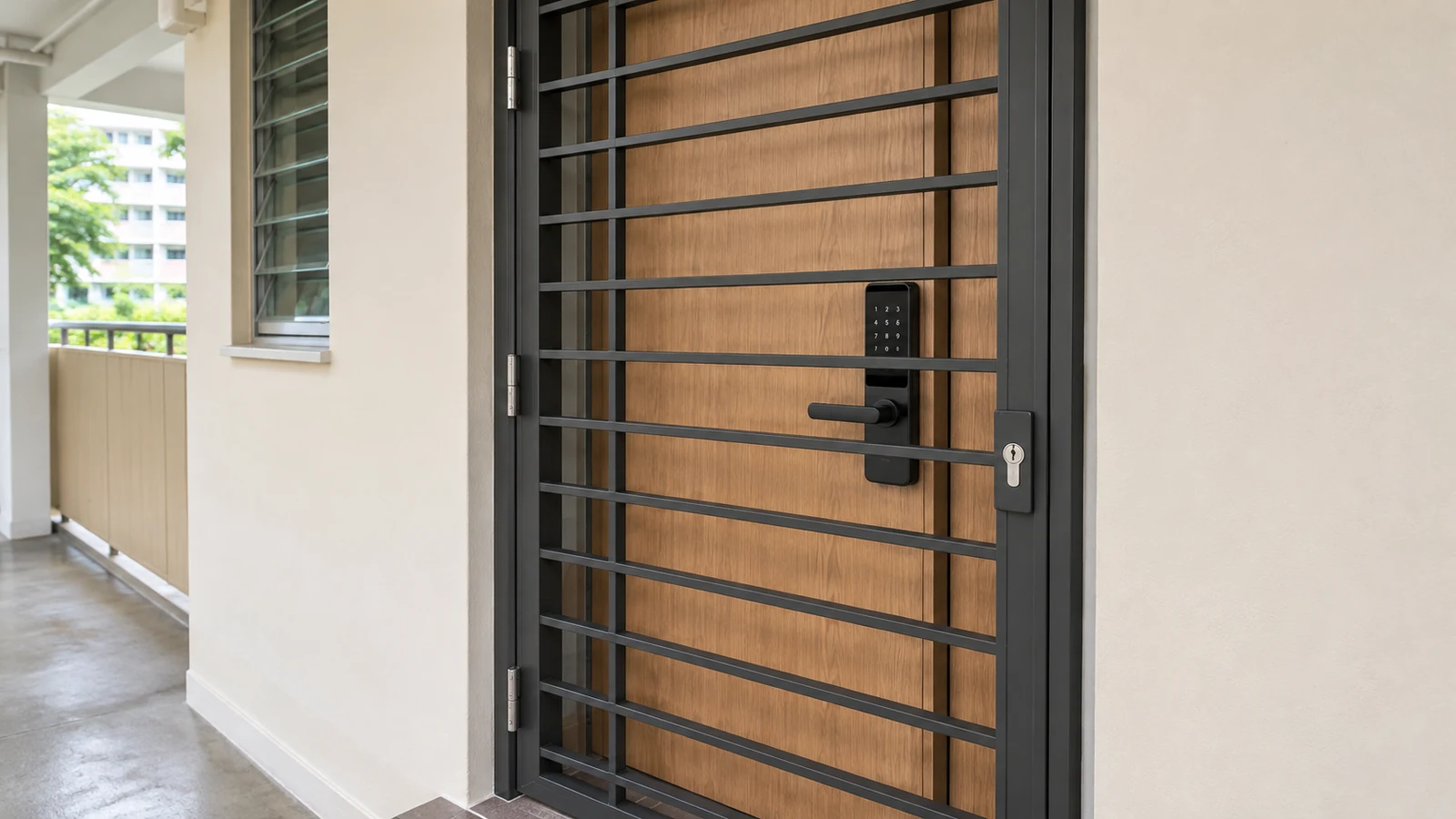
Clearance is the unobstructed space a lock needs to operate and for the door and gate to close without touching it. In a typical HDB entrance, the main door sits behind a metal gate. A digital lock mounts on the outer face of the door, so its handle and backplate sit in the narrow gap between the two. If the gap is too small, the handle strikes the gate bars, the gate cannot close, or the lock is scratched every time someone enters.
Clearance has more than one dimension, and a lock can pass one check and fail another, so they are assessed together.
Why the door-to-gate gap matters
HDB describes the gate as a safety barrier and the main entrance door as a fire safety barrier, so the two parts do different jobs and are not interchangeable. The door often carries the lock and, on many flats, a self-closing device. The gate is a separate frame with its own hinges, bolt and bars. A lock handle that projects too far can prevent either one from closing fully, which affects security and, for a fire door, the self-closing action.
Fit problems tend to surface late, when the lock arrives and changing the door or gate is slower than checking dimensions would have been. For HIP flats, HDB HIP door replacement guidance on the main door and gate explains how the two components are supplied.
The four measurements to check
Record these four values before you shortlist a lock. They map directly to the compatibility fields that lock makers publish.
| Measurement | What it checks | Where to measure | If ignored |
|---|---|---|---|
| Door-to-gate gap | Space for the handle and backplate | From the outer door face to the inner gate face, both closed, at handle height | Handle hits gate bars or gate handle |
| Distance from door edge | Room for the handle and lock body beside the edge | From the latch-side edge to the planned handle position | Lock overlaps the frame, rebate or door profile |
| Door thickness | Compatibility with the lock’s thickness range | Edge of the door leaf, away from the frame | Spindle or bolt does not reach, or bolts protrude |
| Lock height and existing cut-outs | Vertical fit against the existing mortise and door features | Along the latch edge, noting grooves, panels or existing holes | New holes needed, or the old cut-out shows |
Examples of published manufacturer figures
The figures below are illustrative. They show how much the requirement varies between products, and they are not minimums for your flat.
| Product style | Published figure | Source |
|---|---|---|
| Handle-style mortise lock | More than 70 mm between door and gate | igloohome door compatibility guide |
| Deadbolt-style lock | At least 30 mm between door and gate | igloohome door compatibility guide |
| Paired digital gate lock | At least 140 mm between gate and main door, plus a flat mounting area on the gate | Retailer listing for the Kaadas R9 gate lock |
Models and specifications change. Always use the current datasheet for the exact model.
If your main door is fire-rated
Not every HDB main door is fire-rated. HDB determines this flat by flat using SCDF’s Fire Code, and HDB states that fire-rated entrance doors carry a door closer that must not be removed. Where the door is fire-rated, SCDF states that from 1 March 2024 a digital lockset must be certified for fire resistance, either together with the door or individually. The Fire Code also states that the lock’s fire resistance rating must be higher than or equivalent to the door’s.
Compliance note: Clearance and certification are separate checks. A lock can fit the gap and still lack the right certificate. For certificate checks, read the guide to digital locks on fire-rated doors. For permit and replacement questions, see HDB main door replacement rules.
Keep the types of statement apart when you plan the work:
| Type | Example in this topic | Where to confirm |
|---|---|---|
| Regulatory requirement | Certified digital lock on a fire door from 1 March 2024 | SCDF, HDB |
| Project specification | Door type, gate type and hardware group for a precinct or contract | HDB package, door schedule |
| Manufacturer recommendation | Minimum door-to-gate gap, thickness range, cut-out size | Lock datasheet, installation manual |
| General guidance | Measure at several heights, photograph the gap | Good site practice |
Gate-side checks: swing, handle and bars
The gate is usually where the surprises are. Check these before the lock is ordered:
- Handle position against the bars. A horizontal bar level with the lock handle can block it. Louvre and laser-cut panels can also catch a long handle.
- Gate swing. A gate that swings toward the door handle side raises the risk of a clash between the two handles. HDB’s renovation guidelines cover replacement of the main door and front gate, so confirm what applies before changing size, panels or swing.
- Existing gate lock or bolt. The gate’s own latch and thumb-turn also project into the gap.
- Peephole and viewer. Make sure the gate layout does not cover it once the lock is fitted.
Where a gate is being made or modified, give the manufacturer the lock model first. Our metal gate guide for HDB and BTO homes explains how handle clearance and lock housing are coordinated on the gate side.
How to measure the gap step by step
- Close the main door fully, then close the gate. Check both latch properly.
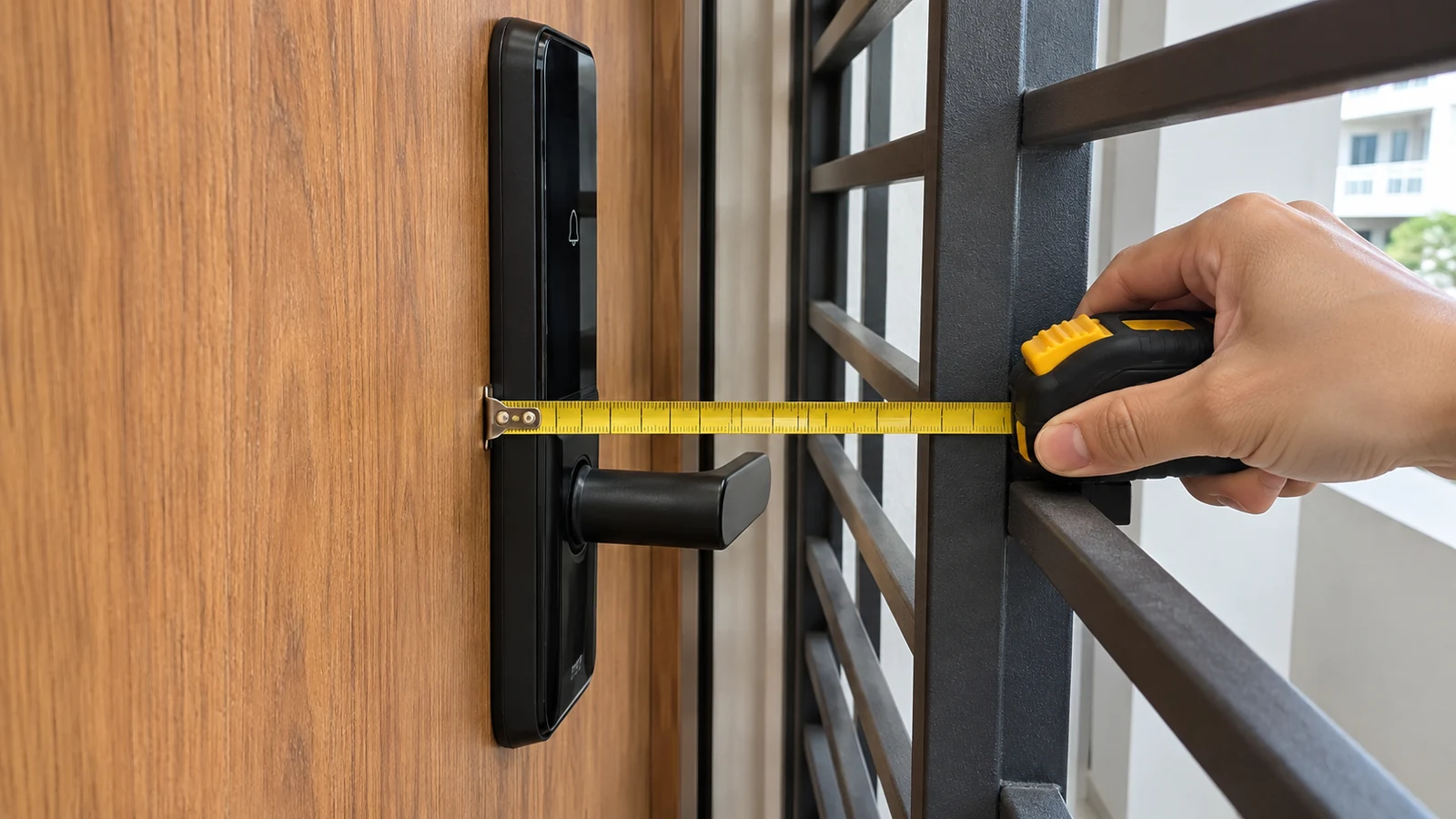
- Measure from the outer face of the door to the inner face of the gate at handle height, using a rigid tape or caliper.
- Repeat near the top and bottom of the door. Hinge sag or frame twist can change the reading.
- Measure the door thickness on the latch edge, and the distance from the latch edge to where the handle will sit.
- Note existing holes, grooves, panels or a mortise pocket on the door face.
- Photograph the setup with the tape visible, and send the figures and photographs to the supplier with the lock model.
Tip: Take the smallest reading, not the average. The handle only needs to clash once. For broader measuring errors, see common door measurement mistakes in Singapore projects.
Lock types and clearance trade-offs
| Lock style | Clearance consideration | Suitable when | Limitation |
|---|---|---|---|
| Push-pull or long handle mortise | Needs the most space between door and gate | The gap is generous and the gate bars are clear of the handle | May conflict with gate handles in older, tighter entrances |
| Lever-handle lock | Moderate projection, with the lever swinging near the gate | The gate is flat and open-bar | Lever may catch bars when pressed |
| Deadbolt-style add-on | Lowest projection, usually no handle | The existing handle stays, or the gap is small | Compatibility with the existing mortise and door thickness must be checked |
| Paired digital gate lock | Needs its own mounting area and gap | One credential should open both barriers | Requires flat bar area and sufficient spacing |
What to do when the gap is tight
A tight gap does not always rule out a digital lock. In order of least disruption:
- Choose a lower-profile or deadbolt-style model whose published minimum is below your measured gap.
- Ask whether a shorter handle option exists for the same product line.
- Have the gate manufacturer adjust bar positions or the gate lock side, so the bars clear the handle path.
- Reconsider whether the gate needs its own digital lock.
Altering the door leaf or frame is the last option. On a fire-rated door, any change should be checked against the door’s certification first.
Common mistakes
- Ordering the lock before measuring, based on appearance or price alone.
- Measuring only the door-to-frame gap, and not the gap to the gate bars.
- Reading one value at one height, when the gap varies along the door.
- Assuming a fire-rated or “fire door compatible” label means a certificate exists. Ask for the Certificate of Conformity for the exact model.
- Removing or disabling a door closer during installation and not reinstating it.
- Installing the lock before flooring and gate work are complete, which risks scratches and re-measuring.
Post-installation inspection checklist
- The door closes and latches fully with the lock fitted.
- The gate closes and latches without touching the lock handle, with both in the closed position.
- The handle moves through its full range without contacting a bar.
- The self-closing device is in place and works on a fire-rated door.
- The manual or mechanical override works, and the backup power method is known.
- No new, unplanned holes or visible cut-out edges remain on the door.
- The certificate, manual and installation record are kept together.
Condominium and commercial entrances
Many condominium units have no gate, so clearance depends on the lobby or corridor layout, and MCST rules may govern door replacement. In offices, hotels, hospitals and schools, locks on fire-rated or exit-route doors may need approval from the project’s Qualified Person or SCDF. HDB flat practice should not be applied to them automatically.
Questions to ask before specifying a lock
- What is the measured door-to-gate gap at handle height, and what is the smallest reading?
- Is the main door fire-rated, and where is that documented?
- Does the lock’s datasheet list a minimum gate clearance and a thickness range?
- Will installation need any new holes or enlarged cut-outs?
- Who keeps the Certificate of Conformity and installation record afterwards?
Frequently asked questions
How much clearance do I need between my HDB main door and gate for a digital lock?
There is no single figure, because each lock model sets its own minimum. Published examples range from about 30 mm for a deadbolt-style lock to more than 70 mm for a handle-style mortise lock, and larger for some paired gate locks. Measure the gap between your closed door and closed gate, then compare it with the datasheet of the exact model you plan to buy.
Can I fit a digital lock if the door-to-gate gap is small?
Often yes, but the choice narrows. A slimmer deadbolt-style lock, a shorter handle or a flush-profile model may suit a tight gap better than a long push-pull handle. Check that the handle clears the gate bars when both are closed. Avoid changing the door leaf to gain space, especially on a fire-rated door, without confirming what is permitted.
Does my HDB main door need a fire-rated digital lock?
Only if the main door is fire-rated. HDB decides this flat by flat using SCDF’s Fire Code, so not every flat is the same. For a fire door, SCDF states that a digital lockset installed from 1 March 2024 must be certified for fire resistance, either with the door or individually. Ask for the Certificate of Conformity for the exact lock model.
Can I drill or cut my main door to make a digital lock fit?
Not without checking first. A fire-rated door is certified as an assembly, so extra holes or enlarged cut-outs may fall outside its tested configuration. Check the door’s documents, the lock’s installation instructions and, where needed, HDB or the door supplier before any drilling. A non-fire-rated door still needs the lock’s own cut-out and thickness limits respected.
Which way should my HDB gate swing when a digital lock handle is fitted?
The swing should follow what HDB allows for your flat, which is usually the swing of the original gate. HDB’s renovation guidelines cover replacing a front gate, so check them before changing size, panels or swing. Within that limit, a gate that opens away from the door handle side reduces the chance of the two handles clashing.
Do I need a separate digital lock for the gate?
No. A digital lock on the main door works without one on the gate, and many homes keep a mechanical gate lock. A gate lock is a separate product with its own mounting area and its own door-to-gate gap requirement. If you plan to add one later, note the gap and gate bar layout now so that you do not close off that option.
When should I measure the door-to-gate gap in a new BTO flat?
Measure after the main door and gate are installed, and before you order the lock. Floor plans do not show real clearances, and installed hinges, frames and gate bars can shift the gap by several millimetres. Take readings at the handle height and again near the top and bottom, then record them with a photograph for the supplier.
Conclusion
HDB digital lock clearance comes down to a few measurements taken before purchase: the door-to-gate gap, the distance from the door edge, the door thickness and the lock height. Handle-style locks generally need more space than deadbolt-style models, and published minimums differ by product. If the main door is fire-rated, certification matters as much as fit, and drilling beyond the tested configuration should be avoided. Installation and maintenance checks complete the job. Because requirements vary by flat and may change, confirm them with HDB, SCDF and the lock manufacturer.
Project teams can review HongRui’s door and gate manufacturing information to compare available materials, applications and installation considerations.
Related guides
References
- Singapore Civil Defence Force: Digital Locksets on Fire-rated Doors
- SCDF Fire Code 2023, Clause 11.8: Additional requirements for specific products
- Housing & Development Board: Home Care Guide, Gate and Door
- Housing & Development Board: Renovation guidelines for building works
- MyNiceHome: How to renovate your HDB flat
- igloohome: Door compatibility guide (manufacturer example)
- Kaadas R9 digital gate lock retailer listing (manufacturer example)
Regulations and technical information last checked: 13 November 2026.