
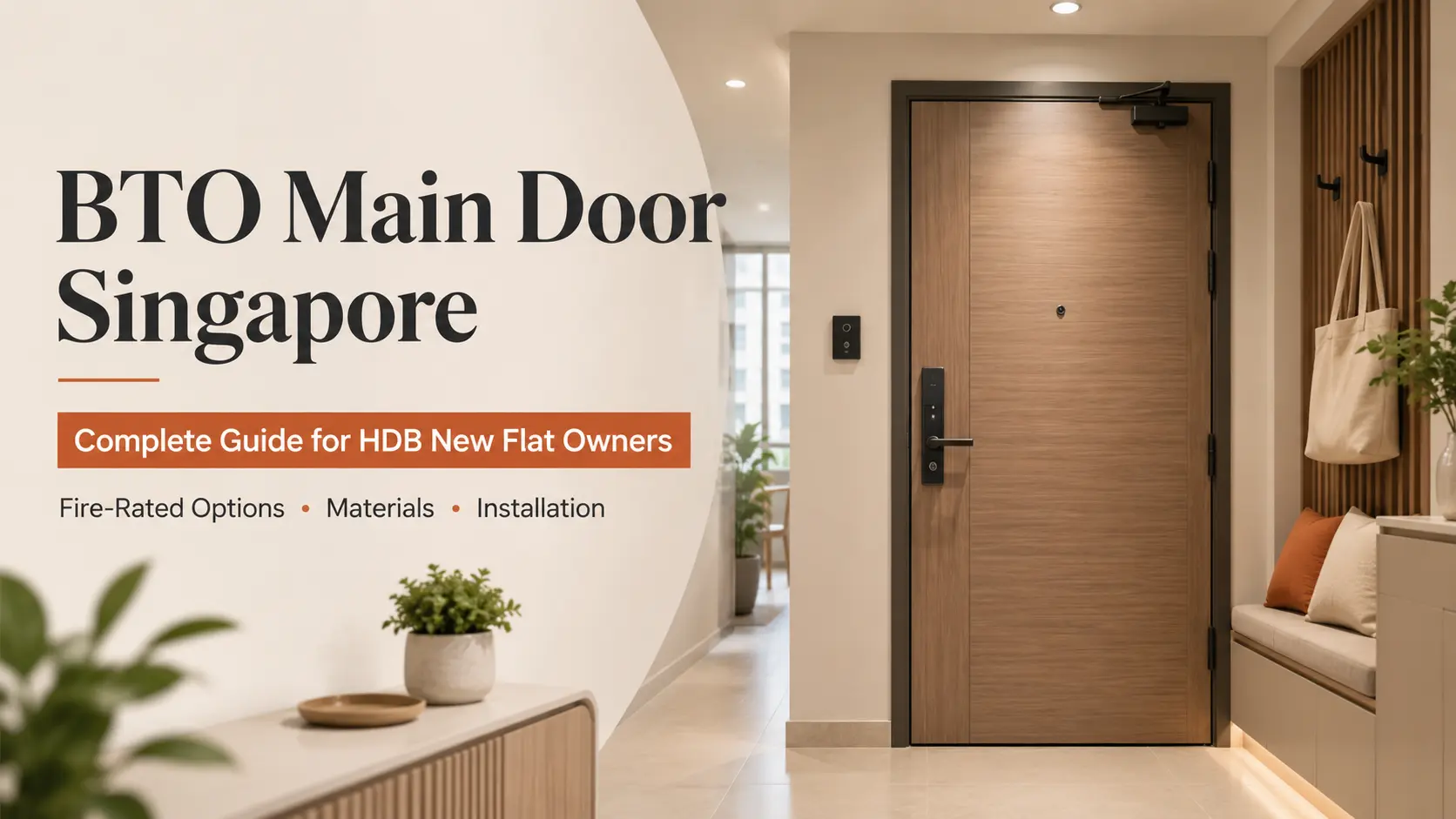
BTO Main Door Singapore: A Complete Guide for New HDB Flat Owners & Renovation Planners
Everything you need to understand about choosing, specifying, and installing a main door for your new BTO flat — from HDB compliance and material selection to contractor coordination and long-term maintenance.
Collecting the keys to a new BTO flat is a milestone moment — and your main door is the first decision most homeowners face during renovation. It is also one of the most consequential: the right door combines structural security, HDB compliance, fire safety, and the aesthetic tone that greets everyone who visits your home.
This guide compiles practical knowledge from Singapore's residential door manufacturing and renovation industry, covering everything from HDB specifications and material science to contractor workflows and long-term upkeep. Whether you are a first-time flat owner, an interior designer coordinating a renovation package, or a contractor sourcing compliant door systems, the information here is designed to be genuinely useful.
What Is a BTO Main Door and Why Does It Matter?
In Singapore's public housing context, a BTO (Build-To-Order) main door refers to the primary entrance door of a new HDB flat unit. Unlike secondary bedroom or bathroom doors, the main door serves multiple simultaneous functions: physical security barrier, fire containment element, acoustic buffer, and the primary visual feature of the unit's entrance corridor.
HDB does not leave the main door entirely to homeowner discretion. Specific requirements govern the door's fire-resistance rating, opening direction, dimensions, and in some cases, the locking hardware. Understanding these requirements before any renovation begins saves time, prevents costly rework, and ensures smooth approval from HDB's renovation guidelines framework.
HDB Requirements for BTO Main Doors in Singapore
Before exploring materials and designs, it is worth grounding the conversation in HDB's core requirements. These apply to all BTO residential flats and are referenced by renovation contractors, interior designers, and building inspectors throughout the project lifecycle.
Fire-Resistance Ratings
HDB requires main entrance doors in residential flats to achieve a minimum fire-resistance rating (FRR) of FD30, meaning the door must withstand fire conditions for at least 30 minutes. For higher-floor units or certain flat types, FD60 ratings may be specified. The fire door must also demonstrate smoke-sealing capability to prevent the spread of smoke through the door gap.
This requirement stems from Singapore's Fire Code and the Building and Construction Authority (BCA) standards, which classify BTO residential corridors as escape routes. The main door's fire rating is integral to the corridor's function as a protected means of egress.
Dimensions and Opening Direction
BTO flat openings generally follow standardised rough opening dimensions, though minor variations exist across different project batches and flat types. Main doors typically open inward (into the unit), which influences handle placement, hinges, and clearance planning during interior fit-out.
- Standard rough opening widths: approximately 900mm to 1000mm for most 3-room to 5-room flats
- Clear height: typically 2100mm to 2400mm depending on the project batch
- Frame rebate: required for fire-rated applications to ensure intumescent seals function correctly
- Threshold: flush or minimal threshold is preferred for accessibility compliance
Renovation Permit Considerations
Under HDB's renovation guidelines, replacing or altering the main door requires a renovation permit. Interior designers and contractors must submit the relevant documentation, including the door manufacturer's certification for fire resistance, before work commences. Failure to obtain the permit or use a non-compliant door can result in rectification orders and delays.
BTO Main Door Materials: Timber vs Fire-Rated Steel vs Engineered Core
The three dominant material systems used in Singapore's BTO main door market each carry distinct performance characteristics, cost profiles, and aesthetic possibilities. Understanding the differences is essential for homeowners, renovation planners, and architects specifying for residential projects.
| Material Type | Fire Rating | Typical Weight | Finish Options | Best For |
|---|---|---|---|---|
| Solid Timber Core | FD30 / FD60 | 45–70 kg | Veneer, paint, laminate | Warm aesthetic, mid-range renovation |
| Steel / Mild Steel | FD30–FD120 | 60–120 kg | Powder coat, spray paint | High-security applications, industrial finish |
| Engineered Composite Core | FD30 / FD60 | 40–65 kg | Full laminate range, wood grain | Budget-conscious, contemporary finishes |
| Aluminium Frame + Infill | FD30 (limited) | 25–50 kg | Anodised, powder coat | Modern/minimal look, lighter weight |
Timber Main Doors
Timber remains a popular choice for BTO main doors in Singapore, particularly in renovations targeting a warm, classic, or Japandi-influenced aesthetic. Solid timber core doors offer natural insulation, satisfying weight and acoustic damping, and can be finished with a wide range of veneers, laminates, or paint.
For fire-rated applications, timber doors incorporate intumescent strips around the perimeter and in the lock block area. When exposed to heat, these strips expand to seal the gap between door and frame, delaying smoke and flame migration. HDB-compliant timber fire doors must be tested and certified — a blanket timber door without fire certification does not satisfy the main entrance requirement.
For a deeper look at timber door specifications in the BTO context, refer to our guide on HDB & BTO Timber Door Fire-Rated Standards in Singapore.
Fire-Rated Steel Doors
Steel doors are frequently specified for projects where higher fire resistance (FD60 or FD120) is required, or where budget constraints favour the durability-per-dollar of steel construction. In commercial mixed-use developments with residential components, steel fire doors at unit entrances are common. Their robustness also makes them a practical choice for lower-floor units in high-traffic environments.
The trade-off is weight and finish flexibility. Steel doors are heavier and require robust continuous hinges. While powder-coat finishes offer durability, they do not match the warmth of timber veneer for residential interiors. Some manufacturers address this with laminated steel doors that combine a steel fire-rated core with a timber-effect laminate surface.
Engineered Composite Doors
Engineered composite cores — typically honeycomb or particleboard — are widely used in the mid-range BTO renovation market. These doors achieve fire ratings through the combination of core density, intumescent treatments, and frame sealing rather than the inherent mass of timber. They are lighter than solid timber equivalents, easier to handle during installation, and accept a full laminate finish range.
Door Design, Finishes, and Hardware in BTO Renovation Contexts
The visual and functional features of a main door are increasingly significant in BTO renovation planning. Interior designers working on full flat renovations frequently use the main entrance as an anchor piece that sets the tone for the home's design language — whether that is a minimalist void-grey flush panel, a warm oak-veneer statement door, or a textured laminate with geometric grooves.
Surface Finishes
- High-pressure laminate (HPL): Durable, scratch-resistant, available in extensive colour and texture libraries. Industry-standard for mid-range BTO renovation.
- Veneer: Real or reconstituted wood veneer over engineered core for authentic grain appearance. Requires sealing in Singapore's humid environment.
- Polyurethane (PU) paint: Smooth, matte or semi-gloss paint finish popular for contemporary interiors. Prone to chipping at high-traffic edges without protective edge trim.
- Powder coat (steel doors): Industrial process producing a hardwearing, UV-stable colour coat. Common in stairwell, commercial, and secondary market applications.
Digital Locks and Smart Entry
Singapore's BTO renovation market has seen strong adoption of digital lock systems over the past several years. Main doors are increasingly specified with preparation for digital mortise locks, which require a specific lock block position and mortise pocket. When specifying a main door, contractors and interior designers should confirm the lock block placement against the intended digital lock dimensions to avoid costly late-stage modifications.
- Fingerprint and PIN entry systems require mortise pocket depth of typically 60–80mm
- Face recognition or RFID card systems may require additional frame-side wiring preparation
- Smart lock integration with home automation platforms is common in design-forward BTO renovation packages
Viewing Panels and Sidelights
Some BTO renovation projects incorporate a viewing panel (peephole or small glazed insert) in the main door for visibility without opening. For fire-rated doors, any glass insert must be fire-rated glazing — standard float glass is not acceptable. Architects and designers specifying custom door configurations should confirm panel options with the manufacturer early in the design process.
Installation Process: From Measurement to Handover
Understanding the installation sequence helps interior designers, contractors, and homeowners plan the renovation programme accurately. Main door installation is typically one of the earlier trades in a BTO renovation — the door frame is set before tiling works begin in the entrance foyer, and the door panel itself is usually installed near project completion to avoid damage from other trades.
Site Measurement and Verification
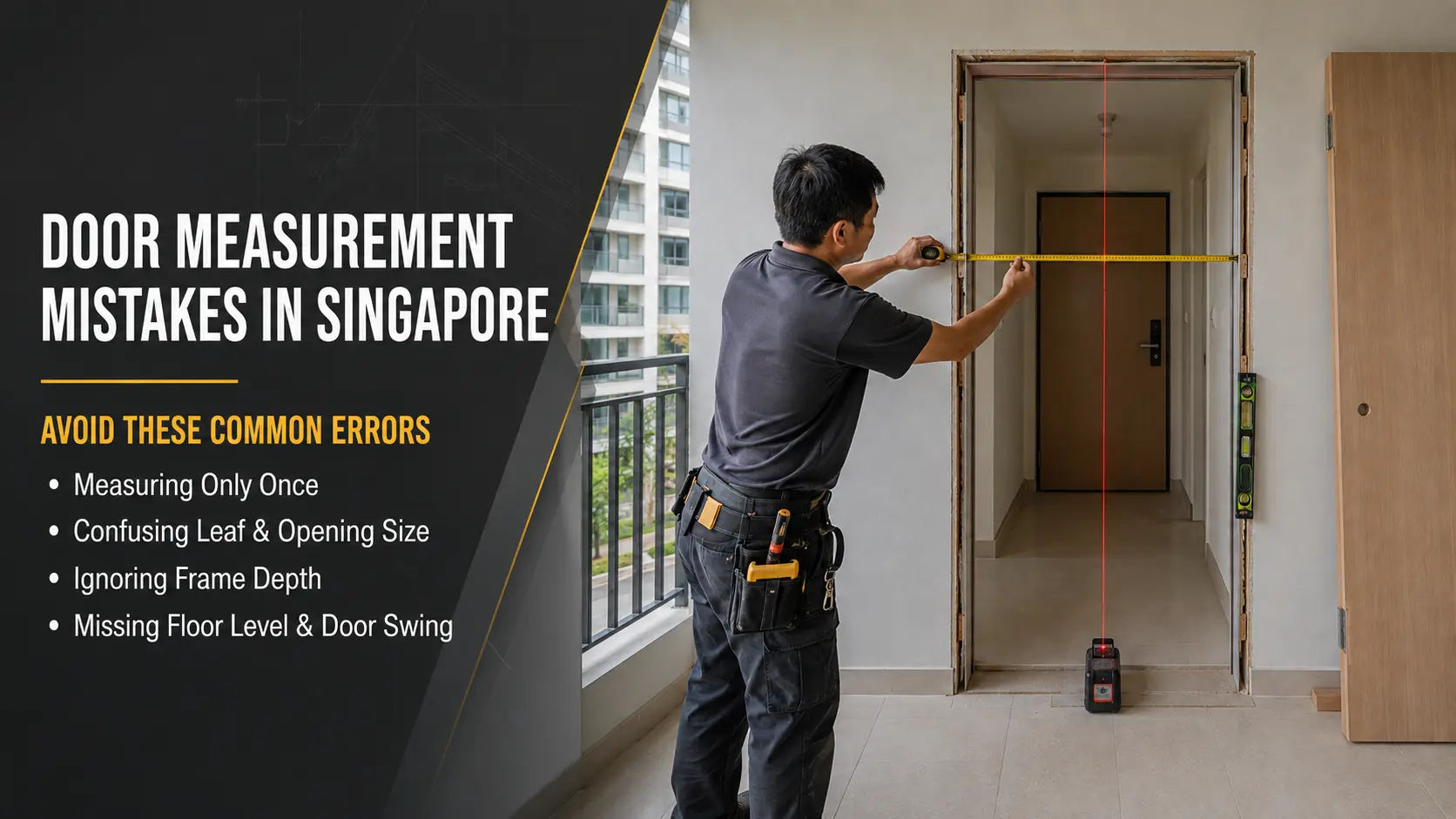
The installer or manufacturer's representative surveys the rough opening dimensions, checks plumb and level of the structural opening, identifies any obstruction from existing frames or cement work, and confirms the floor finish height for threshold planning.
Frame Fabrication and Preparation
The door frame is fabricated to the verified opening dimensions. Fire-rated frames include integral intumescent seal grooves. Frames are primed or finished to the specified colour before delivery to site.
Frame Installation
The frame is set into the rough opening, plumbed, levelled, and anchored with frame fixings appropriate for the HDB concrete structure. Gaps between frame and structure are packed and grouted. Frame installation typically precedes tiling in the entrance foyer.
Door Leaf Hanging and Adjustment
The door panel is hung on the frame hinges and adjusted for even gap reveals and smooth operation. Hardware including lockcase, digital lock preparation block, and door closers (where required) are fitted and tested.
Sealing, Touch-Up and Inspection
Perimeter gaps between frame and wall are sealed with appropriate sealant. Surface touch-ups are completed. The installation is inspected against the fire-rated door certification requirements, and documentation is compiled for the homeowner or renovation permit file.
Maintenance Guide for BTO Main Doors in Singapore's Climate
Singapore's tropical climate — high humidity year-round, intense UV exposure, and frequent temperature cycling from air-conditioned interiors to hot corridors — creates specific maintenance demands for main doors. A well-maintained door retains its structural integrity, aesthetic finish, and hardware function for a decade or more. Neglected doors suffer accelerated delamination, swelling, hinge wear, and hardware corrosion.
Routine Maintenance Checklist
- Wipe door surface with a damp cloth monthly — avoid abrasive cleaners on laminate or veneer finishes
- Inspect and lubricate hinges every 6 months with a PTFE-based or silicone lubricant
- Check and adjust the door closer (if fitted) for speed and latching force twice yearly
- Test intumescent seal condition annually — look for cracking, detachment, or compression damage
- Inspect the door frame–wall junction for sealant cracking, especially after seasonal humidity variation
- Test digital lock battery level and responsiveness monthly; replace batteries before critical depletion
- Inspect the door's leading edge for chipping or moisture ingress, especially near the bottom rail
- Clean and test the lockcase mechanism annually; apply graphite lubricant to the lock bolt
Common Issues and Remediation
- Door swelling or binding: Often caused by moisture absorption in timber or composite cores. Check that the door bottom edge is sealed and that the threshold does not trap water. In persistent cases, frame realignment or planing may be required.
- Laminate delamination: Typically a sign of moisture ingress at unsealed edges. Early-stage delamination can be bonded; advanced delamination usually requires door replacement.
- Hinge creak or stiff operation: Lubrication solves most hinge noise issues. If the door has dropped and hinges are binding, adjustment or hinge replacement may be needed.
- Digital lock malfunction: Most common cause is low battery. If the unit remains unresponsive after battery replacement, the motor or circuit board may require servicing.
Commercial and Mixed-Use Applications
While this guide focuses primarily on the BTO residential context, it is worth noting that the same fire-rated main door systems used in HDB flats are also deployed across a range of commercial and institutional project types in Singapore. Architects and M&E consultants specifying for these projects often draw on residential door manufacturers' experience with HDB compliance as a quality baseline.
- Serviced apartments and hotel residences: Unit entrance doors in serviced apartments typically follow hospitality-grade specifications combining residential aesthetics with commercial durability and fire ratings.
- Student accommodation and co-living developments: High-turnover environments demand robust door hardware, reinforced lock blocks, and durable finishes that withstand frequent use.
- Eldercare and healthcare facilities: Main doors in senior living units often incorporate lever handle hardware for ease of use, wider clear openings for wheelchair access, and lower threshold solutions.
- Commercial stairwell and plant room access: Fire-rated steel doors are standard for stairwell enclosures and mechanical plant access in commercial buildings — a volume application for fire door manufacturers alongside the residential BTO market.
For commercial project procurement and contractor-facing supply arrangements, our guide on How to Choose a B2B Door Supplier in Singapore covers the evaluation criteria relevant to developers, main contractors, and quantity surveyors.
"The main door is the only building element a homeowner touches every day and sees every time they return home — it deserves specification as carefully as any other finish in the renovation."
Renovation Planning: Coordinating Your BTO Main Door with Other Trades
In the context of a full BTO renovation, the main door specification and installation intersects with multiple other trades and decisions. Interior designers and contractors who understand these dependencies can sequence the work programme to avoid delays and rework.
Coordinating with the Entrance Foyer Design
The entrance foyer is typically one of the first spaces a designer develops in a BTO renovation, as it sets the visual transition from the public corridor to the private interior. The main door's width, swing direction, and finish need to be resolved before the designer can finalise shoe cabinet placement, feature wall finishes, and flooring layout in the foyer.
Relationship to the Metal Gate
Many Singapore BTO homeowners specify a secondary metal gate in front of the main door. This gate is typically installed on a separate frame that projects slightly into the corridor, with its own hinges and lockset. The main door and gate must be coordinated to ensure both open and close without obstructing each other, and that the combined assembly does not encroach on the HDB-mandated corridor clearance width.
For full context on gate selection and specifications, see our dedicated guide: Metal Gate Singapore: HDB & BTO Project Guide 2026.
Flooring and Threshold Transitions
The door threshold detail — where the main door's bottom rail meets the floor — requires coordination between the door installer, the tiler, and sometimes the timber flooring installer. The finished floor level in the foyer determines the threshold height and whether a ramp or reducer strip is needed. Getting this detail wrong creates trip hazards, drainage issues for rain ingress at the door base, and gap problems that affect the door's fire seal performance.
Electrical Provisions for Digital Locks
If a wireless digital lock system is planned, the door specification must include an appropriate lock block and mortise. If a wired or semi-wired smart lock system is chosen, the electrical contractor needs to run a low-voltage cable to the door frame before plastering works are completed. This is one of the coordination points most frequently missed in BTO renovations when trades are not communicating through a single interior designer or main contractor.
Frequently Asked Questions
Yes. HDB requires main entrance doors in BTO flats to meet a minimum fire-resistance rating of FD30 (30 minutes). This requirement is derived from Singapore's Fire Code and the BCA's requirements for residential escape routes. The door and its frame assembly must both be fire-rated, and the certification documentation should be retained for the renovation permit file.
When sourcing a main door, always request the manufacturer's fire certification and confirm it specifies the door as tested to SS 332 or an accepted equivalent standard.
BTO flat rough openings vary slightly between project batches, but main door rough openings are typically between 900mm and 1000mm wide, with a height of approximately 2100mm to 2400mm. Site measurement by the door manufacturer or their installer is essential before fabrication — standard assumptions should not substitute for verified field dimensions.
Yes, homeowners can replace the main door during renovation, but this is classified as a structural or fire-safety related alteration that requires a HDB renovation permit. The replacement door must meet fire-resistance requirements, and the manufacturer's certification must be submitted with the permit application. Work should be carried out by a licensed renovation contractor.
A fire door is engineered and tested as a system — door leaf, frame, intumescent seals, hinges, and hardware — to resist fire and smoke migration for a rated period (typically 30 or 60 minutes for residential applications). A standard door uses conventional materials without fire-rated testing and provides no meaningful fire containment. In Singapore's BTO context, a standard non-fire-rated door at the main entrance does not comply with HDB requirements and would fail a renovation inspection.
Frame installation at site typically takes half a day to a full day per unit, depending on site conditions and the complexity of the opening. Door leaf hanging and hardware fitting is generally completed in a second visit, taking two to four hours. Total fabrication and delivery lead time from order placement varies between two and six weeks depending on the manufacturer's production schedule and the degree of customisation.
Yes, HDB permits the installation of a secondary metal gate at the main entrance, provided it does not reduce the corridor's clear width below the minimum required for emergency egress, and that it is installed within the flat's boundary. The gate is typically installed on a separate frame anchored to the corridor wall rather than attached to the main door frame. Coordination between the door and gate installers is recommended to ensure both operate correctly.
Key maintenance tasks include regular surface cleaning (monthly), hinge lubrication (every six months), intumescent seal inspection (annually), digital lock battery checks (monthly), and frame sealant inspection (annually). Singapore's high humidity accelerates hinge corrosion and moisture ingress at unsealed edges, so attention to edge sealing and hardware lubrication is particularly important. A well-maintained fire-rated timber or composite door should remain compliant and functional for ten or more years.
Conclusion
The BTO main door is far more than a functional threshold — it is a fire-safety system, a security element, and the first design statement your home makes. Getting it right involves understanding HDB's fire-resistance requirements, choosing an appropriate material system for your renovation brief, coordinating with related trades including your gate supplier, flooring contractor, and electrician, and planning for long-term maintenance in Singapore's demanding climate.
For renovation professionals and developers, sourcing from a manufacturer with documented BTO project experience and verifiable fire certifications is a baseline requirement — not merely a preference. The documentation trail from certification to permit approval is part of the product, not separate from it.




Leave A Comment