
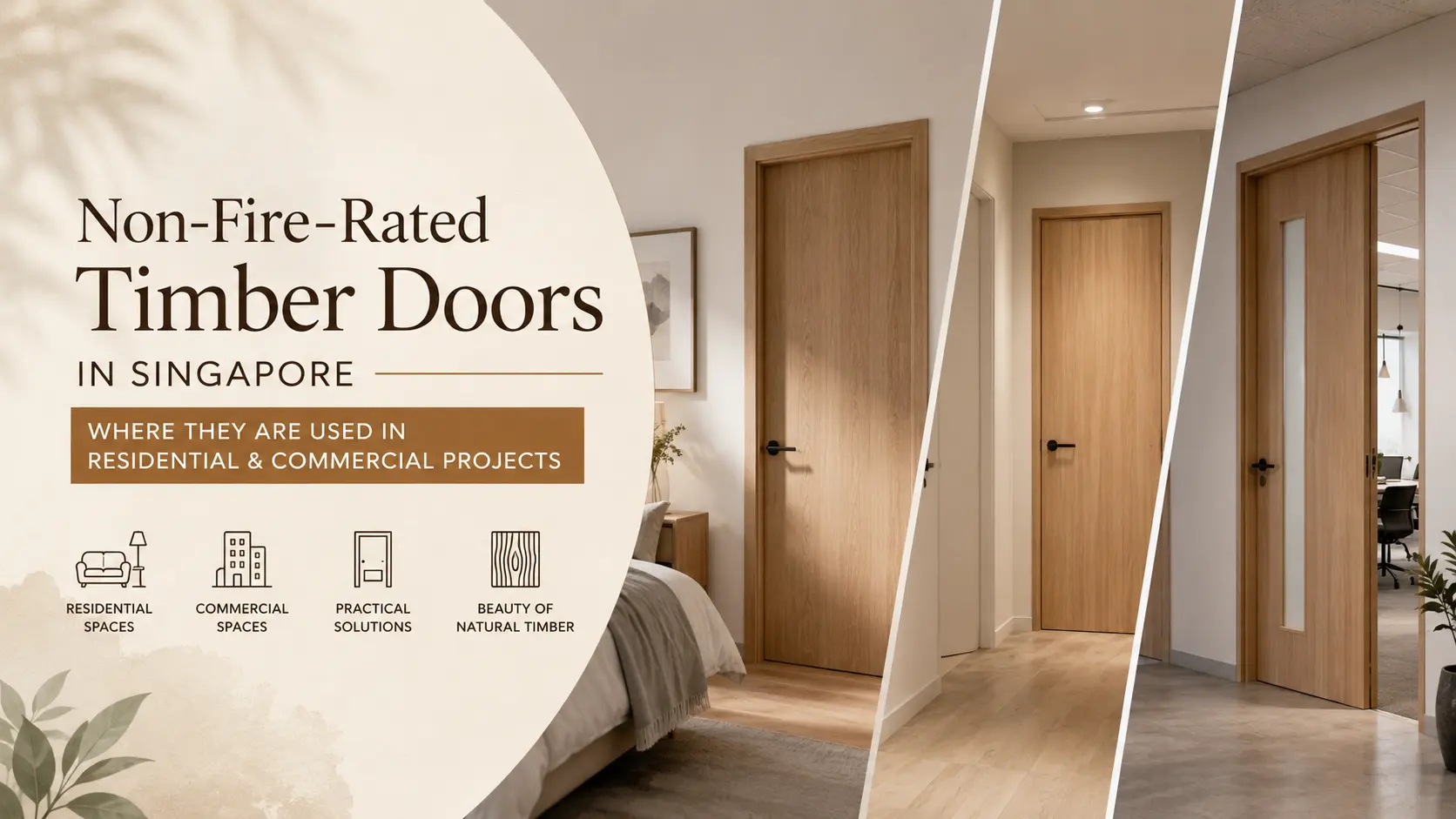
Non-Fire-Rated Timber Doors in Singapore:
Where They Are Used in Residential & Commercial Projects
Not every door in a building needs to be fire-rated. Bedroom doors, study room doors, internal partitions, and many commercial interior doors fall outside fire compartmentation requirements — and this is where standard, non-fire-rated timber doors are commonly and correctly specified across Singapore homes and businesses.
What Is a Non-Fire-Rated Timber Door?
A non-fire-rated timber door is a standard interior door constructed from solid timber, engineered timber, or timber-faced honeycomb/particleboard cores, without the certified fire-resistant core, intumescent seals, or tested frame assembly required of a fire door. These doors are designed primarily for privacy, acoustic separation, and aesthetic continuity within a space — not for containing fire or smoke for a defined duration.
In Singapore, the use of non-fire-rated timber doors is entirely appropriate and common in locations that fall outside the fire compartmentation requirements set out under the SCDF Fire Code. Recognising where these doors are suitable — and where a fire-rated door is instead mandatory — is one of the more practical pieces of knowledge a contractor, architect, or interior designer needs when planning a renovation or fit-out.
Why the Fire-Rated vs Non-Fire-Rated Distinction Matters
Fire compartmentation strategy in any building is based on identifying which areas need to be sealed off from fire spread — typically escape routes, staircase lobbies, service risers, and boundaries between different occupancy types. Doors within these compartment boundaries must be fire-rated. Doors that sit entirely within a single compartment — such as a bedroom door inside a residential unit — generally do not need to be.
| Factor | Fire-Rated Timber Door | Non-Fire-Rated Timber Door |
|---|---|---|
| Core material | Certified fire-resistant core (mineral board, calcium silicate) | Honeycomb, particleboard, solid timber, or engineered timber core |
| Seals | Intumescent and smoke seals required | No fire seals; may have standard acoustic or weather seals |
| Certification | Requires Certificate of Conformity (CoC) | No fire certification required |
| Door closer | Mandatory self-closing device | Optional; typically a standard lockset only |
| Typical location | Escape routes, staircase lobbies, service rooms | Bedrooms, studies, internal partitions, retail fitting rooms |
| Design flexibility | Limited by tested assembly scope | Greater flexibility in panel design, glazing, and finish |
Where They Are Used in Residential & HDB/BTO Projects
In Singapore's residential context — HDB flats, BTO units, condominiums, and landed homes — the vast majority of internal doors within a single dwelling unit are non-fire-rated timber doors. The main entrance door is typically the exception, as it usually forms part of the fire compartmentation between the unit and the common corridor.
- Most common application of non-fire-rated timber doors in HDB and BTO flats
- Prioritises acoustic privacy and finish consistency with the rest of the home
- Often selected to match overall interior design theme during renovation
- Increasingly specified in BTO renovations with work-from-home study rooms
- Sometimes specified with partial or full glazing for natural light transfer
- Solid-core options chosen where sound insulation for calls/meetings matters
- Lower-cost honeycomb or hollow-core doors typically sufficient
- Common in HDB flats for storeroom, service yard, and utility cupboard openings
- Timber doors with moisture-resistant treatment used where aluminium is not the preferred finish
- Distinct from toilet door material guides, which often favour aluminium for wet-area durability
- Used for space-saving in compact BTO layouts, particularly for study rooms and walk-in wardrobes
- Lightweight construction relies on track hardware rather than hinges
- Greater design freedom for solid timber, veneer, or custom panel detailing
- Often selected for higher-end finishes not constrained by fire-rated core requirements
Why BTO Owners and Renovation Contractors Choose Non-Fire-Rated Doors for These Areas
- Design flexibility: A wider range of panel styles, glazing options, louvres, and finishes are available compared to certified fire door assemblies.
- Cost efficiency: Non-fire-rated doors generally involve simpler core construction and are more straightforward to produce in custom sizes for irregular BTO door openings.
- Lighter weight: Hollow-core and honeycomb-core doors are easier to handle during installation and place less load on standard residential door hinges and frames.
- Faster lead times: Without the certification documentation and tested component matching required for fire doors, production and replacement timelines are typically shorter.
Where They Are Used in Commercial Projects
In commercial settings, non-fire-rated timber doors serve similar privacy and aesthetic functions, applied within the parts of a building's layout that sit outside the fire safety plan's compartmentation requirements.
Office Meeting & Manager Rooms
Internal office doors not adjoining a fire-rated corridor or escape route are typically specified as standard timber doors, often with glazed vision panels for an open-plan aesthetic.
Retail Fitting Rooms
Boutique and retail fit-outs commonly use lightweight timber doors or swing panels for fitting rooms, where fire compartmentation is not typically a design requirement.
Salon & Spa Treatment Rooms
Privacy-focused internal doors for treatment and consultation rooms, often specified with acoustic considerations and a finish that matches the overall interior brand identity.
Hotel Guestroom Wardrobes & Bathrooms
Internal doors within a guestroom — wardrobe doors, en-suite bathroom doors — are generally non-fire-rated, distinct from the guestroom corridor entrance door which is typically part of the fire compartmentation strategy.
F&B Front-of-House Partitions
Decorative or semi-private partition doors between dining zones, distinct from kitchen-to-dining fire doors which fall under separate compliance requirements.
Show Flats & Sales Galleries
Showroom and sales gallery interiors often use non-fire-rated doors to demonstrate finish options, as these temporary or semi-permanent structures typically fall outside standard fire compartmentation requirements.
Architects and interior designers working on commercial fit-outs should always cross-reference the project's approved fire safety plan before finalising the door schedule. A space that appears to be a simple internal partition may, depending on the building's occupancy classification and escape route layout, still require a fire-rated door — particularly in buildings with mixed-use zoning or specific occupancy load thresholds.
Materials & Construction Types
Non-fire-rated timber doors are available in a range of core constructions, each suited to different performance and budget requirements.
Common Core Types
- Hollow-core (honeycomb) doors: A lightweight kraft paper honeycomb structure sandwiched between thin timber-veneered or laminate facings. Cost-effective and widely used for bedroom, study, and storeroom doors in HDB and BTO flats.
- Solid-core engineered timber doors: A denser particleboard or engineered timber core providing better acoustic insulation and a more substantial feel, often chosen for study rooms, home offices, and higher-specification residential renovations.
- Solid timber doors: Constructed from genuine timber staves or laminated timber sections, typically reserved for landed properties or premium commercial interiors where the natural grain and weight of solid wood are part of the design intent.
- Engineered stile-and-rail doors: A framed construction with timber stiles and rails surrounding infill panels (solid, glazed, or louvred), commonly used in both residential and commercial interiors for a more architectural appearance.
Common Facing & Finish Options
- Melamine-faced finishes — durable, available in a wide colour and texture range, low maintenance
- Timber veneer finishes — natural wood grain appearance over an engineered core
- Laminate finishes — practical for high-traffic commercial applications
- Painted timber finishes — common in landed homes and premium commercial fit-outs
- Glazed panel inserts — frosted, clear, or patterned glass for partial light transfer in study rooms, offices, and retail interiors
- Louvred panel sections — used where ventilation is needed, such as storeroom or utility doors
Features to Consider When Specifying
Beyond material selection, several functional features influence how well a non-fire-rated timber door performs in its intended location.
- ✔Acoustic performance: Solid-core or stile-and-rail doors with proper perimeter seals reduce sound transfer better than basic hollow-core doors — relevant for study rooms, home offices, and commercial meeting rooms.
- ✔Moisture resistance: Doors near bathrooms, kitchens, or balcony-adjacent areas benefit from moisture-resistant core treatment or laminate facings to reduce swelling in Singapore's humidity.
- ✔Door swing direction and clearance: Particularly relevant in compact BTO layouts, where swing doors may conflict with furniture placement — sliding or pocket door alternatives are often considered at this stage.
- ✔Hardware compatibility: Lockset, hinge, and handle specifications should match the door's core density — hollow-core doors require reinforced blocking at hinge and lock points to prevent long-term hardware loosening.
- ✔Ventilation requirements: Storeroom and utility doors may need louvred sections or undercuts to support airflow, particularly where the space houses water heaters or electrical equipment.
- ✔Visual continuity: Interior designers typically specify door finishes that align with the unit or premises' overall material palette — particularly relevant in show flats and premium commercial interiors.
Installation Guidance
While non-fire-rated timber doors do not carry the strict assembly-matching requirements of fire-rated doors, proper installation practice still affects long-term performance, especially in Singapore's climate conditions.
- Frame squareness: Confirm the door frame opening is plumb and square before installation. Renovation works in older HDB flats sometimes reveal settled or slightly out-of-square openings that require packing or adjustment.
- Hinge positioning: Three hinges are generally recommended for solid-core or taller doors to prevent warping over time, compared to two hinges typically sufficient for lightweight hollow-core doors.
- Gap allowance: A small, consistent gap (typically a few millimetres) around the door perimeter allows for natural timber movement due to humidity changes without the door binding against the frame.
- Threshold and floor clearance: Adequate clearance at the floor should be maintained, particularly where flooring materials change between rooms (e.g. timber flooring to tiled bathroom flooring).
- Sealing edges before installation: For solid timber and engineered timber doors, sealing all six faces (including top and bottom edges) before installation helps prevent uneven moisture absorption that can lead to warping.
Maintenance in Singapore's Climate
Singapore's consistently high humidity and occasional large day-to-night temperature swings (particularly with air-conditioning use) place ongoing demands on timber doors. While non-fire-rated doors do not require the seal and label inspections mandated for fire doors, routine care still extends their service life and appearance.
- Wipe down door surfaces regularly with a dry or slightly damp cloth — avoid excessive moisture on veneer or laminate finishes.
- Check hinge screws periodically, particularly on frequently used bedroom and study doors, and tighten or re-plug as needed.
- Monitor for slight swelling or sticking during the wetter months, which may indicate the need for minor edge planing or improved ventilation in the room.
- Avoid prolonged direct sunlight exposure on timber veneer finishes, which can cause uneven fading over time — relevant for doors near glazed balcony areas.
- Reapply protective sealant or varnish on solid timber doors every few years, particularly in landed homes where doors may be more exposed to environmental conditions.
- Address any water staining near the door base promptly, as prolonged moisture exposure at the bottom edge is a common cause of core degradation in hollow-core and engineered timber doors.
Frequently Asked Questions
Do bedroom doors in HDB flats need to be fire-rated?
Generally, no. Bedroom doors within a single HDB unit are internal doors that sit entirely within one fire compartment and typically do not require fire rating. The main entrance door of the unit, which forms the boundary between the unit and the common corridor, is the door most likely to require fire-rated specification. Always check the unit's approved layout or consult the relevant authority if there is uncertainty about a specific door's classification.
Can I replace a non-fire-rated internal door without a renovation permit?
For HDB flats, most internal, non-structural door replacements (bedroom doors, storeroom doors) are considered minor renovation works, though specific permit requirements can vary depending on the scope of works and whether other renovation activities are being carried out simultaneously. It's advisable to check current HDB renovation guidelines or consult your renovation contractor before proceeding, particularly if the renovation also involves changes to walls, electrical points, or plumbing near the door location.
What is the typical lifespan of a non-fire-rated timber door in Singapore?
With proper installation and routine maintenance, hollow-core and engineered timber doors typically last 10 to 15 years in residential settings before facing or hardware wear becomes noticeable. Solid timber doors, particularly in landed homes, can last considerably longer — often 20 years or more — provided they are periodically resealed or repainted and protected from prolonged moisture exposure.
Are glazed timber doors suitable for use in commercial offices in Singapore?
Yes, glazed timber doors are commonly used in commercial office fit-outs for meeting rooms, manager's offices, and internal partitions where an open, transparent aesthetic is desired alongside acoustic separation. These doors are typically non-fire-rated unless the office layout requires the door to form part of a fire-rated corridor or escape route boundary, in which case a fire-rated glazed door assembly with a valid Certificate of Conformity would be required instead.
How do I know if a specific door location in my renovation project requires fire rating?
The building's approved fire safety plan, prepared by the project's Qualified Person (Fire Safety), identifies which doors form part of the fire compartmentation strategy. For HDB flats, this is generally limited to the main entrance door. For commercial and mixed-use developments, the fire safety plan should be consulted, as requirements vary based on occupancy type, escape route layout, and building classification. When in doubt, contractors and interior designers should verify with the building's management or the appointed QP before finalising door specifications.
Can a non-fire-rated timber door be upgraded to a fire-rated one later?
Not by retrofitting fire-rated components onto an existing non-fire-rated door. Fire rating is a property of a complete, tested assembly — door leaf, frame, seals, and hardware together — verified through laboratory testing and documented in a Certificate of Conformity. A non-fire-rated door cannot simply have seals or hardware added to achieve a fire rating; the entire door and frame assembly would need to be replaced with a certified fire-rated product if that location's requirements change.
What's the difference between hollow-core and solid-core non-fire-rated doors, and which should I choose?
Hollow-core doors use a lightweight honeycomb structure and are more economical, making them suitable for low-traffic areas like storerooms or where budget is a primary consideration. Solid-core doors use a denser engineered timber or particleboard core, offering better acoustic insulation and a more substantial feel — generally preferred for bedrooms, study rooms, and home offices where sound privacy is more important. The choice often comes down to balancing budget against the acoustic and durability needs of the specific room.
Conclusion
Non-fire-rated timber doors occupy a practical and necessary place in Singapore's residential and commercial building landscape. They are the right choice for the great majority of internal doors — bedrooms, study rooms, storerooms, office partitions, and retail interiors — where fire compartmentation is not a regulatory requirement, allowing for greater material flexibility, simpler installation, and finishes that align with broader interior design intentions.
For renovation contractors and interior designers, the key practical step is always confirming a door's position relative to the building's fire safety plan before finalising specifications — ensuring non-fire-rated doors are used appropriately, while fire-rated doors remain correctly specified at compartment boundaries, escape routes, and unit entrances. With that distinction clearly understood, project teams can confidently select timber door materials and finishes suited to comfort, acoustics, and design, while staying aligned with the relevant compliance framework where it applies.
Proper installation practices and routine maintenance — particularly attention to humidity-related movement in Singapore's climate — further ensure these doors perform reliably and retain their appearance over the long term, whether in a BTO flat, a landed home, or a commercial fit-out.




Leave A Comment