
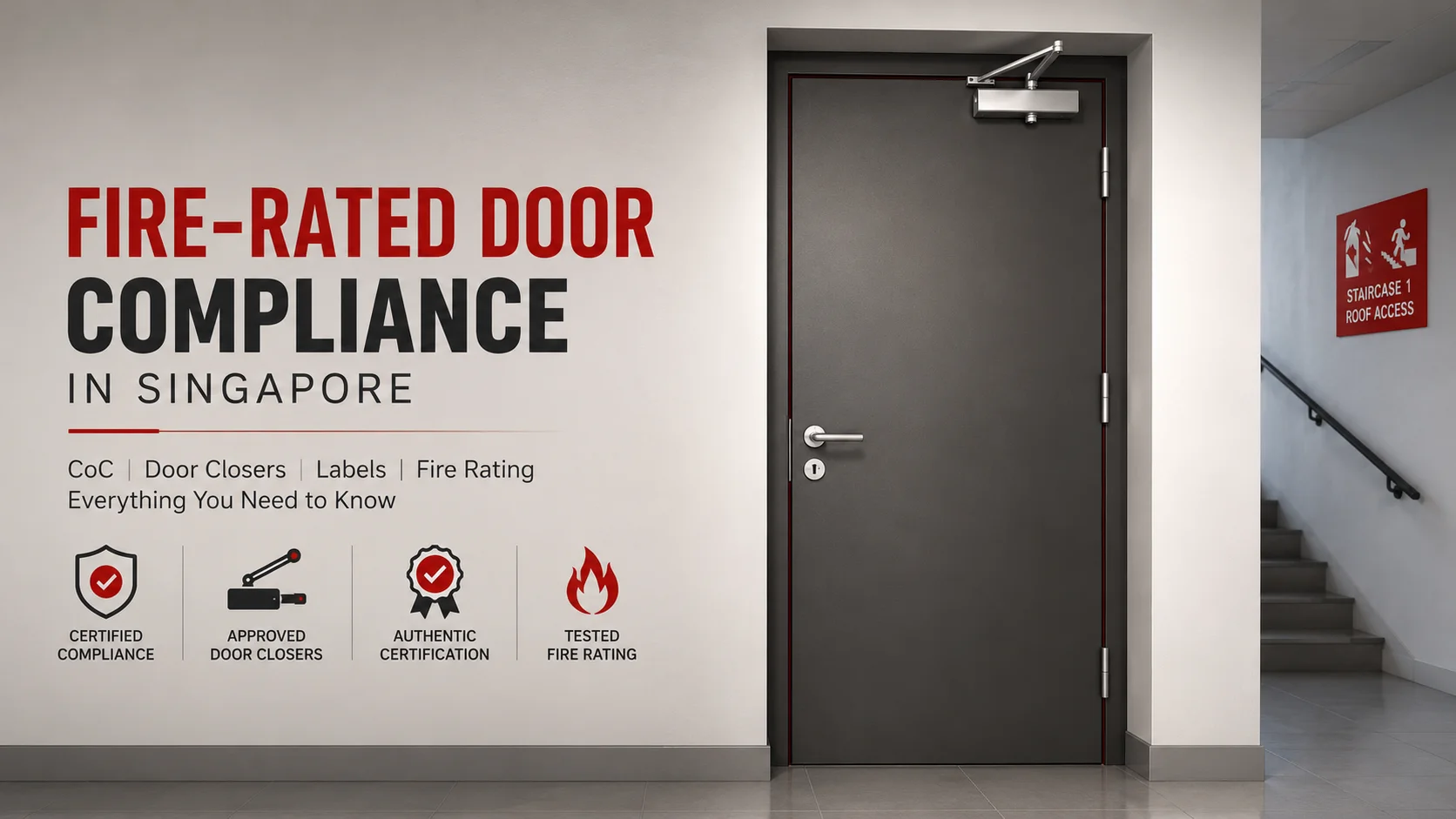
Fire-Rated Door Compliance in Singapore:
CoC, Door Closer, Labels & Fire Rating Explained
Specifying, procuring, and installing a fire-rated door in Singapore involves far more than selecting a door leaf. The Certificate of Conformity, the door closer type, the compliance label, and the full assembly configuration must all align — or the door may fail an SCDF inspection regardless of its appearance.
The Certificate of Conformity (CoC): What It Actually Documents
The Certificate of Conformity — commonly abbreviated as CoC — is the primary compliance document for fire-rated doors in Singapore. It is issued by an accredited third-party testing body following a fire resistance test conducted in a controlled laboratory setting under standardised fire exposure conditions, using either BS 476 Part 22 or EN 1634-1.
Understanding what a CoC actually records is essential for anyone specifying or procuring fire doors for Singapore projects. It is not simply a pass/fail certificate for a door leaf. It is a precise technical record of a specific, tested assembly configuration — and any deviation from that configuration on-site may invalidate the rated performance.
What a CoC Records in Detail
🗂 Anatomy of a Fire Door Certificate of Conformity
CoC in the Project Workflow: QPs, Contractors & Permit Submissions
In Singapore's construction and renovation ecosystem, the CoC touches multiple stakeholders at different stages of a project. Understanding the document flow prevents last-minute compliance gaps at inspection.
-
QP (Fire Safety) Specification Stage The Qualified Person for fire safety specifies the required fire rating for each door location in the approved fire safety plan. The CoC reference — or at minimum the required rating and standard — is noted in the door schedule submitted to SCDF or BCA.
-
Contractor Procurement Stage The main contractor or nominated subcontractor procures fire doors from a manufacturer or supplier. Before placing an order, the contractor must verify that the supplier's CoC covers the exact door configuration, size range, and hardware specified in the project schedule.
-
Supplier Documentation Handover The fire door supplier issues the CoC (or a certified copy) alongside delivery. This document must be retained on-site and presented to inspectors. For HDB projects, the CoC is also required for the renovation permit submission.
-
Installation & Configuration Check During installation, the contractor must verify that every component — frame, seals, closer, hinges — matches the CoC. Any substitution requires written confirmation from the door manufacturer that the substitute falls within an approved equivalent range.
-
SCDF Inspection / TOP Submission During the SCDF fire safety inspection (or QP certification for smaller projects), the inspector verifies that installed doors match the CoC on file. Missing documentation or mismatched components are among the most common causes of inspection failures.
-
Post-Handover Record Retention Building owners and MCSTs should retain CoC documents for the life of the fire door installation. These records are required during annual fire safety inspections and any future A&A works affecting the fire-rated wall or door assembly.
Reading a Fire Door Label: Field Verification Guide
Every certified fire door manufactured under a valid CoC must carry a permanent certification label — typically a metal plug or adhesive label affixed to the top rail or hinge edge of the door leaf. This label is the on-site proxy for the full CoC document and is the first thing an SCDF inspector or facilities manager checks during an inspection.
Certification Body Logo
The mark of the accredited third-party certification authority that audits the manufacturer's factory production and holds the CoC on record. In Singapore, common marks include BWF Certifire (UK), Intertek, and SAC-accredited local certifiers.
Fire Rating Mark
e.g. FD30, FD60, FD120. This refers to the tested fire resistance period in minutes. Some labels also include an "S" suffix (e.g. FD30S) indicating the door also carries smoke resistance performance.
Certificate / Licence Number
A unique alphanumeric reference traceable to the specific CoC held by the testing or certification body. This allows inspectors and QPs to verify the certificate against the body's register.
Manufacturer & Factory Code
Identifies the licensed manufacturer and, in some cases, the specific production facility. This traceability confirms the door was made under an active licensed production scheme, not simply stamped with a third-party certificate.
Common Label Problems Found During Inspections
- Painted over: Labels hidden under layers of paint from building repainting cycles — a very common finding in older HDB blocks and commercial buildings undergoing renovation.
- Missing or removed: Labels removed during door refurbishment or after a door leaf was replaced with a non-certified alternative.
- Illegible due to humidity damage: Paper-based labels in high-humidity environments (kitchens, carparks, toilets) may degrade over time. Metal plugs are the more durable alternative.
- Mismatched label and door: A certified label on a door that has been structurally modified — planked down, vision panel added without CoC coverage, or seals replaced with incorrect type — does not make the door compliant.
Fire Rating — What the Number Really Means on Site
The fire rating number — 30, 60, 90, or 120 minutes — is widely understood as a duration, but the practical implications of that number on a Singapore construction or renovation project go beyond simply picking a higher number for better protection.
What the Fire Resistance Test Actually Measures
Under BS 476 Part 22 and EN 1634-1, the fire door assembly must demonstrate three performance criteria during the test period:
- Integrity (E): No through-cracks, holes, or gaps that allow flames or hot gases to pass. The door must remain in its frame and structurally intact.
- Insulation (I): The temperature on the unexposed face of the door must not rise above specified thresholds — protecting occupants and materials on the exit side from radiant heat.
- Radiation (W): In some standards and applications, radiant heat flux from the door surface must remain below levels that could ignite combustible materials nearby.
A door labelled FD60 has maintained all applicable criteria for 60 continuous minutes under standardised furnace conditions reaching over 900°C. That 60-minute window is what SCDF's fire compartmentation strategy relies on to allow safe evacuation and emergency response before the barrier fails.
Rating vs. Specification: The Common Mismatch
A fire rating on a label does not override the CoC. If a door leaf is rated FD60 but the CoC specifies a steel frame with mineral wool packing, installing the same leaf in a timber frame is not compliant — even though the leaf rating remains valid. The rating is a property of the tested assembly, not of individual components in isolation. This distinction matters enormously in Singapore's renovation and fit-out context, where frames are often sourced separately from door leaves.
Door Closer Compliance: Types, Specifications & Common Mistakes
The door closer is one of the most frequently mishandled elements of a fire door installation in Singapore — both at the specification stage and during ongoing building management. It is also one of the most common non-conformances found during SCDF inspections.
Why the Door Closer Is Non-Negotiable
A fire door held open — whether by a doorstop, a brick, or simply an inoperative closer — provides zero fire compartmentation. SCDF and BCA regulations require that all fire-rated doors be fitted with a self-closing device that reliably returns the door to the fully closed and latched position after every use. This applies to doors in commercial buildings, staircase lobbies, residential common areas, and HDB main entrance doors alike.
Types of Door Closers and Their Project Applications
Surface-Mounted Overhead Closer Most Common
- Fixed to the top of the door leaf and frame
- Visible arm mechanism — functional and easy to adjust
- Suitable for commercial, industrial, and HDB applications
- Cost-effective; widely available; straightforward maintenance
- Must match the closer model listed in the CoC
Concealed Overhead Closer Architectural
- Recessed fully into the door leaf or top rail
- No visible mechanism — preferred for hospitality and high-end commercial interiors
- Higher cost; requires precise routing during door manufacturing
- Must be specified during door manufacturing, not retrofitted
- CoC must explicitly list the concealed closer model
Floor Spring Closer Heavy Doors
- Installed in the floor below the door pivot point
- Used for heavy single-leaf or double-leaf fire doors in lobbies and entrances
- Provides superior control for large, heavy door assemblies
- Installation requires coordination with structural slab work
- Common in hotel main lobbies and large commercial entrances
Electromagnetic Hold-Open High-Traffic Zones
- Holds the fire door open during normal building operations
- Releases automatically upon fire alarm activation — door closes under spring tension
- Linked to the building's fire alarm system (BAS integration required)
- Requires annual functional testing as part of fire alarm system maintenance
- Common in hospital wards, school corridors, and large office common areas
Door Closer Specification Mistakes to Avoid
- ✖Substituting a non-listed closer model without approval. Replacing a failed closer with a "similar" model not listed in the CoC or without manufacturer equivalency confirmation technically voids the assembly's certification.
- ✖Adjusting closing speed to the point the door fails to latch. A common comfort adjustment made by building occupants — but a door that swings shut and does not latch is not a closed fire barrier.
- ✖Installing a hold-open device without fire alarm integration. Wedges, hooks, or non-electromagnetic hold-open arms used on fire doors are a direct regulatory breach under the Fire Safety Act.
- ✖Removing a closer during renovation and not reinstating it. A fire door with a removed closer is non-compliant from the moment the closer is detached. Renovation works on or near fire doors must include temporary measures to maintain the self-closing function.
- ✖Specifying a closer rated for a lighter door class. Closers are rated by door weight and width. An under-specified closer will not reliably return a heavy fire door to the closed position under all conditions, particularly in high-air-pressure staircase lobbies.
Why the Full Assembly — Not Just the Door Leaf — Must Match the CoC
One of the most persistent misconceptions encountered in Singapore's renovation and fit-out sector is the belief that a certified fire door leaf can be installed with any frame, any hinges, and any closer, as long as the leaf itself carries a valid label. This is incorrect — and it is a position that will not hold up during an SCDF inspection.
A fire door certificate covers a specific, complete assembly. Each component contributes to the overall fire resistance performance:
Door Leaf Core
Provides the primary thermal barrier. Cutting down, planing, or adding apertures (letterboxes, vision panels) beyond the CoC scope affects the core's protective capacity.
Door Frame
The frame anchors the door in the wall opening and forms part of the fire seal perimeter. A non-certified frame type — even with a certified door leaf — creates a weak link the fire can exploit.
Intumescent Seals
Seals must be the exact product specified in the CoC, in the specified location and profile. Substituting with a thinner or narrower seal — or omitting a cold smoke seal where one is specified — leaves a gap at operating temperatures before intumescent expansion activates.
Hinges & Locks
Standard residential-grade hinges are not rated for fire conditions. The CoC specifies the hinge type, quantity, and vertical positioning. Non-certified hinges can fail structurally under heat, causing the door to drop and gap before the rated period expires.
Commercial Project Considerations: Glazed Panels, Electromagnetics & Double-Leaf Doors
Commercial, institutional, and mixed-use projects in Singapore often involve fire door configurations that go beyond the standard single-leaf residential door. Each variation introduces specific compliance considerations.
Fire-Rated Glazed Vision Panels
Incorporating a vision panel into a fire-rated door is permissible — but only if the glazing is explicitly covered within the CoC for that door assembly. Key constraints include:
- Fire-rated glass must be specified by product name and type in the CoC — standard float glass or wired glass will not maintain the door's rating.
- The maximum glazed area is fixed in the certificate. Exceeding this area requires a separate test or an extended field of application (EFA) report.
- Glazing beads must be fire-rated components, listed in the CoC. Standard timber or aluminium beads are not acceptable.
- Vision panels cannot be added to a door after manufacture unless the modification is covered by the existing CoC or supported by a new assessment.
Double-Leaf Fire Doors
Double-leaf fire door assemblies — commonly used for loading bays, hospital corridors, and main commercial entrances — are among the more complex fire door configurations to specify correctly. The critical compliance points are:
- The CoC must explicitly cover the double-leaf configuration. A certificate for a single-leaf assembly does not automatically extend to a double-leaf installation.
- The meeting stile (where the two leaves meet at the centre) requires specific intumescent and smoke seal treatment — this is detailed in the CoC and is not a matter of contractor judgment on site.
- Coordinator sets (door sequence controllers) may be required to ensure the correct leaf closes first and the second closes against it, maintaining seal continuity.
Electromagnetic Hold-Open Systems in Commercial Buildings
For high-footfall commercial buildings — shopping malls, hospitals, schools — electromagnetic hold-open closers allow fire doors to remain open during normal operations while guaranteeing closure upon fire alarm activation. Their compliance requirements include:
- The electromagnetic device must be integrated with the building's fire detection and alarm system by a licensed electrical engineer.
- The system must be tested annually as part of the building's fire alarm maintenance regime.
- Signage indicating "Fire Door — Keep Shut" is still required on the door even when an electromagnetic hold-open is fitted, as the door must be capable of manual closure if the electromagnetic release fails.
HDB & BTO Context: When Compliance Gets Complicated
For contractors and interior designers working on HDB resale flats and BTO renovation projects, fire door compliance introduces a specific set of challenges that differ from commercial project workflows.
The most common complication arises when a flat owner wishes to replace the standard HDB-issued main door — which may be a plain fire-rated steel or timber door — with a more aesthetically refined alternative. This is entirely permissible under HDB's renovation guidelines, provided:
- The replacement door carries a CoC for an equivalent or higher fire rating to the original.
- A valid HDB renovation permit is obtained before installation begins.
- The full assembly — including frame, seals, and door closer — matches the replacement door's CoC.
- The installation is carried out by an HDB-registered renovation contractor.
Where complications arise most frequently is in older resale flats where previous owners have replaced the original fire door with a non-certified alternative — sometimes an attractive timber door without any fire rating. The current owner and their renovation contractor inherit a non-compliant door that must be rectified before further renovation works can be properly permitted.
Frequently Asked Questions
What is the difference between a CoC and a fire test report?
A fire test report is the raw output of a laboratory fire resistance test — it records the exact conditions and results of the test but refers only to the specific prototype tested. A Certificate of Conformity (CoC) is issued separately by a certification body and certifies that a manufacturer's production doors conform to the tested design. The CoC covers a defined range of sizes and configurations based on the test report data. For regulatory purposes in Singapore, the CoC — not the test report alone — is the document required by SCDF and BCA.
Can a fire door CoC from the UK or Europe be used for a Singapore project?
Yes, provided the CoC was issued by an accredited testing and certification body under BS 476 Part 22 or EN 1634-1, both of which are accepted standards under Singapore's fire code. Certificates from bodies such as Warrington Certifire, Intertek, BM Trada, and Efectis are generally accepted. However, the Qualified Person and SCDF retain the right to request additional evidence or an assessment if the certificate scope or configuration does not clearly match the project's installation conditions.
Can I add a digital lock or smart lock to a fire-rated door without affecting the CoC?
This depends entirely on what the CoC specifies for the door's hardware. If the existing CoC already lists the specific digital lock model or covers an approved range of locks, then fitting that lock is compliant. If the CoC specifies a different lock or latch type, adding a digital lock that is not listed or not covered by an approved equivalent assessment technically modifies the assembly beyond the certificate's scope. For HDB doors, any lock change on a fire-rated main door should be discussed with the door manufacturer and the CoC checked first.
How do I know if my existing fire door closer is still compliant after a few years of use?
A door closer remains functionally compliant as long as it reliably closes and fully latches the door without manual assistance, operates smoothly without fluid leaks, and is the model (or an approved equivalent) listed in the door's CoC. Over time, closer hydraulic fluid can degrade, seals can leak, and the closing speed may become inconsistent. Annual servicing by a qualified ironmongery or fire door specialist is the recommended approach for commercial buildings. For HDB residential doors, check the closer at least annually and replace it if it fails to reliably latch the door.
Does painting a fire-rated door affect its compliance?
Painting a fire door is generally permissible, with two important caveats. First, the CoC must be checked to confirm that the facing material and finish type covered in the certificate are consistent with the paint being applied — some certificates restrict finishing materials. Second, paint must never be applied over the intumescent seals or the certification label. Paint on intumescent seals can prevent them from expanding as designed during a fire event. Painting over the certification label makes it illegible, which creates problems during inspections even if the door itself remains compliant.
What happens to a fire door's CoC if the manufacturer goes out of business?
The CoC itself remains valid as a document recording what was tested. If a manufacturer ceases operations, the fire door assembly already installed remains compliant as long as it continues to match the tested configuration and is properly maintained. The practical challenge arises when replacement components (seals, hinges, closers) are needed and the original manufacturer can no longer confirm equivalent replacements. In this scenario, engage a fire door specialist to conduct an assessment of available replacement components against the original CoC specifications.
Is there a difference in door closer requirements for a staircase lobby fire door versus an HDB main door?
The principle is the same — both require a functioning self-closing device that reliably returns the door to the fully closed and latched position. However, staircase lobby fire doors in commercial buildings typically face more demanding conditions: higher door frequency of use, higher door weights, and the additional challenge of stack effect pressure differentials in high-rise buildings that can work against door closure. For staircase lobbies, a closer with a higher EN grade (e.g. EN 1154 size 4 or higher) may be specified compared to a lighter-duty closer on a residential main door. Always defer to the CoC for the closer specification.
Can fire doors in commercial fit-outs be specified with a flush, paint-finish look rather than a steel industrial appearance?
Yes. Timber fire doors with flush laminate or painted finishes are widely used in commercial fit-outs across Singapore — offices, hotels, service apartments, and retail developments. These doors achieve the required fire rating (typically FD30 or FD60) with a finish that is architecturally compatible with interior design schemes. The key is to specify the finish as part of the CoC-covered assembly from the outset, rather than specifying the door and applying a non-certified finish later. Fire-rated timber flush doors with selected laminate or veneer finishes are available from Singapore manufacturers with the appropriate CoC coverage.
Conclusion
Fire-rated door compliance in Singapore sits at the intersection of regulatory obligation, technical specification, and day-to-day building management. The Certificate of Conformity is the foundation — a precise document that defines a specific tested assembly, not just a door leaf. The door closer is the most operationally critical component — without it, the fire door's compartmentation purpose is nullified the moment it is propped open. The certification label is the field verification tool that confirms an installed door matches what the CoC says it should be.
For architects and QPs specifying fire doors, the discipline of referencing CoC numbers in door schedules — and reviewing those CoCs before signing off on procurement — is the single most effective safeguard against compliance failures at inspection. For contractors installing fire doors, treating the full assembly — not just the leaf — as the unit of compliance avoids the component-mismatch problems that generate rectification notices. For facilities managers and MCSTs, maintaining fire doors in the condition they were installed in — with seals intact, labels legible, and closers operational — is both a legal duty and a genuine life-safety function.
The questions covered in this article — around CoC scope, label verification, closer types, double-leaf configurations, and the complications that arise in HDB renovation contexts — are the practical, day-to-day challenges that Singapore's construction and facilities management community encounters. Getting them right ensures that when fire protection is needed, the door performs as designed.




Leave A Comment