
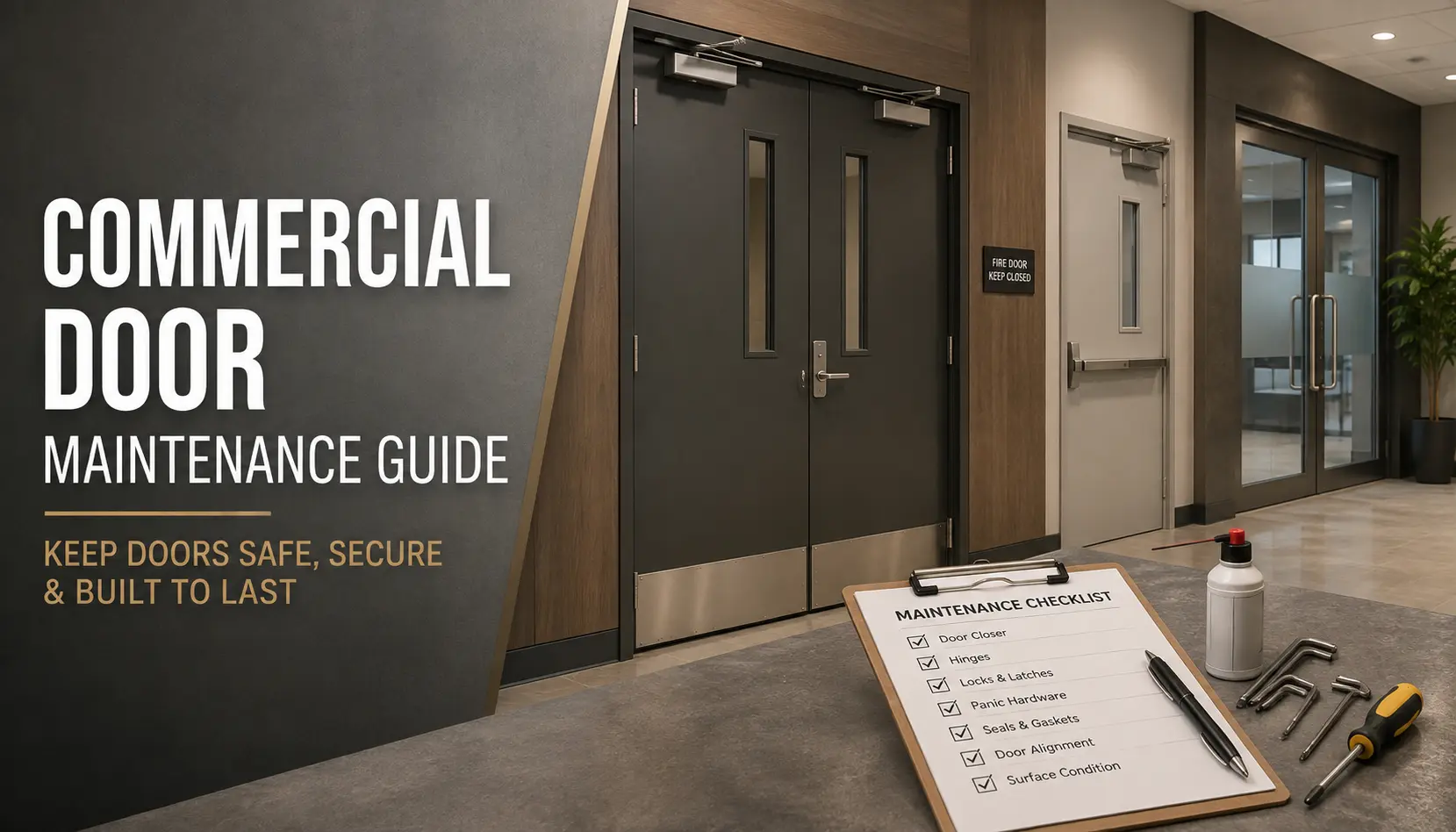
Door Manufacturing · Facility Maintenance
Commercial Door Maintenance in Singapore: A Guide to Hinges, Closers, Locks, Seals and Frame Checks
A practical reference for facility managers, contractors and commercial property teams planning routine door hardware maintenance in Singapore's tropical, high-traffic building environment.
Quick Answer
Commercial door maintenance in Singapore generally covers five areas: hinge lubrication and alignment, door closer speed and latching checks, lock and digital lock function tests, seal and weatherstrip condition, and frame squareness and fixing integrity. Frequency depends on traffic volume, door type and whether the door is fire-rated, since fire doors carry additional self-closing and compartmentation requirements under Singapore's fire safety framework.
Commercial buildings in Singapore put doors through more daily cycles, more humidity exposure and more hardware wear than most residential doors will ever see. A staircase lobby door in an office tower, a service corridor door in a hotel, or a plant room door in a hospital may open hundreds of times a day. Commercial door maintenance in Singapore is the routine work of keeping those doors, and their hinges, closers, locks, seals and frames, in reliable working condition throughout the building's operating life.
This guide is written for facility managers, building owners, contractors and property teams who are planning or reviewing a door maintenance programme. It sets out what to check, how often, and which checks relate to fire safety obligations versus general good practice.
Key Takeaways
- Hinges, closers, locks, seals and frames each fail in different ways and on different timelines, so a single blanket maintenance interval rarely suits every door.
- Door closers on fire-rated doors carry a specific self-closing and latching function that inspectors treat as a compartmentation issue, not just a hardware convenience.
- Digital locksets fitted to fire-rated doors must be fire-resistance certified with effect from 1 March 2024; this applies separately from general lock servicing.
- Frame condition is often the first sign of a deeper problem, since a misaligned frame will keep undoing hinge and closer adjustments until it is corrected.
- Not every maintenance task is a regulatory obligation; some are manufacturer guidance or good facility practice, and this guide distinguishes between the two.
What Commercial Door Maintenance Covers
Commercial door maintenance is broader than oiling a squeaky hinge. A door assembly in an office, retail, hotel, hospital, school or industrial setting is made up of several systems that each need attention: the leaf, the hinges that carry its weight, the closer that controls its swing, the lock or digital lock that secures it, the seals that manage smoke, sound or weather, and the frame that holds everything square. A maintenance programme walks through each system on a set interval rather than waiting for a visible fault.
Fire-rated doors add a compliance dimension. A fire door is only as effective as its complete, tested assembly, so hardware substitutions or a disabled closer can affect how it performs. Project teams can review HongRui's guide to fire-rated door compliance, closers and labelling for how the Certificate of Conformity and door closer requirements interact at specification stage.
Why It Matters in Singapore
Singapore's climate and building density create specific pressure points. Year-round humidity causes timber leaves to expand and contract, accelerates corrosion on unprotected metal hardware, and softens seal adhesives over time. High-traffic premises, such as shopping complexes, hospitals, schools and hotel back-of-house corridors, also put mechanical stress on hinges and closers that residential doors rarely see.
There is a regulatory backdrop too. Under the Fire Safety Act 1993, certain public buildings, industrial premises and other qualifying developments must hold a Fire Certificate, and SCDF requires such buildings to be inspected annually to maintain their fire protection systems. Door maintenance sits within this framework where the door forms part of the building's fire compartmentation, such as staircase lobby and riser doors. Where a door is not fire-rated and the building holds no Fire Certificate, hardware upkeep is generally manufacturer guidance and good facility practice rather than a statutory inspection regime.
Hinges: Inspection and Maintenance
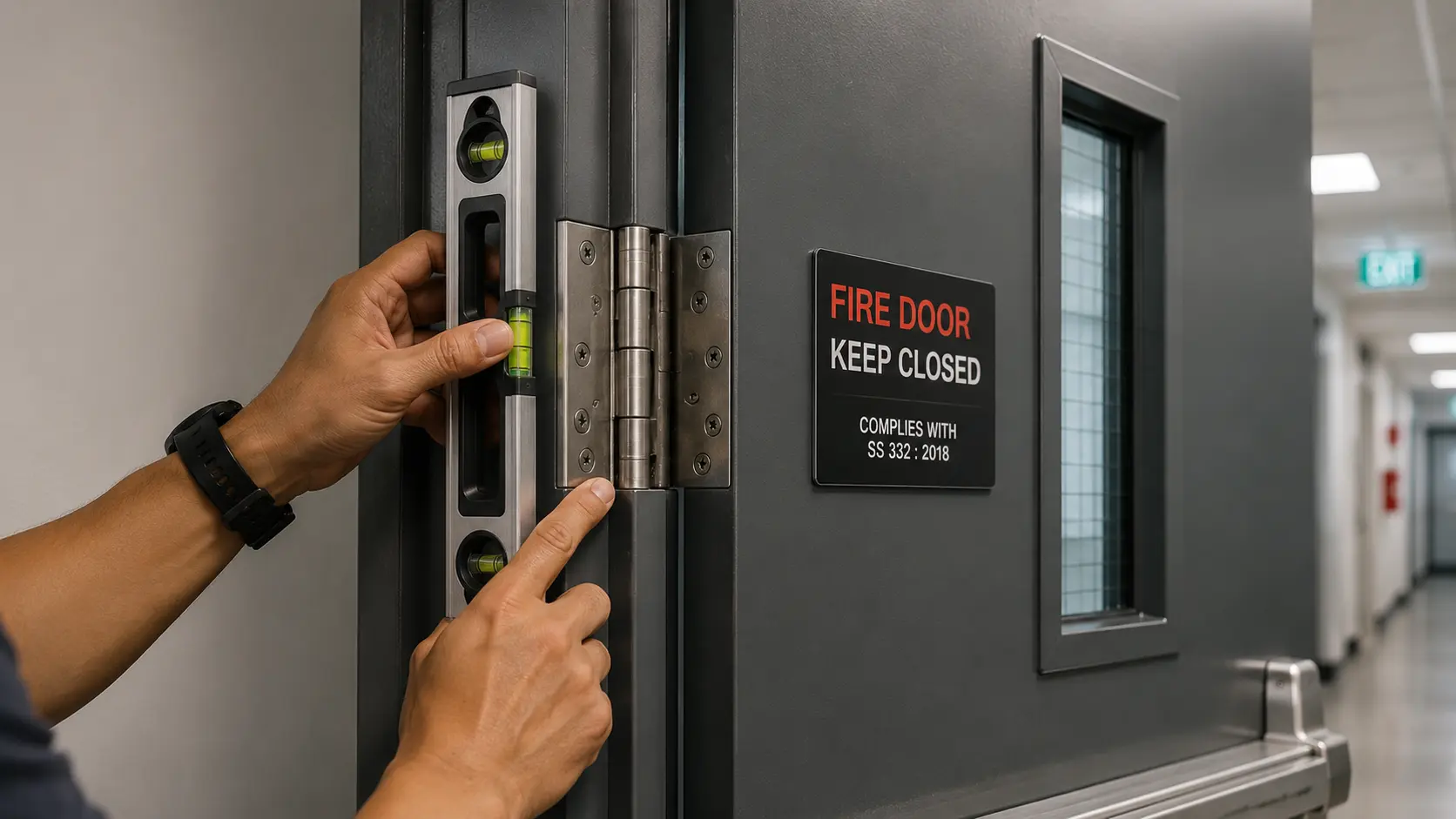
Hinges carry the full weight of the door leaf, which makes them one of the first components to show wear. Sagging, a door that no longer closes flush, or a metallic squeal are usually hinge symptoms before anything else.
- Check for play and wear. Lift the door slightly at the handle side while open; noticeable movement at the pin usually means it is worn and due for replacement.
- Lubricate on schedule, not just when noisy. A light machine oil or graphite-based lubricant on hinge pins helps prevent dry friction, especially on doors used dozens of times a day.
- Confirm screws are fully seated. Repeated movement works fixing screws loose over time; loose hinge leaves are a common cause of a door that no longer sits square.
- Match hinge specification to door weight and fire rating. Fire-rated doors are tested as a complete assembly, including hinge type and quantity; substituting a lighter-duty hinge can affect that certification.
Door Closers: Inspection and Maintenance
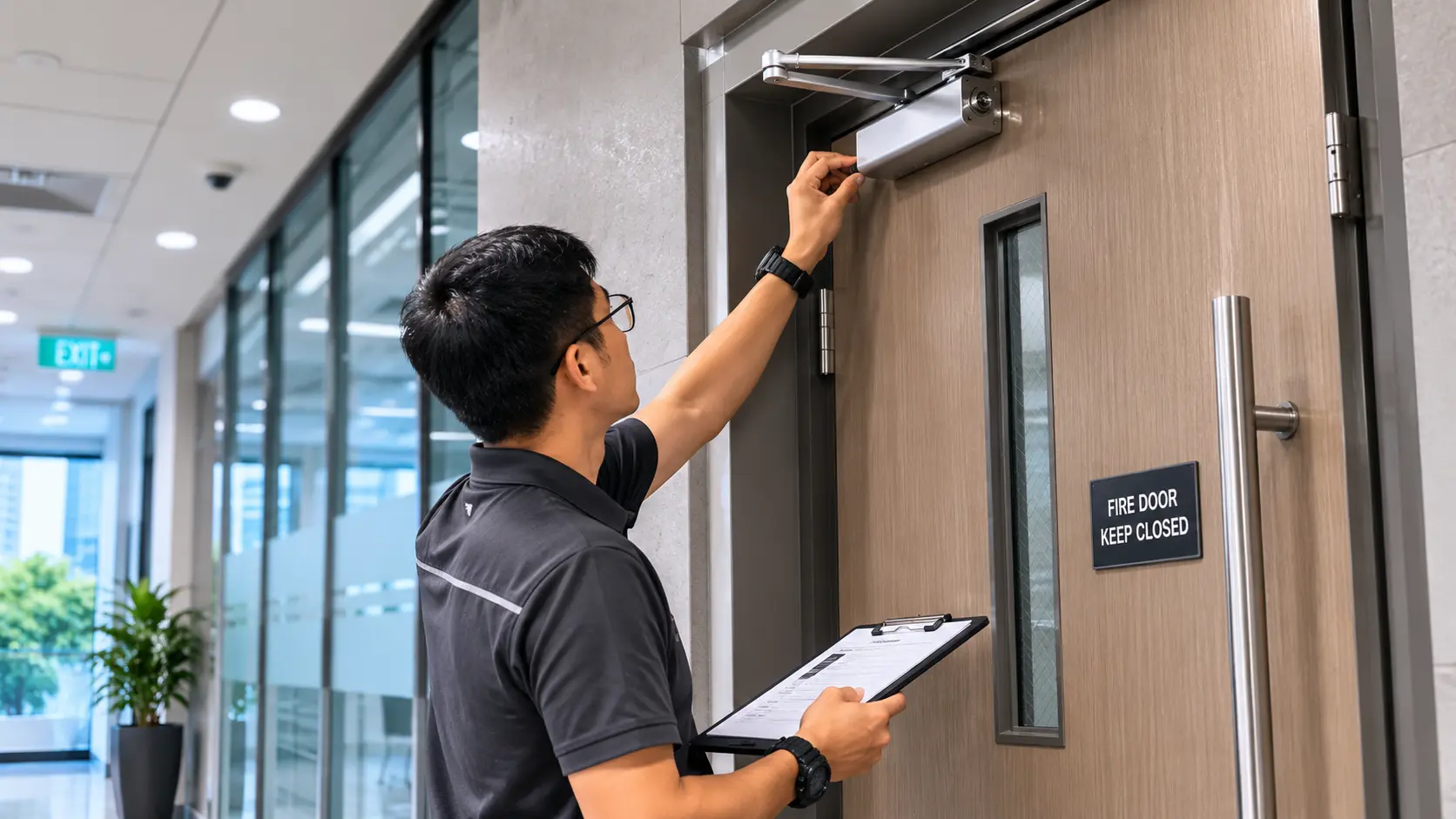
The door closer is one of the most functionally important, and most frequently neglected, pieces of commercial door hardware. It controls closing speed and final latching, and on a fire-rated door this is a genuine safety function, not a convenience one.
- Test the full swing cycle. Open the door fully and let it close unassisted; it should close smoothly and the latch should engage on the first attempt.
- Check closing speed adjustment. Adjustable sweep and latch speed valves can drift over time, or get adjusted by staff trying to make a heavy door easier to push.
- Look for fluid leaks. Hydraulic closers that leak oil gradually lose closing force and can eventually fail to latch.
- Confirm the arm and fixings are intact. A loose or bent closer arm is a common cause of a door that appears to work but does not fully close.
Fire-Rated Doors and Self-Closing Devices
SCDF and Building and Construction Authority (BCA) requirements call for fire-rated doors to be fitted with a self-closing device that reliably returns the door to a fully closed and latched position after every use, across commercial buildings, staircase lobbies and residential common areas alike. A fire door that has been propped open, whether with a doorstop, a wedge, or simply an inoperative closer, cannot perform its compartmentation function. This is a frequent finding during fire safety inspections and one of the simplest issues for a facility team to catch through routine visual checks.
Locks and Digital Locks
A commercial building often runs a mix of mechanical locks, electronic access-controlled locks and digital locksets, each with different service needs.
- Mechanical function. Check that the latch and deadbolt (where fitted) throw smoothly, and that strike plates are aligned with the frame.
- Battery and power checks for digital locks. Test for low-battery warnings and mechanical fail-safe override, so the door can still open if the battery fails.
- Access credential audits. For electronically controlled doors, periodically reviewing who holds active credentials is a security task worth coordinating alongside hardware maintenance.
Digital Locks on Fire-Rated Doors
Fire-rated doors carry an additional requirement for any digital lockset fitted to them. With effect from 1 March 2024, a digital door lock (DDL) installed on a fire-rated door in Singapore must itself be certified for fire resistance, either as part of the door's original Certificate of Conformity or through an individual product certification. Facility teams can verify this by checking whether the DDL's brand and model appear in the door's compliance documentation, or by asking the supplier to produce the DDL's own Certificate of Conformity, tested to SS 332 or EN 1634-1. HongRui's guide to digital lock installation on fire-rated doors covers compatibility considerations for teams planning an upgrade.
Seals and Weatherstripping
Seals do different jobs depending on the door, so it is worth checking which type applies before assessing condition.
- Weatherstripping and acoustic seals on perimeter doors and meeting rooms manage draughts, moisture and sound, and typically show wear as compression loss, cracking or peeling within a few years in Singapore's humidity.
- Smoke seals on fire-rated doors are part of the tested assembly, restricting smoke passage around the door edges. They should not be trimmed, painted over thickly, or replaced with a generic non-rated seal, as this can affect performance.
- Threshold seals are prone to physical damage from trolleys and foot traffic in commercial and industrial settings, and warrant a shorter check interval than wall-mounted seals.
Frame Checks
A frame problem is often mistaken for a hinge or closer problem: a frame out of square will bind or fail to latch no matter how well the hardware is adjusted. Frame checks are therefore a useful diagnostic starting point.
- Check for square and plumb. An uneven gap between the leaf and frame on one side versus the other usually points to frame movement rather than a hardware fault.
- Inspect fixings into the surrounding wall. Frame anchors loosen over years of use, particularly on heavier metal-framed commercial doorsets.
- Look for corrosion on metal frames. Humidity and poor drainage around external openings can corrode unprotected steel frames from the base upward.
- Confirm intumescent seals remain intact on fire-rated frames. These strips are part of the tested assembly and should not be removed or damaged during other works.
For contractors comparing frame material during a fit-out, HongRui's door frame selection guide comparing timber and metal frames covers durability trade-offs in more detail.
Recommended Maintenance Schedule
Maintenance frequency should reflect door traffic, door type and whether the door is fire-rated. The schedule below is general guidance for planning purposes; project-specific requirements should follow the manufacturer's recommendations and any conditions attached to the building's Fire Certificate or fire safety plan.
| Component | High-traffic doors | Standard commercial doors | What to check |
|---|---|---|---|
| Hinges | Every 3 months | Every 6 months | Wear, play, lubrication, fixing tightness |
| Door closers | Every 3 months | Every 6 months | Latching, closing speed, arm condition, leaks |
| Locks / digital locks | Every 3 months | Every 6 months | Mechanical function, battery status, credentials |
| Seals and weatherstripping | Every 6 months | Annually | Compression, tearing, adhesion, smoke seal integrity |
| Frames | Annually | Annually | Squareness, fixings, corrosion, intumescent strips |
Common Commercial Door Maintenance Mistakes
- Propping fire doors open. Even temporarily, this defeats the self-closing requirement and is a common non-conformance flagged during fire safety checks.
- Painting over compliance labels or intumescent seals. Fire rating labels and intumescent strips are part of the tested assembly and should be protected during repainting, not coated over.
- Swapping hardware without checking fire rating implications. Replacing a closer, hinge or lock on a fire-rated door with a generic equivalent can affect certified performance.
- Treating all doors on the same interval. A back-of-house service door used hundreds of times daily needs more frequent attention than a rarely used plant room door.
- Deferring frame checks. Frame issues often present as hinge or closer symptoms, so teams sometimes re-adjust hardware without fixing the underlying movement.
Commercial Door Inspection Checklist
- Door closes fully and the latch engages on the first attempt
- No visible sag, drag or scraping along the floor or frame
- Hinges show no excess play and fixing screws are tight
- Closer arm is secure with no visible fluid leaks
- Lock and strike plate are aligned; digital lock battery status is normal
- Seals are intact, with no tearing, peeling or compression loss
- Frame is square with even gaps on both sides of the leaf
- Fire rating label and intumescent strips are visible and undamaged (fire-rated doors)
- No obstructions or devices propping the door open (fire-rated doors)
- Maintenance record updated with date, findings and any rectification works
When Replacement May Be Needed Instead of Repair
Most hinge, closer, lock and seal issues can be repaired without replacing the door. Replacement becomes more practical when the leaf has warped, delaminated or suffered water damage, when a fire-rated assembly has been altered beyond its original certification, or when a frame has corroded or shifted to the point where re-hanging the leaf will not hold alignment. For fire-rated doors, a Registered Inspector or the original certifying body is best placed to advise whether repair within certification is possible.
Questions to Ask Before Specifying a Maintenance Contract
- Which doors are fire-rated, and is there an up-to-date register of their certification and labelling?
- What interval does the door or hardware manufacturer recommend for this specific product line?
- Does the contractor have experience servicing fire-rated assemblies without invalidating certification?
- How are records kept, and can they be produced quickly during a fire safety audit?
Frequently Asked Questions
How often should commercial door hardware be inspected in Singapore?
Most commercial doors benefit from a hinge, closer and lock check every three to six months, with frame checks at least annually. High-traffic doors, such as staircase lobby or service doors, need the shorter end of that range. Buildings holding a Fire Certificate should align door checks with their annual fire protection system inspection cycle.
Is door closer maintenance a fire safety requirement in Singapore?
For fire-rated doors, yes, the self-closing function is a safety requirement, not a convenience feature. SCDF and BCA regulations require fire-rated doors to have a self-closing device that reliably closes and latches after use. For non-fire-rated commercial doors, closer maintenance is generally manufacturer guidance and good facility practice.
What causes commercial door hinges to sag or squeak in Singapore's climate?
Sagging usually comes from mechanical wear on the hinge pin or loose fixing screws, worsened by high door-cycle counts. Squeaking is typically dry friction at the pin, accelerated by humidity washing away lubricant faster than in drier climates. Both are usually addressed with lubrication, fixing checks and, where wear is advanced, replacement.
Can facility teams service digital locks on fire-rated doors themselves?
Routine tasks like battery checks can generally be handled in-house, but any hardware swap should be checked against the door's Certificate of Conformity first. Since 1 March 2024, digital locksets fitted to fire-rated doors must themselves be fire-resistance certified, so an uncertified replacement may affect the door's compliance even if mechanically compatible.
What is the difference between a general door seal and a fire door's smoke seal?
A general weatherstrip or acoustic seal manages draughts, moisture and sound and can be replaced with an equivalent product. A smoke seal on a fire-rated door is part of the tested fire assembly, restricting smoke passage around the door edges; it should be maintained or replaced only with a matching certified product.
When should a commercial door frame be replaced instead of repaired?
Replacement is usually considered when corrosion has compromised structural strength, the frame has shifted enough that re-squaring will not hold, or fixings into the surrounding wall have failed repeatedly. Minor misalignment can often be corrected without full replacement; a contractor or the original supplier can assess this on site.
Do all commercial buildings in Singapore need a Fire Certificate for their doors?
Not all commercial buildings require a Fire Certificate. The requirement under Section 35 of the Fire Safety Act 1993 applies to specific categories, including certain public buildings with an occupant load above 200 persons, qualifying industrial buildings and hospitals. Owners should check their building's classification with SCDF or their appointed fire safety professional.
Who is responsible for commercial door maintenance in a Singapore building?
Responsibility generally sits with the building owner or occupier, who may delegate upkeep to a facility management team, an MCST for strata-titled developments, or a specialist contractor. Tenants are typically responsible for doors within their leased space, while common-area and fire-rated doors usually remain the owner's or MCST's responsibility, depending on the lease or strata by-laws.
Conclusion
Commercial door maintenance in Singapore comes down to five recurring checks, hinges, closers, locks, seals and frames, applied on a schedule matched to each door's traffic level and fire rating. General wear items are largely good facility practice, while self-closing function, hardware certification and smoke seal integrity on fire-rated doors sit closer to compliance territory and are worth documenting. Because requirements vary by building classification and manufacturer guidance, teams should confirm door-specific requirements with their fire safety professional rather than applying one standard across a portfolio.
Project teams can review HongRui's door manufacturing services and related door guides to compare fire-rated and non-fire-rated options, hardware compatibility and installation considerations for commercial projects.




Leave A Comment