
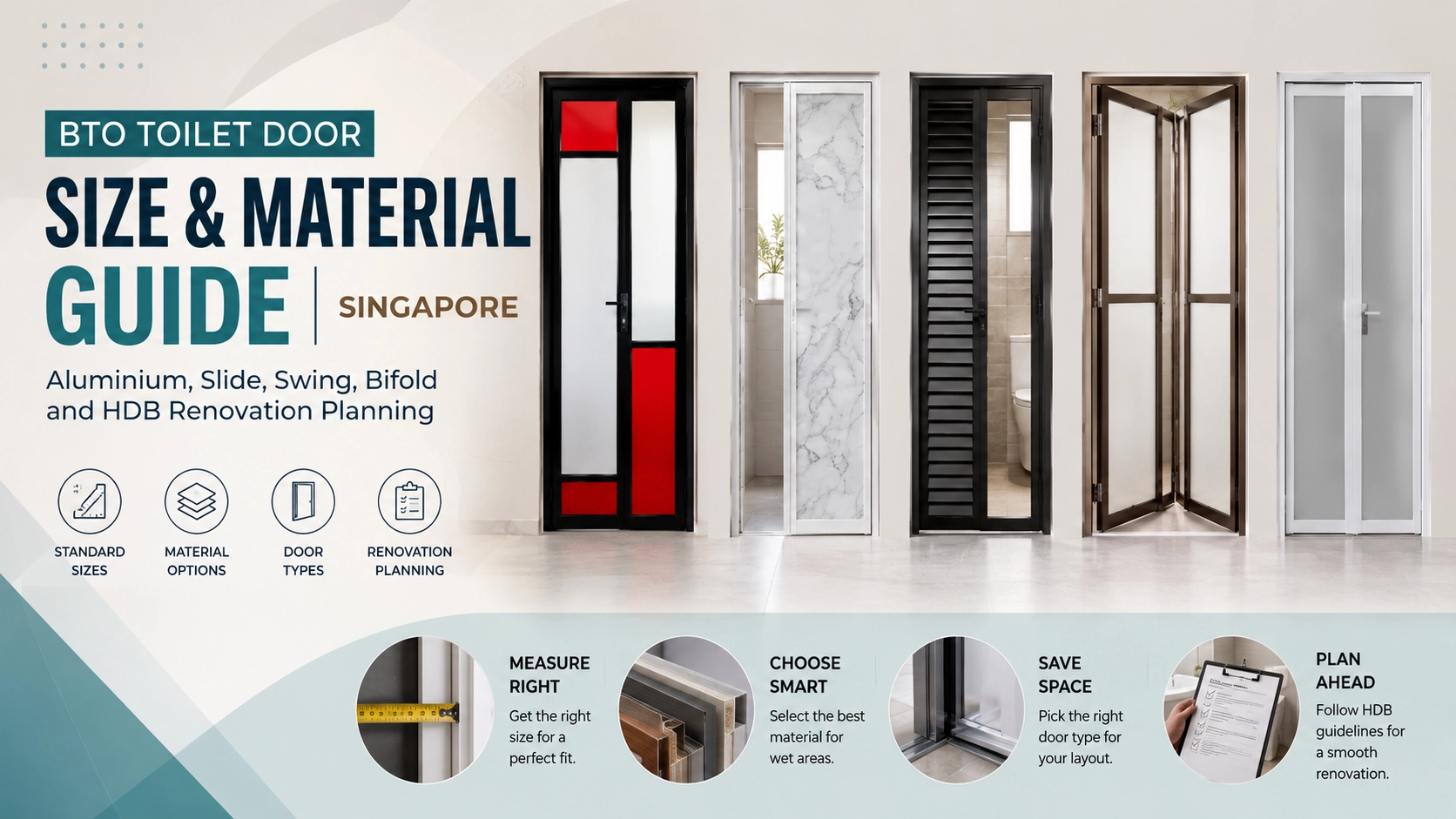
BTO Toilet Door Size & Material Guide: Aluminium, Sliding, Swing & Bifold
Everything architects, interior designers, and renovation contractors need to know about selecting and installing toilet doors in Singapore HDB and BTO flats.
Why Toilet Door Selection Matters in BTO Flats
In Singapore's compact HDB and BTO flats, every square centimetre counts. The toilet door is not merely a privacy screen — it directly affects the usability of narrow corridors, the longevity of your bathroom interior, and the overall aesthetic coherence of a renovation project.
For interior designers, renovation contractors, and homeowners embarking on a BTO renovation, the choice of door type, material, and swing direction can determine whether a bathroom feels cramped or comfortable. With Singapore's high humidity and daily water exposure, the material selection also has a significant bearing on maintenance costs over a 10–20 year lifespan.
Standard HDB Toilet Door Sizes in Singapore
Understanding the standard rough opening dimensions for HDB toilet doors is essential before any renovation or replacement project begins. HDB toilet doors typically follow standardised dimensions, though older BTOs and resale flats may have variations.
| Door Location | Standard Width | Standard Height | Notes |
|---|---|---|---|
| Common Toilet (BTO) | 700 mm – 750 mm | 2050 mm – 2100 mm | Most common in 3-room to 5-room BTO units |
| Master Bathroom | 750 mm – 800 mm | 2100 mm | Slightly wider to accommodate master bedroom access |
| Powder Room / Half Bath | 650 mm – 700 mm | 2050 mm | Often found in landed or larger HDB units |
| Accessible / Wheelchair | 900 mm – 1000 mm | 2100 mm | Required under BCA accessibility code for certain projects |
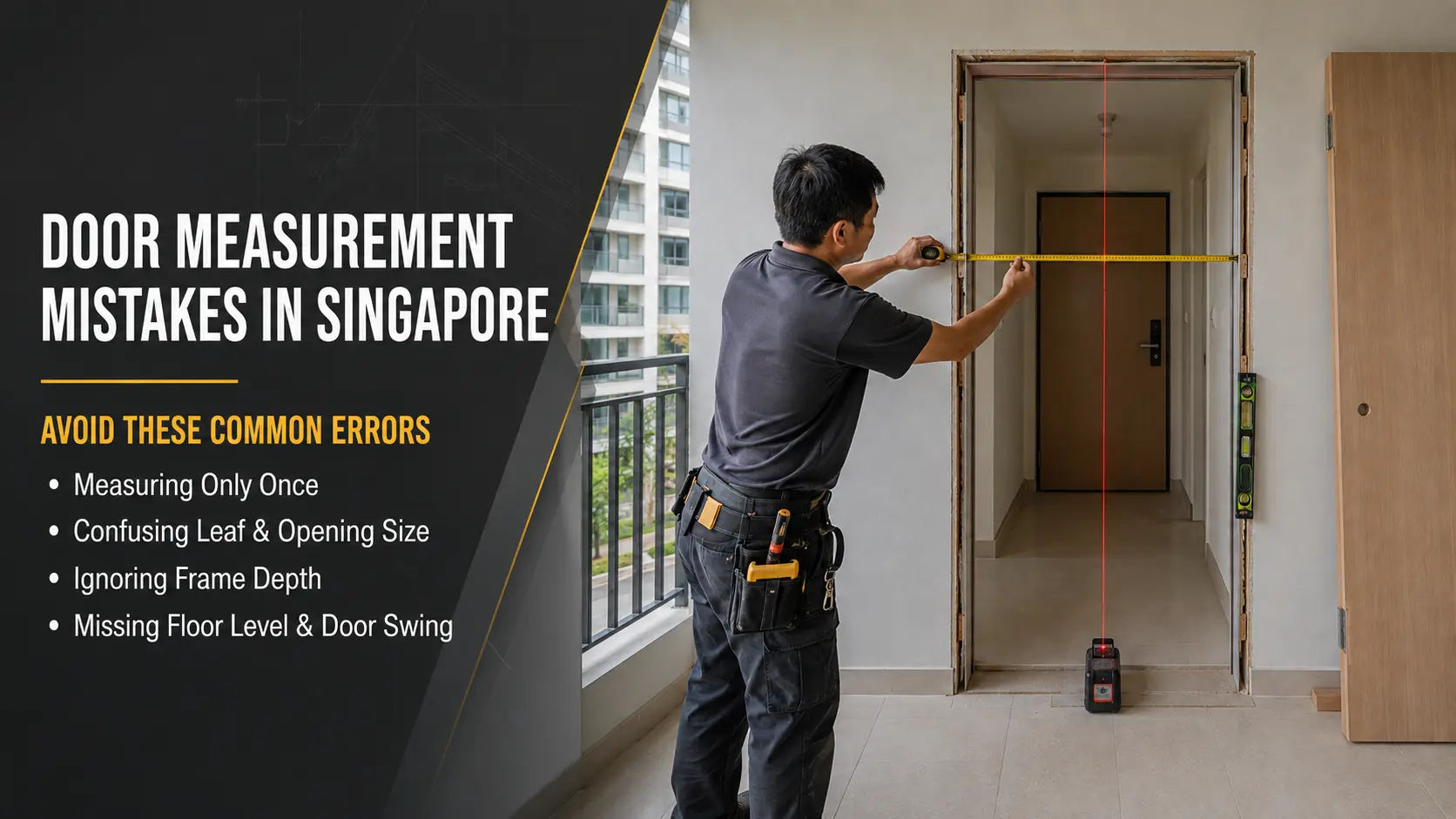
Renovation contractors should always measure the actual rough opening on-site, as developer tolerances during BTO construction can introduce variations of ±10–20 mm. Confirming measurements before ordering custom aluminium frames or door panels prevents costly remakes.
Door Types: Swing, Sliding, Bifold & Aluminium
Each door configuration has specific advantages depending on the toilet layout, available floor space, and the renovation project's budget. Here is a structured breakdown of the four most commonly specified types in Singapore HDB and BTO renovations.
1. Swing Doors (Hinged Doors)
The traditional swing door remains the most widely installed toilet door type across HDB estates. It can be configured to swing inward or outward depending on the available clearance space.
Advantages
- Simple installation and replacement
- Full door width for access — good for mobility
- Lower hardware cost and maintenance
- Wide material choice (aluminium, PVC, wood-core)
Limitations
- Requires swing clearance space (min. 700–800 mm arc)
- Outward swing can block corridor traffic
- Inward swing is risky if someone faints inside
2. Sliding Doors
Sliding toilet doors are an increasingly popular choice in BTO flats with narrow bathrooms or corridors. They run on top-hung or bottom-track rail systems and are available in aluminium-framed glass, solid PVC, or polycarbonate panels.
Advantages
- No swing clearance required — saves floor space
- Ideal for en-suite bathrooms adjacent to wardrobes
- Soft-close mechanisms available for premium projects
- Suitable for elderly-friendly and accessible renovations
Limitations
- Wall space required for the door to slide into
- Track maintenance and cleaning required over time
- Slightly higher hardware and installation cost
3. Bifold Doors
Bifold toilet doors fold along a centre hinge and are anchored to a top rail. They are particularly useful where neither a full swing nor a slide configuration is practical — for example, in recessed bathroom alcoves or utility bathrooms in HDB corridors.
Advantages
- Compact fold requires minimal clearance
- Visually lighter appearance, suits modern interiors
- Works well with narrow 600–700 mm rough openings
Limitations
- Hinges exposed to moisture — require stainless or aluminium hardware
- Less sound and light privacy than solid swing doors
- More moving parts mean more potential maintenance points
4. Aluminium-Framed Toilet Doors
Aluminium toilet doors are the dominant choice in Singapore's BTO and commercial renovation market due to their combination of water resistance, durability, and low maintenance. They are available in swing, sliding, and bifold configurations and can be fitted with various panel infills.
Material Breakdown & Specifications
The Singapore climate — characterised by high humidity, consistent temperatures around 26–32°C, and near-daily rainfall — places unique demands on bathroom door materials. Below is a practical assessment of the most commonly specified materials in renovation projects.
Aluminium
Rust-free, lightweight, powder-coated or anodised. Industry standard for Singapore bathrooms.
PVC / uPVC
Budget-friendly, fully waterproof, available in white or wood-effect finishes.
Solid Timber
Premium aesthetic but requires moisture sealing and maintenance. Better suited to dry bathrooms.
Tempered Glass
Used in frameless or aluminium-framed panels. Creates spacious feel in master baths.
Polycarbonate
Lightweight, shatter-resistant, diffuses light. Common in HDB utility and maid's room bathrooms.
Composite / HDF Core
Moisture-resistant compressed wood core with laminate skin. Mid-range option for dry-area bathrooms.
Aluminium Toilet Doors — A Closer Look
Among all available options, aluminium toilet doors represent the most widely specified product in Singapore's HDB BTO renovation market. Here is a deeper look at the key specifications that renovation contractors and interior designers should evaluate.
Frame Profile Options
- Standard Profile (45–60mm): Commonly used in residential HDB and BTO projects. Suitable for swing and bifold configurations.
- Slim Profile (25–35mm): Preferred by interior designers for a more refined, architectural look — especially in master bathroom renovations.
- Heavy-Duty Profile (70–80mm): Specified for commercial projects such as office toilets, F&B outlets, and hotel bathrooms where higher usage frequency demands greater structural rigidity.
Surface Finish Options
- Powder Coating: Available in a wide range of RAL colours. Durable, UV-stable, and resistant to chipping. Most common finish in residential BTO renovations.
- Anodising: Creates an integral oxide layer on the aluminium surface. More abrasion-resistant than powder coating and retains a metallic lustre. Common in commercial fit-outs.
- Brushed / Mill Finish: Uncoated aluminium with a matte brushed texture. Less common due to susceptibility to staining over time.
Panel Infill Options for Aluminium Frames
- Frosted / Obscure Glass: Offers privacy while allowing diffuse light transmission. Popular for en-suite bathrooms.
- Clear Tempered Glass: Used in open-plan or hotel-style bathrooms where full light pass-through is desired.
- PVC Louvre Panels: Promotes ventilation — often used in older HDB estates or utility toilets without mechanical ventilation.
- Solid Aluminium Panel: Full privacy and sound attenuation. Heavier but fully opaque and structurally robust.
BTO-Specific Renovation Considerations
Homeowners and interior designers working on a first-time BTO renovation will encounter specific constraints and requirements that differ from resale flat upgrading or condo renovation projects.
HDB Renovation Rules for Toilet Doors
- HDB's renovation guidelines generally permit the replacement of toilet doors without prior approval, provided structural walls are not affected.
- Works must be carried out by a HDB-registered renovation contractor. Engaging unregistered contractors risks void warranties on BTO defect liability periods.
- Toilet door frames must not be fixed into load-bearing structural walls without HDB approval and an engineer's endorsement.
- Any work involving hacking of wall tiles around door frames must comply with HDB's noise and working-hours restrictions.
BTO Defect Liability Period (DLP)
New BTO flats come with a one-year Defect Liability Period during which HDB rectifies construction defects at no cost to the homeowner. Renovation contractors and homeowners should document the condition of existing door frames and finishes before commencing renovations to distinguish developer defects from renovation-related damage.
Swing Direction and Corridor Clearance
In BTO 3-room and 4-room flats, the corridor leading to the common toilet is often 900–1050 mm wide. When specifying a swing door, contractors must confirm that the outward swing arc does not conflict with the corridor traffic path or adjacent bedroom doors. In tight corridors, a sliding or bifold toilet door is the more practical solution.
Planning for Elderly-Friendly Bathrooms
With Singapore's ageing population, many BTO renovation projects now incorporate elderly-friendly design features from the outset. For toilet doors, this typically means:
- Outward-swinging or sliding doors (to allow emergency access if a person falls inside)
- Lever-style door handles (instead of round knobs) for ease of grip
- Minimum 800 mm clear door width for potential wheelchair or walking-frame access in future
- Contrasting colour frames to improve visibility for those with visual impairment
Installation & Contractor Guidance
For renovation contractors and site supervisors, the following installation checkpoints are critical to ensuring a quality fit and a long-lasting result across all toilet door types.
Pre-Installation Checks
- Verify rough opening dimensions against door leaf and frame specifications — account for clearance gaps of 5–10 mm on all sides for shimming and levelling.
- Confirm wall substrate condition: hollow block walls (common in BTO) require appropriate anchor fixings rather than standard concrete screws.
- Check that wall tiling is complete before door frame installation to avoid gaps at the door reveal.
- For sliding doors, confirm that the overhead lintel or beam is sufficiently solid to carry the track load and door leaf weight.
Frame Fixing and Sealing
- Use stainless steel or zinc-plated anchor bolts for all door frame fixings — standard mild steel fasteners will rust within 12–24 months in Singapore's humid toilet environment.
- Apply a continuous bead of neutral-cure silicone sealant (not acetoxy) at all frame-to-wall and frame-to-tile junctions to prevent water ingress behind the frame.
- Allow a minimum 24-hour curing period for silicone before the door is subjected to water or steam exposure.
Hardware Specifications
- Hinges: Specify 304 stainless steel or solid brass hinges — 3 hinges per door leaf for doors above 1800 mm height or heavier than 20 kg.
- Lock and Latch: Bathroom locks should incorporate an emergency release feature operable from the outside (a coin-turn or screwdriver slot).
- Handle: Grade 304 stainless steel or powder-coated aluminium. Avoid zinc alloy handles in high-humidity bathrooms as they are prone to pitting and surface deterioration.
- Door Stop / Holder: Install a wall-mounted or floor-mounted door stop to prevent handle damage to tiles or walls.
Maintenance & Longevity Tips
With proper maintenance, a quality aluminium toilet door installed in a Singapore BTO flat should provide 15–25 years of reliable service. The following routine maintenance practices extend the lifespan of all common toilet door types.
Aluminium Doors
- Wipe down the frame monthly with a damp cloth. Avoid abrasive cleaners that can scratch powder-coated or anodised surfaces.
- Inspect silicone seals annually and re-seal any cracked or peeling sections to prevent water ingress behind the frame.
- Lubricate hinges annually with a light machine oil or a PTFE-based spray lubricant to prevent squeaking and wear.
Sliding Door Tracks
- Clean bottom tracks monthly to remove soap residue, hair, and debris that can impede smooth operation.
- Check and tighten top-hung roller carriage screws every six months — vibration from regular use can cause them to work loose.
- Inspect the nylon rollers or stainless steel wheel carriages annually for wear. Replace if the door no longer slides smoothly or develops lateral play.
Bifold Door Hinges and Tracks
- Inspect pivot pins and knuckle hinges every 6 months — bifold doors place greater stress on hinge pivot points than standard swing doors.
- Adjust the pivot bracket alignment if the door develops a scraping or binding motion during operation.
Commercial & Landed Property Applications
While much of this guide focuses on HDB BTO units, toilet door specification decisions in commercial contexts — such as office fit-outs, F&B renovations, retail spaces, and landed property projects — often follow similar material logic but with heavier-duty requirements.
Commercial Office Toilets
Commercial toilet doors in Singapore office buildings typically specify heavy-duty aluminium frames (70 mm+ profile) with solid panel infills, mortise lock bodies rated for high-cycle use, and continuous hinges or piano hinges for added durability. Interior designers and M&E consultants should ensure door swing directions comply with the Fire Code's emergency egress requirements.
F&B and Retail Outlet Toilets
Public toilet doors in F&B or retail environments face significantly higher use cycles than residential bathroom doors. Stainless steel or heavy-duty powder-coated aluminium frames with solid-core infills are standard. Touchless or push-pull hardware is increasingly specified in post-pandemic commercial fit-outs to reduce contact surfaces.
Landed Property & Condominium Bathrooms
In landed properties, interior designers have greater design latitude. Frameless or slim-profile tempered glass shower screens combined with slim-profile aluminium-framed toilet doors create a cohesive, spa-like aesthetic. For walk-in wardrobes with en-suite access, sliding bifold glass doors are a popular choice among Singapore architects.
Frequently Asked Questions
Conclusion
Choosing the right toilet door for a BTO or HDB renovation in Singapore requires balancing material performance, spatial constraints, safety considerations, and design intent. Aluminium-framed doors remain the dominant and most dependable choice for Singapore's tropical climate, offering long service life with minimal maintenance across swing, sliding, and bifold configurations.
For renovation contractors, interior designers, and architects specifying doors for BTO, resale HDB, or commercial projects, the key decisions revolve around frame profile, panel infill material, hardware grade, and swing or slide direction relative to the available corridor clearance.
A well-planned toilet door specification — matched to the project's use intensity, budget, and accessibility requirements — is a small but important contributor to a renovation that performs well for decades in Singapore's demanding climate conditions.




Leave A Comment