
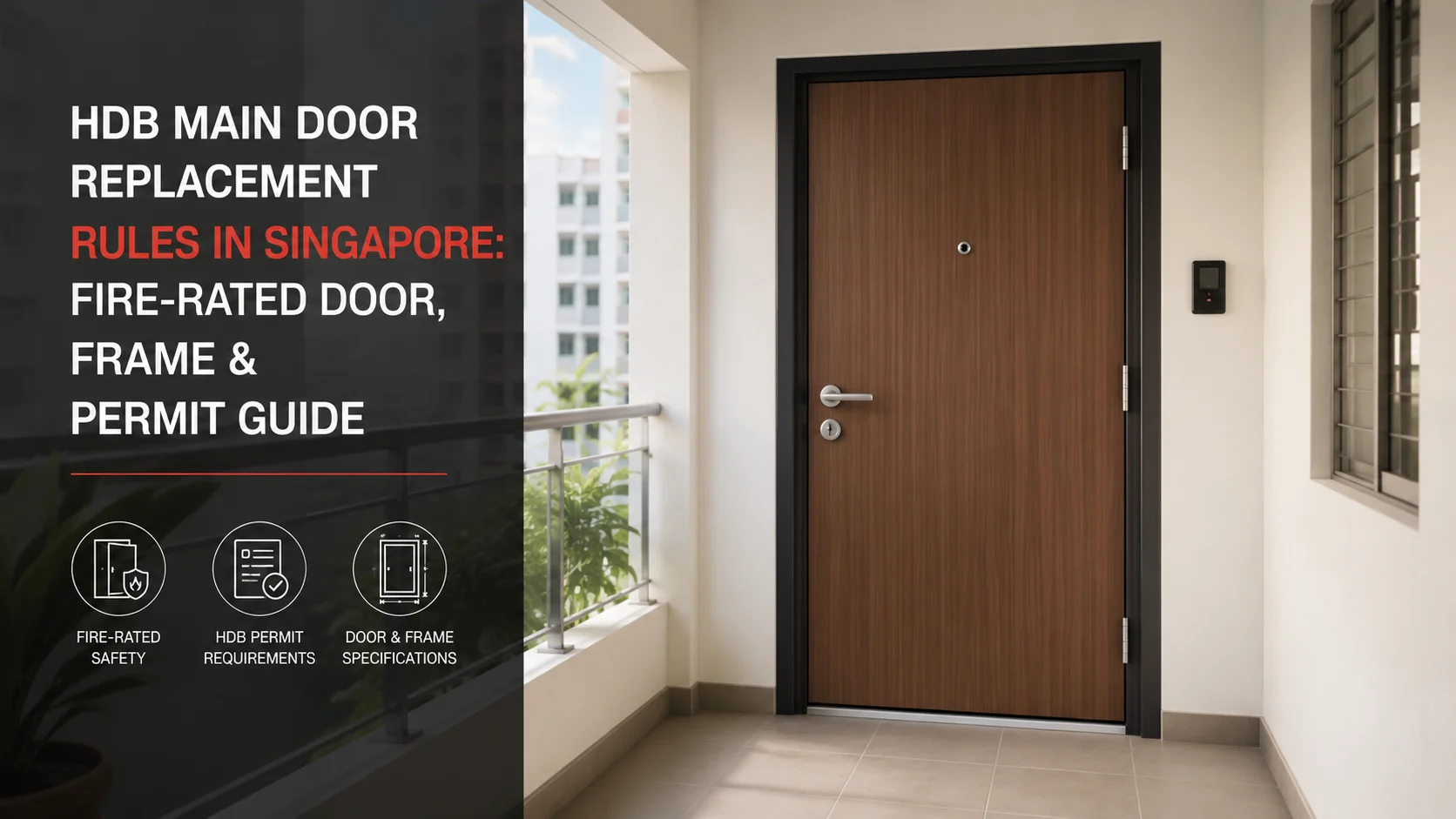
HDB Main Door Replacement Rules in Singapore: Fire-Rated Door, Frame & Permit Guide
Thinking of replacing your HDB main door? Before you start shopping for designs, there are rules you need to know — and skipping them can mean costly rectification work, or worse, a door that fails in a fire emergency.
Replacing an HDB main door seems straightforward on the surface — pick a design you like, engage a contractor, and get it done during the renovation. But the reality is a little more layered than that. The main entrance door of every HDB flat in Singapore is classified as a fire safety component, and it comes with strict regulatory requirements that apply to the door itself, the frame, the hardware, and even how the work is carried out.
This guide is written for homeowners planning a renovation, contractors handling HDB projects, interior designers advising clients on door selection, and anyone involved in BTO flat fitting-out. Whether you are upgrading aesthetics or replacing an ageing door, understanding the rules upfront saves time, money, and headaches down the line.
Why the HDB Main Door Must Be Fire-Rated
Singapore's HDB blocks house thousands of residents in close proximity. In a fire scenario, the design of the building itself does a lot of the safety work — and the main entrance door of each flat is a critical part of that system.
Each flat is designed as a fire compartment. The main door forms the boundary between the flat and the common corridor. When a fire breaks out inside a unit, a properly rated fire door contains the flames and, just as importantly, the smoke within that compartment for a defined period of time. This keeps the escape corridor clear and usable, gives other residents time to evacuate safely, and allows the Singapore Civil Defence Force (SCDF) to carry out a more effective response.
This is not a technicality or bureaucratic formality. Smoke inhalation is the leading cause of fire-related fatalities in residential buildings. A main door that fails early — because it was not fire-rated, or because it was improperly installed — removes a critical layer of protection for everyone in the block, not just the household where the fire started.
Under the Fire Safety Act (Cap 109A) and HDB's renovation guidelines, the main entrance door of every HDB flat must be replaced with a certified fire-rated door. Installing a non-compliant door is a regulatory offence. HDB conducts spot inspections, and non-compliant homeowners and contractors face rectification notices and potential fines.
HDB Technical Requirements & Standards
The technical requirements for HDB main door replacements draw from two primary sources: HDB's own Renovation Guidelines and Singapore's Code of Practice for Fire Precautions in Buildings (CP13), administered by SCDF. In practice, this means the door and its installation must meet specific performance criteria that have been independently tested and certified.
What does "fire resistance rating" actually mean?
A fire resistance rating tells you how long a door can withstand fire conditions before it fails — either structurally, or by allowing flames and heat to pass through. For HDB main doors, the minimum required rating is FD30, meaning the door must resist fire for at least 30 minutes under standardised test conditions.
The test standard commonly referenced is BS 476: Part 22 (British Standard) or its Singapore equivalent, SS 332. Some HDB developments — particularly those with mixed-use or commercial elements — may require FD60 (60-minute rated) doors. Always check the building's approved plan or consult with HDB directly if you are unsure which applies to your flat.
| Requirement | Standard / Specification | Notes |
|---|---|---|
| Minimum fire rating | FD30 (30 min) | FD60 may apply in some developments |
| Test standard | BS 476: Pt 22 or SS 332 | Or SCDF-recognised equivalent |
| Door leaf thickness | Typically 45–55 mm | Varies by product and core material |
| Self-closing device | Mandatory | Door must latch shut from any open angle |
| Intumescent seals | Mandatory (all four edges) | Expand under heat to seal gaps |
| Smoke seals | Recommended / often required | Prevents cold smoke penetration |
| Fire-rated frame | Required | Frame must match or exceed door rating |
| Fire-rated glazing | Required if glazed panels used | Standard glass is not permitted |
| Certification | SAC / UKAS-accredited lab | Test cert required — not just a label |
The importance of third-party certification
A door that looks heavy, or is made of steel, is not automatically fire-rated. The only reliable way to confirm compliance is a fire test certificate issued by a laboratory accredited by the Singapore Accreditation Council (SAC) or an internationally recognised equivalent body (such as UKAS in the UK). This certificate should reference the exact construction tested — including the door leaf specification, core material, intumescent seal detail, and frame type.
When engaging door suppliers for HDB renovation projects, always request this certificate before committing to a purchase. A reputable supplier will have it readily available.
Types of Approved Fire-Rated Doors
The market offers several categories of fire-rated main doors suitable for HDB applications, each with different material properties, aesthetics, and price points. The right choice depends on the project brief, the client's lifestyle, and the specific technical requirements of the flat.
Steel fire doors
Steel fire doors are the most widely used type in HDB main door applications. They offer consistently reliable fire performance, excellent structural rigidity, and long service life. Modern steel fire doors are available in flush panel designs, embossed wood-grain finishes, and a wide range of powder-coat colours — making them far more versatile aesthetically than the utilitarian grey doors that were standard in HDB blocks through the 2000s and early 2010s.
For renovation projects where the contractor or interior designer needs to match a specific colour palette or external facade, powder-coated steel doors can be factory-finished to almost any RAL colour. They are also highly compatible with multi-point locking systems, digital locks, and reinforced hinges for enhanced security.
Fire-rated engineered timber doors
For homeowners and interior designers seeking a warmer, more residential aesthetic, fire-rated engineered timber doors are a well-established option. These use a specially treated solid timber or mineral core that achieves the required fire resistance, typically faced with a timber veneer for the finished appearance.
Fire-rated timber veneer doors are a popular specification in higher-end HDB renovation projects. They can be designed to match internal joinery and cabinetry, creating a seamless visual flow from the entrance into the home. The key requirement is that the fire test certificate covers the actual door construction being installed — not a visually similar but differently constructed product.
Composite fire doors with glazing
Where natural light into the entryway is part of the design intent, composite fire doors with glazed panels are an option. These must incorporate fire-rated glass throughout — typically Georgian wired glass or modern clear intumescent glazing. The glazed sections must be fully framed with intumescent seals, and the total fire rating of the door set must still meet the FD30 minimum.
This type of door is more commonly seen in commercial-adjacent HDB shop units and mixed-use developments, but is occasionally specified in residential renovation projects by architects or interior designers where the design brief calls for it.
Door Frame Requirements — What Most People Overlook
This is the section that catches many renovation projects out. A certified fire-rated door installed in a non-rated or damaged frame will not perform to its tested rating. The frame is not an afterthought — it is an integral part of the fire door assembly.
Frame materials
Steel frames are the most common and the most straightforward option for achieving a matching fire rating. Fire-rated timber frames are acceptable where they have been tested and certified as part of the complete door set alongside the leaf. Standard aluminium or uPVC frames are generally not suitable for HDB fire door applications unless they form part of a specifically tested and certified assembly — which is rarely the case for residential main door products in Singapore.
The gap between the frame and the wall
When a new frame is installed, the gap between the frame and the surrounding wall structure must be properly fire-stopped. This is done using mineral wool packing and intumescent mastic sealant applied to all perimeter joints. If these gaps are left unfilled, or filled with standard expanding foam (which is not fire-rated), the entire compartment boundary is compromised regardless of how well the door and frame perform on their own.
If you are replacing only the door leaf and retaining the existing frame, check the frame condition carefully before proceeding. An existing frame that is warped, corroded (for steel frames), or no longer square may not form a proper seal with the new door leaf. A mismatched or deteriorated frame can invalidate the fire performance of an otherwise compliant door. When in doubt, replace the full door set together.
Rebated frames and the door stop
Most HDB fire door installations use rebated frames, which have a raised lip that the door leaf closes against. This rebate contributes directly to the smoke and fire seal performance of the assembly. Non-rebated frames are less common in standard HDB residential applications and generally require additional threshold seal detailing to compensate.
The HDB Permit Process, Step by Step
HDB classifies main door replacement as licensed renovation work. This means it must be carried out by an HDB-registered renovation contractor, and in most cases, formal approval must be obtained before work begins. The process is not complicated, but skipping steps creates unnecessary risk for both homeowners and contractors.
- Engage an HDB-registered contractor. Only contractors on HDB's approved register are authorised to carry out main door replacement works. You can verify a contractor's registration status via the HDB InfoWEB portal. Do not engage an unlicensed contractor for this work, even if they offer a lower price — the liability falls on the homeowner.
- Notify your immediate neighbours. HDB requires written notification to all adjoining neighbours (above, below, and both sides) before renovation works begin. Some contractors handle this on behalf of the homeowner; confirm this with your contractor before proceeding.
- Submit the renovation application via MyHDBPage. The registered contractor submits the renovation application on the homeowner's behalf through the HDB MyHDBPage portal. The application should include the type of door being installed and the fire door certification details.
- Wait for written approval before starting work. HDB typically processes straightforward door replacement applications within a few working days. Do not allow work to begin until written approval is confirmed — verbal assurance from a contractor that "HDB won't check" is not a substitute.
- Comply with permitted renovation hours. Renovation work is restricted to Monday–Saturday, 9 am to 6 pm. No works are permitted on Sundays and Public Holidays. Verify the current guidelines with HDB before scheduling, as these can be updated.
- Keep documentation after completion. Retain the fire door test certificate, the HDB approval letter, and any installation records. These documents may be requested during an HDB inspection, or by a buyer's lawyer during a future resale transaction.
What does not require a permit
Minor maintenance activities — repainting the existing door, replacing the door handle or lock on a like-for-like basis, or adjusting the self-closer speed — generally do not require an HDB permit. The key threshold is whether the door leaf or frame is being physically replaced. If it is, the full permit process applies.
BTO Flat Owners: What You Need to Know
If you have recently collected the keys to a new BTO flat, the main door installed by HDB already meets fire safety requirements. Many homeowners choose to replace it during the initial renovation as part of a wider interior design project — either to upgrade the aesthetic, or to install a door with better soundproofing, a digital lock system, or a more premium finish.
This is entirely permissible, but the replacement door must still comply with all the fire-rated door requirements described in this guide. The fact that you are replacing an original HDB-installed door does not grant any exemption from compliance.
Sizing considerations for BTO flats
BTO flat main door openings follow HDB standard dimensions, but there can be variations between different BTO projects, flat types, and developers. Always measure the actual opening on-site before ordering a door. As a general guide, typical HDB main door dimensions fall in the following ranges:
- Width: 880 mm to 1,000 mm (single leaf)
- Height: 2,100 mm to 2,300 mm
- Frame depth (wall thickness): varies — measure at the actual opening
For BTO renovation projects, many contractors recommend coordinating the main door replacement with other major works — such as flooring, carpentry, or partition installation — to minimise disruption to neighbours and streamline site access and waste disposal.
When specifying a BTO main door as part of a full renovation design, consider the relationship between the external door finish and the internal entrance area. Contractors and interior designers who coordinate the door selection early — before flooring, lighting, and carpentry are confirmed — tend to achieve more cohesive results. The door is often the first and last thing residents and visitors see; it rewards careful selection.
Installation Best Practices for Contractors
Even a fully certified fire door set can fail to perform its intended function if it is poorly installed. For renovation contractors carrying out HDB main door replacement work, the following practices represent the standard of workmanship that regulators and building owners expect.
Before installation begins
- Verify that the door and frame assembly holds a valid, unexpired fire test certificate for the specific construction being installed — not a similar product from the same range
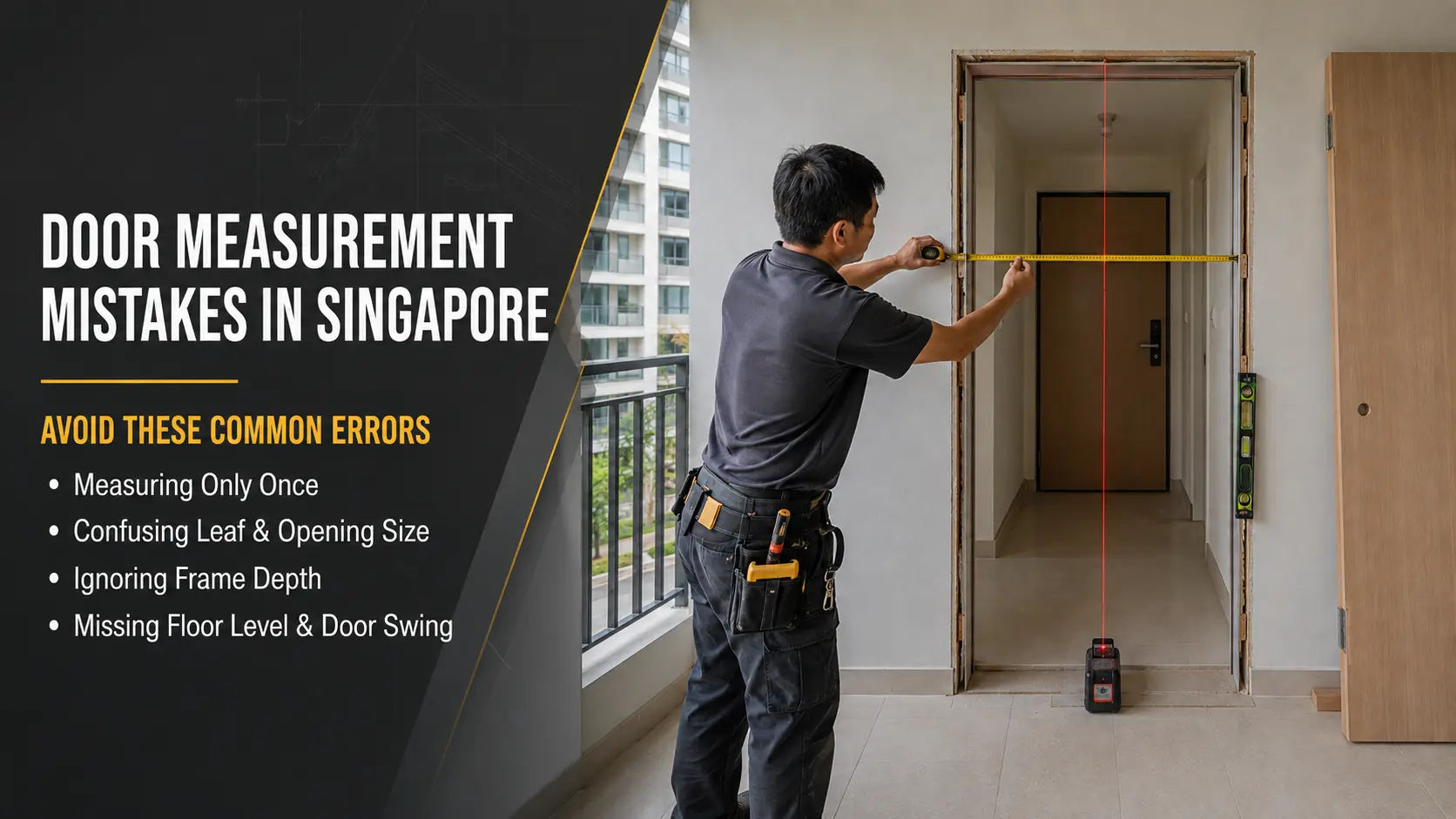
- Measure the door opening accurately and confirm the door dimensions against the approved order
- Inspect the existing opening for structural damage, previous non-compliant alterations, or moisture damage in the surrounding wall
- Confirm that the floor finish and threshold detail will allow the door to sweep freely and latch fully without obstruction
Frame setting and fire-stopping
- Set the frame plumb, level, and square before anchoring — a frame that is out of square will cause door alignment problems and may prevent the door from latching under fire conditions when the frame expands
- Use only fire-rated materials to fill the perimeter gap between the frame and the wall — mineral wool and intumescent sealant, not standard expanding foam
- Allow all mortar, adhesive, or sealant to fully cure before hanging the door leaf
Hardware and seals
- Fire-rated doors typically require a minimum of three hinges — use only the hinge specification that was part of the tested assembly
- The self-closing device must be set so the door closes completely and latches from any open position, including fully open at 180°
- Install all intumescent seals strictly according to the manufacturer's instructions — do not overlap, trim, or omit any section, including the threshold seal if specified
- Verify that the lock body and escutcheon plate do not cut through or compress the intumescent seal material
Final checks before handover
- Test the door through multiple full open-and-close cycles from both sides
- Confirm the self-closer engages correctly under normal residential use conditions
- Walk the resident through the fire door maintenance requirements and hand over the fire test certificate
- Photograph the completed installation for the contractor's project records
Maintenance & Long-Term Care
A fire-rated main door is not a set-and-forget installation. Like any mechanical assembly, it needs periodic attention to keep performing correctly. The good news is that the maintenance required is straightforward and takes very little time.
What homeowners should check regularly
- Monthly: Check that the door closes and latches fully without needing to be pulled shut. A door that sticks, drags, or fails to latch on its own needs attention — the self-closer may need adjustment, or the frame may have shifted.
- Quarterly: Visually inspect the intumescent and smoke seals around all four edges of the door. They should be intact, evenly compressed when the door is shut, and free from cuts, gaps, or sections that have become detached. Check the self-closer for any signs of hydraulic fluid leakage.
- Annually: Check hinges for wear, loose screws, or corrosion. Inspect the frame-to-wall junction for cracking or movement. Lubricate hinges and the door closer mechanism if the manufacturer recommends it.
When to call a professional
Some issues go beyond routine homeowner maintenance and require a qualified contractor to assess and rectify. These include: a door that no longer latches fully, visible warping or deformation of the door leaf, intumescent seals that are significantly damaged or missing, any corrosion that has penetrated the frame material, and any situation where the door was exposed to fire or intense heat — even if no structural damage is immediately obvious.
Using a door wedge or any object to keep the main entrance door open for extended periods defeats the fire compartmentalisation the door is designed to provide. HDB bylaws prohibit obstructing fire doors. If you regularly need the door held open for ventilation or access, consider installing a fire door retainer — a device that holds the door open but releases it automatically when the fire alarm activates.
Frequently Asked Questions
These are the questions that come up most often in the context of HDB main door replacement projects in Singapore.
No. Regardless of aesthetics or personal preference, the main entrance door of every HDB flat must be replaced with a certified fire-rated door. Non-fire-rated doors — even heavy solid-wood doors that appear substantial — do not meet the regulatory requirement and must be rectified if discovered during an HDB inspection. Rectification is at the homeowner's expense, and repeated non-compliance can result in financial penalties.
Request the fire test certificate from the supplier before purchasing. The certificate should be issued by a SAC-accredited or UKAS-accredited laboratory, and should clearly specify the exact door construction tested — including the door leaf dimensions, core material, intumescent seal specification, and frame type. Be cautious of suppliers who reference a certificate for a "similar" product; the certificate must cover the specific construction you are buying. Some manufacturers also affix a fire door identification label to the door edge, but this is an additional indicator, not a substitute for the full certificate.
Generally, replacing door hardware — such as handles, locks, or hinges — on a like-for-like basis does not require an HDB renovation permit. However, when installing a digital lock on a fire-rated main door, it is important to verify that the lock body and installation method do not cut through or compromise the intumescent seals embedded in the door leaf. Reputable digital lock installers experienced in fire door installations will know how to handle this correctly.
Structural modifications to the main door opening are generally not permitted for HDB flats, as the surrounding wall typically forms part of the building's load-bearing or fire-rated compartment structure. Any application to modify a structural opening would need to be reviewed by HDB's Structural Engineering team, and most such applications are declined for standard residential flats. If a wider door configuration is required — for example, to accommodate mobility aids — consult HDB directly to understand what options may be available.
No, you are not obligated to replace the original HDB-installed door if it is still in good condition and fully functional. The requirement to use a certified fire-rated door applies when a replacement is carried out — it is not a directive to replace functional existing doors. However, if the door is damaged, no longer latches properly, or is missing seals, it should be repaired or replaced to restore its fire-rated performance.
HDB-registered renovation contractors who carry out non-compliant works — including installing a non-fire-rated main door — risk suspension or removal from HDB's register of renovation contractors. This effectively prevents them from carrying out any future HDB renovation work. The homeowner may also receive a rectification notice requiring the non-compliant door to be replaced at their own cost. For contractors, maintaining a reputation for compliant work is both a professional and commercial necessity.
Yes. Commercial units within HDB mixed-use or neighbourhood shopfront developments are subject to SCDF's fire safety requirements for commercial premises, which are typically more stringent than those for residential HDB flats. These may include higher fire resistance ratings (FD60 or above), panic exit hardware on egress doors, and specific requirements for door coordination in larger fire-compartmented spaces. Commercial renovation projects should involve a qualified fire safety consultant, and the architect or M&E engineer appointed for the project should confirm the applicable requirements before door selection begins.
With proper maintenance, a well-made steel or engineered timber fire door can last 15 to 25 years or more. The hardware — particularly the self-closing device and hinges — may need servicing or replacement before the door leaf itself does. The key indicators that a door needs attention are: failing to latch under its own closer, visible damage to the intumescent seals, structural warping or deformation of the leaf, or significant corrosion of the frame. Any of these warrant a professional assessment.
Wrapping Up
Replacing an HDB main door is one of those renovation tasks that looks simple on the surface but has meaningful regulatory substance behind it. The fire-rated door requirement is not red tape for its own sake — it is a fundamental part of how HDB blocks are designed to protect residents in an emergency.
For homeowners, the practical takeaway is to always work with an HDB-registered contractor, verify the fire test certificate before the door is ordered, and keep the paperwork after the job is done. For contractors and interior designers, understanding the full scope of requirements — door, frame, seals, hardware, and fire-stopping — is what separates a compliant, professional installation from one that creates liability.
Done properly, a new fire-rated main door is also a genuine upgrade: better security, improved acoustics, a fresh aesthetic, and the confidence that comes from knowing the installation meets Singapore's safety standards.




Leave A Comment