
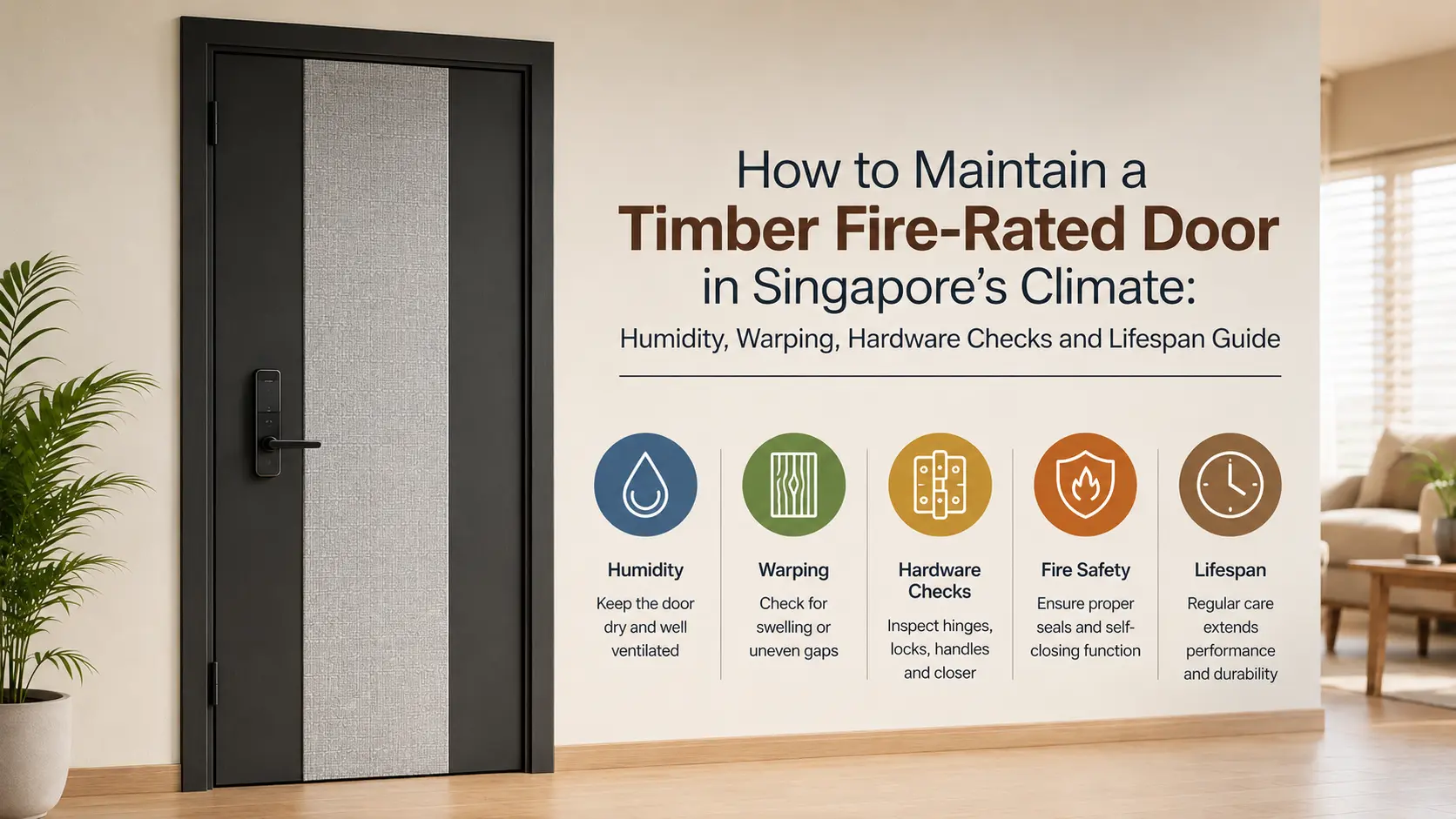
How to Maintain a Timber Fire-Rated Door in Singapore's Climate: Humidity, Warping, Hardware Checks and Lifespan Guide

Singapore's tropical climate is one of the most demanding environments a timber door will ever face. With year-round humidity averaging 70–90%, daily temperature swings, and relentless UV exposure, even a well-manufactured timber fire-rated door requires consistent care to stay compliant with Singapore's fire safety regulations — and to keep performing correctly for years to come.
This guide focuses entirely on what happens after your door is installed: how to care for it, what warning signs to watch for, how Singapore's climate affects performance, and when to call in a professional. It is relevant for HDB homeowners, BTO flat residents, renovation contractors managing project handovers, and interior designers advising clients on post-renovation upkeep.
A timber fire-rated door is a life-safety assembly. Neglected hardware, deteriorated seals, or a warped leaf can compromise the door's fire rating — even when the door still looks acceptable on the surface. Maintenance is not optional.
How Singapore's climate affects timber fire-rated doors
The humidity problem
Wood is hygroscopic — it absorbs and releases moisture in response to its environment. In Singapore's persistently humid conditions, this natural movement is amplified into a continuous cycle of expansion and contraction that affects the door leaf, frame, and the tolerances between them.
When timber absorbs moisture it swells, most noticeably along the vertical edges and bottom rail. In severe cases, a swollen leaf presses tightly against the frame, making the door difficult to open or close. During drier periods — typically during prolonged air-conditioned use — timber shrinks and leaves visible gaps. For a fire-rated door, these gaps are a compliance concern: intumescent seal systems are engineered to work within specific tolerances, and excessive gaps reduce their effectiveness against early smoke spread.
UV exposure and surface degradation
For doors facing external corridors, lift lobbies, or positions with indirect sunlight, UV radiation accelerates the breakdown of laminate surfaces and timber veneers. Early signs include fading, micro-cracking, delamination at panel edges, and yellowing lacquer. What begins as a cosmetic issue becomes structural when exposed edges allow moisture to penetrate the door core.
Condensation around air-conditioned spaces
Where the interior is heavily air-conditioned, the temperature differential at the door surface creates condensation. Over time this accelerates timber movement, promotes mould growth on frames, and causes laminate to bubble along the lower sections of the door leaf — a common and underappreciated maintenance failure in Singapore homes.
Routine maintenance schedule for Singapore conditions
The following schedule is recommended for residential and light commercial settings. More frequent checks are warranted in older HDB blocks, ground-floor units, or properties close to the sea or water features.
Month
- Check door operation — swing should be smooth with no dragging, sticking, or excessive force required
- Confirm latch engages the strike plate cleanly and holds the door securely closed
- Wipe down the door surface with a soft, slightly damp cloth to remove humidity residue and dust
3 Months
- Inspect the door frame junction — gaps between leaf and frame should be even at 2–4mm on all four edges
- Test the door closer — the door must return to fully closed and latched without assistance, every time
- Inspect hinges on both the door leaf and frame sides; tighten any loose fixing screws immediately
- Check for surface damage: chips, peeling laminate, or bubbling veneer — especially at corners and bottom edge
6 Months
- Lubricate hinges and latch mechanism with PTFE-based or silicone lubricant (not WD-40)
- Check the drop seal — must deploy on closure and retract cleanly on opening
- Run fingers along the intumescent strip — it must be intact, continuous, and seated in its channel
- Press gently on the door frame at multiple points — any movement indicates loosened wall fixings
Year
- Full compliance inspection by a qualified door contractor — leaf, frame, seals, and all hardware
- Assess whether surface refinishing or recoating is needed if UV fading or fine cracking is visible
- Commercial settings: review door-use frequency and plan hardware replacement cycles proactively
Use PTFE-based or silicone lubricant for hinges and latch mechanisms — not WD-40. In Singapore's heat, WD-40 evaporates quickly and attracts dust, accelerating wear rather than preventing it.
Hardware-specific checks: what to inspect and why
Each hardware component on a timber fire-rated door plays a direct role in fire performance. Understanding what each one does — and what failure looks like — makes routine inspections far more effective.
Door Closer
Must return the door to fully closed and latched on every use. Check for oil leakage, slamming, or failure to close fully. Typical residential lifespan: 8–12 years.
Fire-Rated Hinges
Must be certified steel ball-bearing type. Check all screws on both leaf and frame sides. Watch for rust in coastal or poorly ventilated HDB blocks.
Latch & Lock
Latch bolt must engage the strike plate cleanly every time without lifting or forcing the door. Stiffness or misalignment indicates the door leaf has shifted.
Drop Seal
Must deploy on closure and retract fully when opening. Check rubber strip for cracks or missing sections. A non-deploying seal leaves a smoke gap at floor level.
Warning signs that need professional attention
Some tasks are straightforward for any homeowner. The following conditions require a qualified door contractor — do not defer them.
- Door leaf no longer sits flush in the frame, with gaps exceeding 4–5mm at any edge
- Door cannot latch without lifting or pushing the leaf into the frame first
- Visible warping — look along the face from one corner; the surface should appear completely flat
- Laminate or veneer delaminated beyond a small localised area, particularly near the door perimeter
- Door closer leaking oil, seized, or consistently failing to return the door to the closed position
- Intumescent strips that are loose, partially missing, or visibly deteriorated
- Any movement in the door frame when pressed — indicates loosened wall fixings
- Any door directly impacted during renovation works, moving furniture, or accidents
How long should a timber fire-rated door last in Singapore?
With proper maintenance, a quality timber fire-rated door should perform reliably for 15 to 25 years in a Singapore residential setting.
Doors in sheltered positions with consistent upkeep reach the upper end of that range. High-traffic commercial settings see hardware wear faster — plan closer and hinge replacement on a 5 to 8 year cycle rather than the longer residential timeline.
Renovation and refurbishment considerations
Do not paint over intumescent seals
A frequent renovation mistake is repainting door frames and inadvertently covering the intumescent strip. Paint build-up impairs the strip's ability to expand correctly in a fire condition. If repainting around the door frame is part of your renovation scope, always mask the intumescent channel — and replace the strip if it has been contaminated with paint.
Do not change hardware without verifying certification
Replacing handles, locks, or hinges with off-the-shelf hardware that is not rated for fire door use creates a compliance issue. All hardware on a certified fire door assembly must either be part of the original tested specification or a certified equivalent. Contractors and interior designers specifying hardware upgrades should confirm compatibility with the door manufacturer before proceeding.
Refurbishment vs full replacement
Surface refurbishment — refinishing laminate, replacing handles, adjusting the door closer — is generally acceptable and does not affect the fire rating provided the core assembly remains intact. Full replacement of the door leaf, however, requires a new certified assembly meeting Singapore's current requirements. This is not a cost-only decision.
Including fire door maintenance guidance in your client handover documentation is a mark of professional practice — and helps clients meet ongoing compliance obligations under Singapore's fire safety regulations.
Frequently asked questions
Key takeaway
A timber fire-rated door is a functioning life-safety assembly — not just a decorative feature. Monthly checks, six-monthly hardware inspections, and an annual professional review keep a quality door compliant and performing correctly throughout its 15 to 25 year lifespan. For HDB and BTO homeowners, renovation contractors, and interior designers, building these habits into the maintenance routine is both a safety responsibility and a long-term investment in the property.
Speak with a door specialist

Leave A Comment