
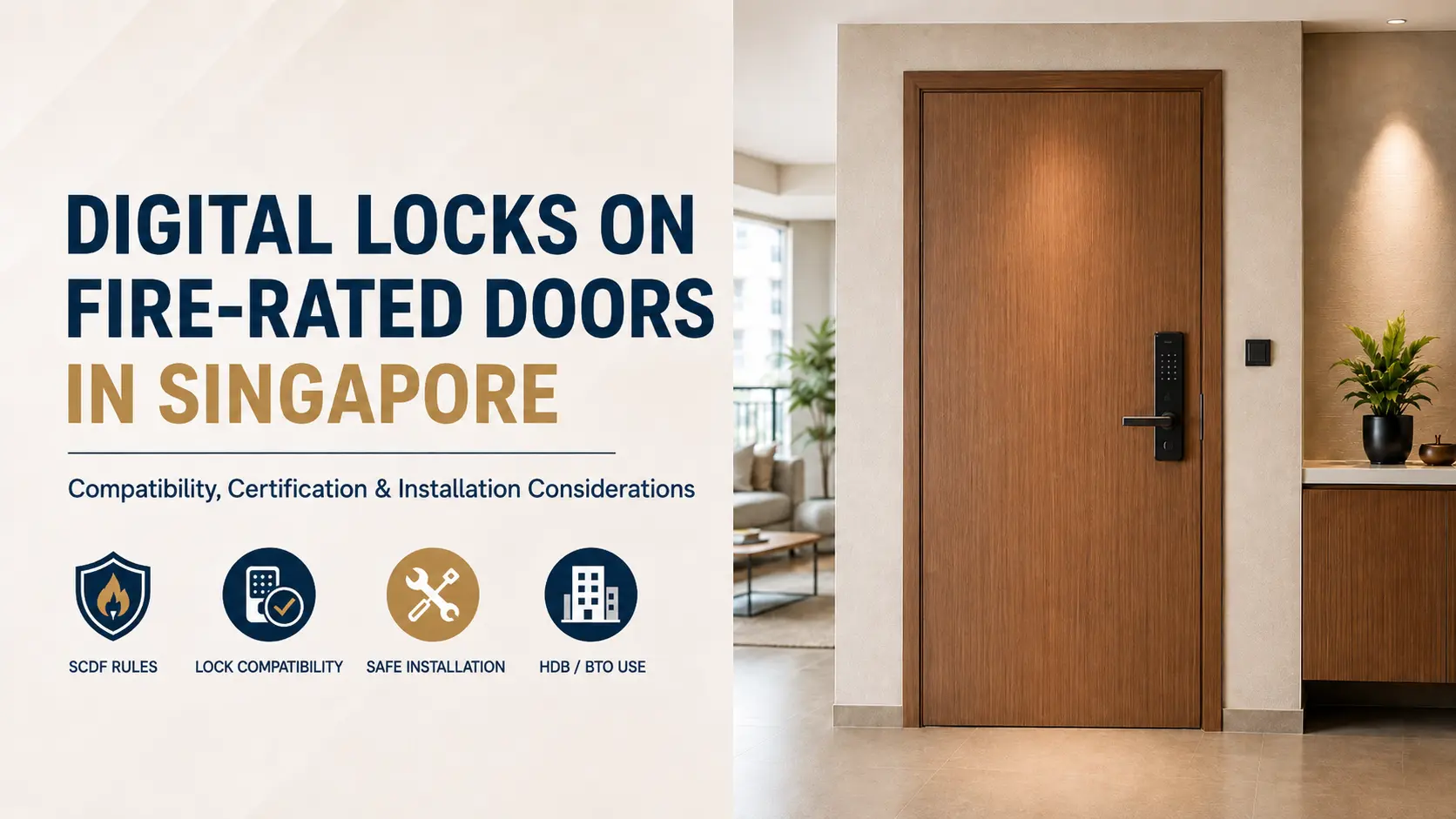
Digital Lock Installation on Fire-Rated Doors in Singapore: Compatibility and Project Considerations
Yes, a digital lock can be installed on a fire-rated door in Singapore, but since 1 March 2024 it must be a certified digital door lock (DDL) with a Certificate of Conformity (CoC) that matches the door's fire-rating duration. The DDL can be supplied and tested together with the door, or individually certified for retrofitting onto an existing certified fire-rated door.
Installing a digital lock on a fire-rated door in Singapore is no longer just a matter of style or convenience. Since 1 March 2024, any digital door lock (DDL) fitted to a fire-rated door must be certified for fire resistance, because the lock forms part of a tested door assembly rather than a separate accessory. This matters to HDB and BTO homeowners planning a main door upgrade, and equally to architects, contractors, interior designers, developers and facility managers specifying hardware for condominiums, commercial premises and institutional buildings. This article sets out what a fire-rated door is, how digital lock certification works under current Singapore Civil Defence Force (SCDF) requirements, where compatibility issues commonly arise across different project types, and what project teams should verify before specifying or installing a digital lock on a fire-rated door.
- Since 1 March 2024, any digital door lock (DDL) fitted to a fire-rated door in Singapore must carry a Certificate of Conformity (CoC) confirming fire-resistance certification.
- Not every HDB or BTO main door is fire-rated; HDB determines this on a flat-by-flat basis, based on the SCDF Fire Code.
- A compliant DDL must match or exceed the door's fire-rating duration and include a mechanical fail-safe for manual exit.
- Drilling or altering a fire-rated door beyond its tested configuration can affect its certified performance, regardless of the lock used.
- Keep the DDL's CoC on file — it may be requested during MCST or HDB checks, inspections or resale.
What Is a Fire-Rated Door, and Why Hardware Matters
A fire-rated door is a complete assembly — leaf, frame, hinges, seals and closing hardware — tested and certified to resist the passage of fire and smoke for a set duration, commonly 30 minutes (FD30) or 60 minutes (FD60) in Singapore residential and commercial buildings. In HDB blocks, fire-rated doors are part of the building's compartmentation strategy: containing a fire within a unit for long enough that the common corridor and escape routes stay usable. Because the door is tested as a complete system, the hardware fitted to it is part of what was actually tested, not an accessory added on afterwards. SCDF's Fire Code lists a number of door components as Regulated Fire Safety Products requiring their own Certificate of Conformity, among them door closers, locks and latches, lever handles, hinges and lock cylinders. This is why a hardware decision, including the choice of digital lock, cannot really be separated from the door's fire rating. HongRui's overview of fire-rated timber door construction covers how the leaf, core and seals work together to achieve a fire-resistance rating.
How Digital Locks Interact With Fire Door Certification
Because a fire-rated door is certified as one system, swapping in a digital lock isn't quite the same as upgrading a lock on an ordinary door. Two questions tend to come up on Singapore projects: whether the specific lock model is certified for fire-rated doors, and whether the way it is fitted, particularly any drilling into the door leaf, stays within the door's tested configuration.
Why an Uncertified Lock Can Be a Problem
According to SCDF guidance, fire doors and components such as digital locksets are tested and certified together precisely because every part contributes to how the door performs in a fire; fitting hardware that has not been through that same testing can affect the door's ability to slow fire spread. This certification requirement for digital locksets took effect on 1 March 2024, and it applies whether the lock is supplied with a new fire door or added to an existing one. A robust-looking lock with a metal backplate is not enough on its own — what matters is whether that specific lock and door combination, or the lock on its own, has actually been tested and certified.
Certified-with-the-Door vs Individually Certified Retrofits
There are two accepted routes to compliance. The first is a digital lock supplied and tested together with the fire door as a complete set, where the lock's brand and model are listed in the door's CoC, usually in an appendix; this is typical when a digital lock is specified at the point of ordering a new fire door. The second route covers retrofitting an existing certified fire door: the digital lock itself needs its own individual CoC, issued by an accredited certification body, confirming it has been tested to Singapore Standard SS 332 or the European standard EN 1634-1. Only a small number of certification bodies, including Element Testing Services, SETSCO Services and TÜV SÜD PSB, are currently authorised to issue these certificates for digital locksets, so it is worth asking suppliers to produce the current CoC rather than relying on marketing claims. HongRui's guide to fire-rated door compliance in Singapore covers CoC labels and door closers in more detail.
Before purchase or installation, ask the supplier or installer to show the digital lock's current CoC, and check that: the brand and model match the product being installed; the fire-rating duration is equal to or greater than the door's rating; and the documentation confirms a mechanical fail-safe so the door can still be opened manually if the battery fails. This is general guidance — always confirm current requirements with SCDF or your supplier, since products and certifications can change.
Fire-Rated Doors and Digital Locks in HDB, BTO and Commercial Projects
Fire-rated doors and the locks fitted to them look a little different depending on the project. The considerations for a BTO main door are not identical to those for a hotel corridor or a hospital ward, even though the underlying certification principles are the same.
HDB and BTO Considerations
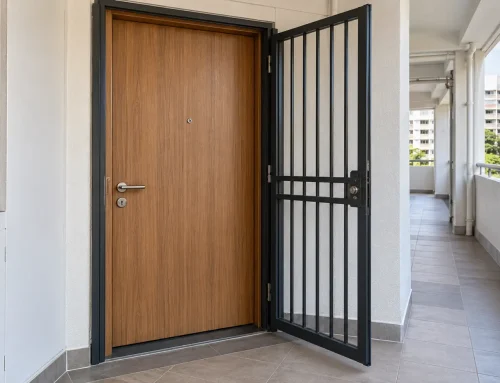
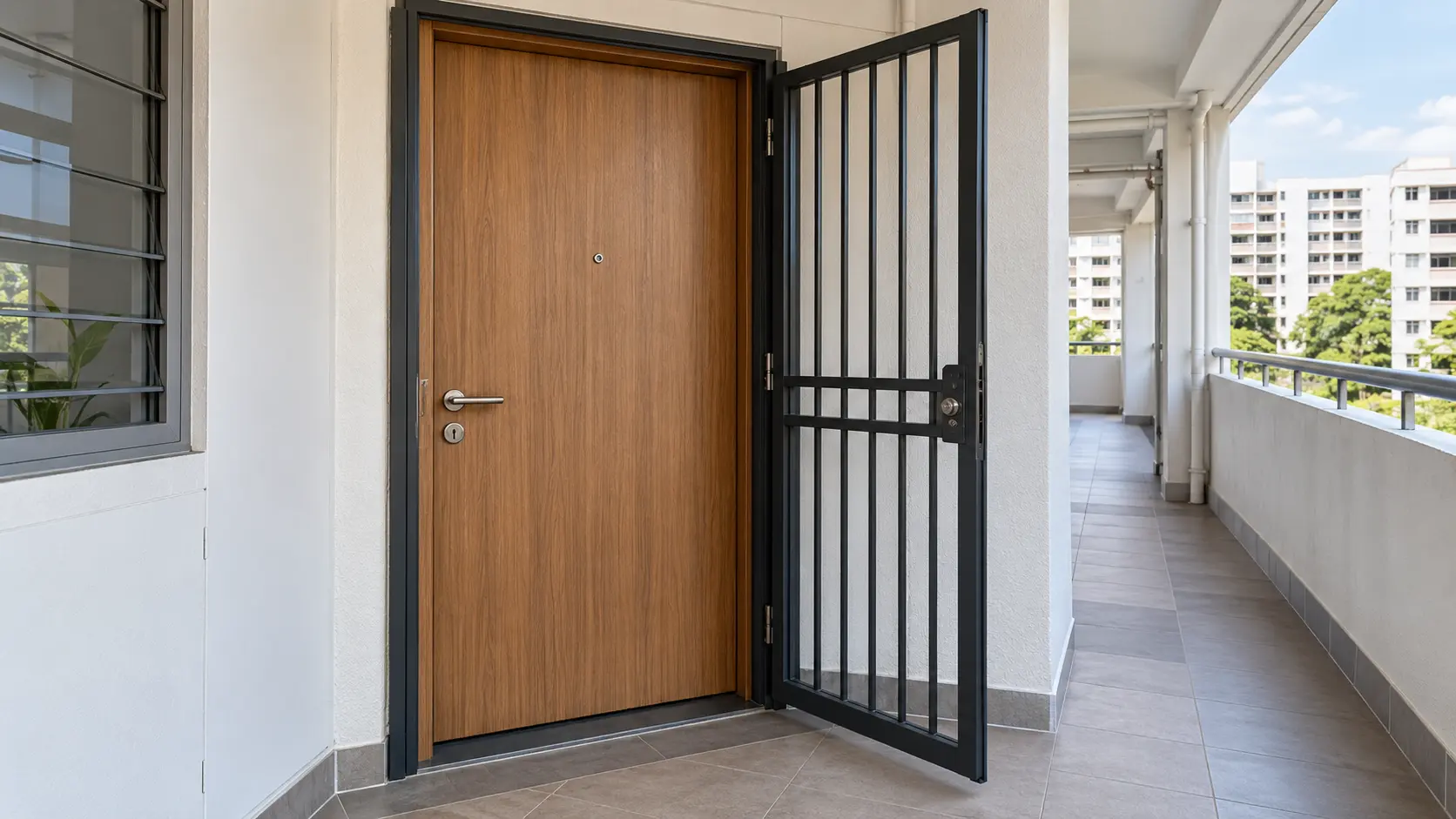
Not every HDB flat has a fire-rated main door. Under HDB's Home Improvement Programme, for instance, HDB first determines whether a flat requires a fire-rated or non-fire-rated main door based on the SCDF Fire Code, and only flats that require one are offered the fire-rated option. Where a flat does have a fire-rated main door, it is typically fitted with a self-closing door closer that HDB advises should not be removed, since it returns the door to a closed position and helps contain a fire within the unit.
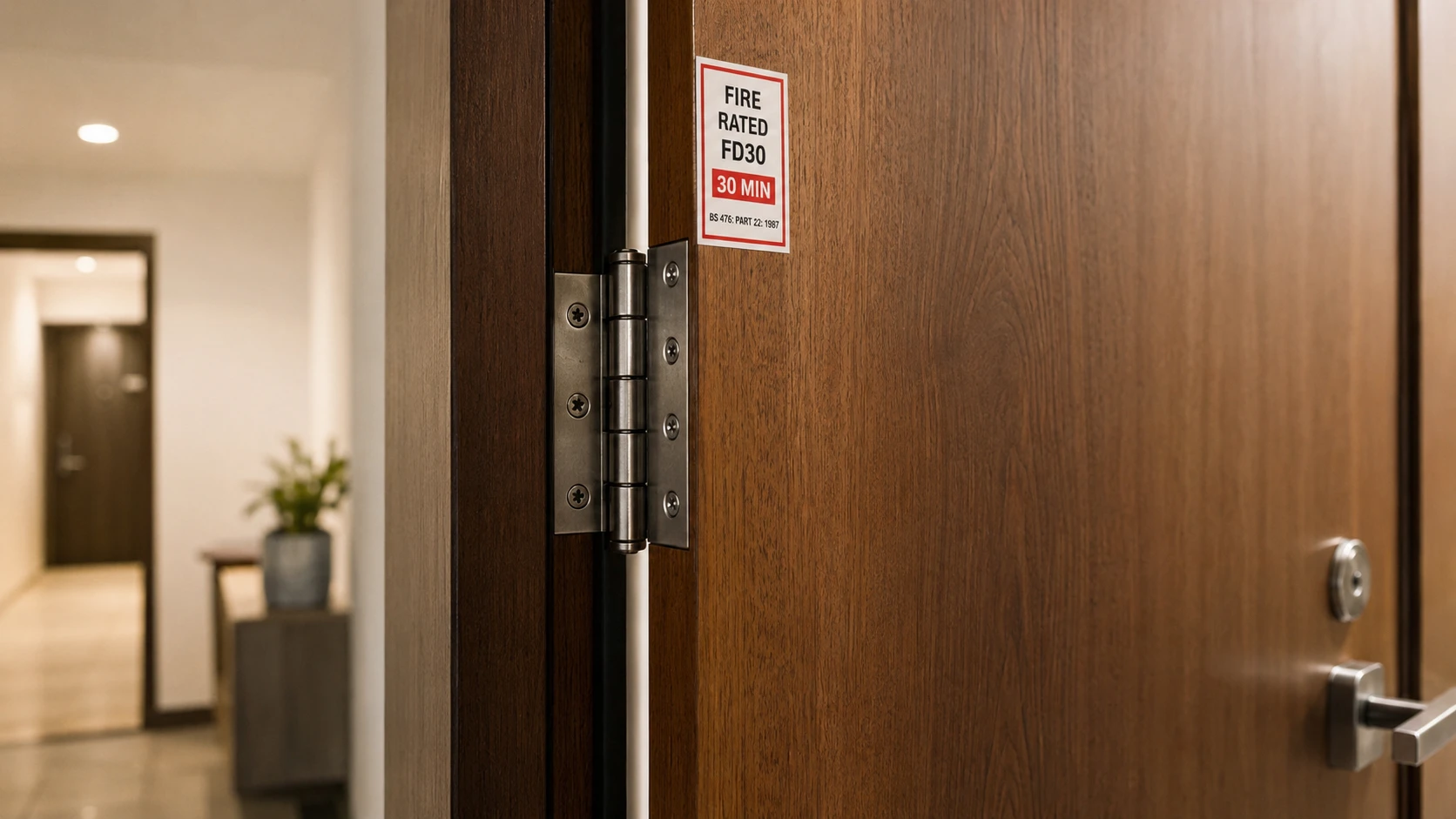
For a digital lock upgrade, the practical first steps are usually the same: confirm whether the door is fire-rated from the label near the hinges, or by checking with HDB or the MCST, then identify whether a compatible certified lock is already specified or needs to be sourced separately. HongRui's overview of HDB fire-rated door supply covers related sizing and material considerations.
Commercial, Institutional and Industrial Applications
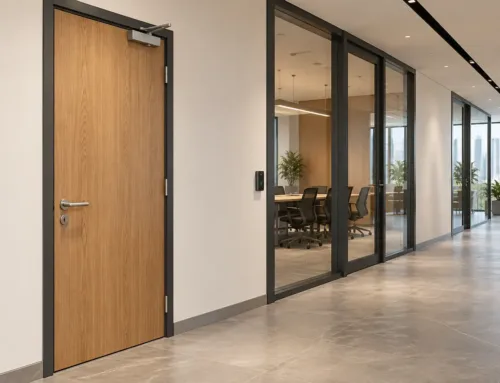
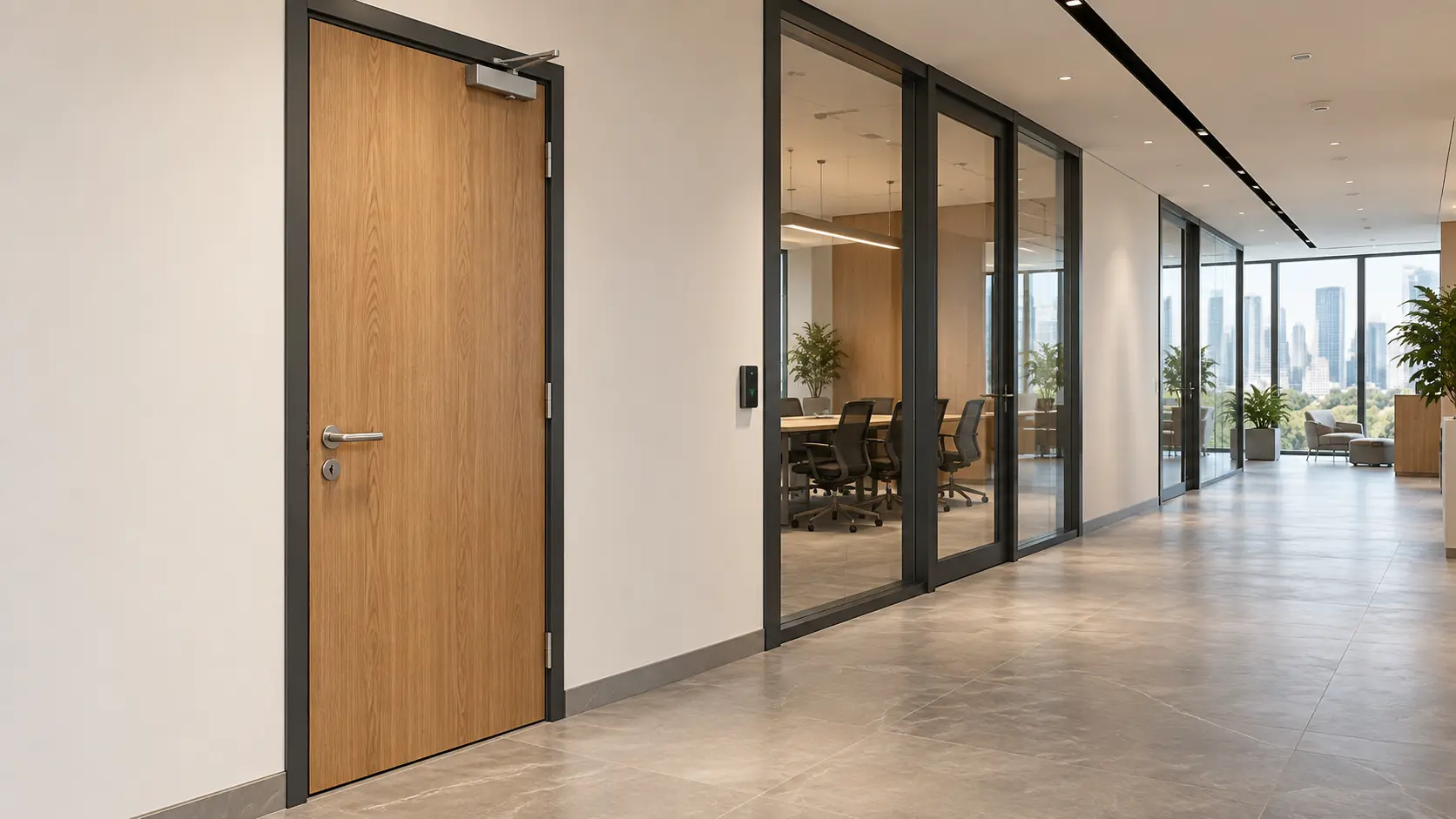
Commercial and institutional buildings — offices, hotels, hospitals, schools and industrial facilities — generally use a wider range of fire doors than a typical HDB flat, including doors to staircases, risers, plant rooms and fire hose cabinets, often in metal rather than timber. SCDF's Fire Code generally restricts locking devices on doors to exit facilities such as protected staircases, and prior approval is normally needed before fitting any locking device to such doors. This differs from a residential unit's main entrance door, where a locking device is permitted for security reasons. For commercial projects considering digital access control on fire-rated doors, this distinction matters: the door's role in the escape route and the applicable approval pathway should be confirmed with a Qualified Person or SCDF, rather than assumed from residential practice. HongRui's fire-rated metal doors guide covers material options for these settings.
Choosing a Digital Lock That Is Compatible With a Fire-Rated Door
Compatibility comes down to how a lock was certified and how it will be fitted, rather than brand or feature set alone. The table below summarises the routes project teams are likely to encounter; it does not replace checking the actual CoC for a specific product and door.
| Installation Route | What It Generally Involves | Compatibility Consideration |
|---|---|---|
| Factory-fitted with the door | The digital lock is selected and tested together with the fire door as one certified set | The lock's brand and model should appear in the door's CoC, usually in an appendix |
| Certified retrofit | An existing certified fire-rated door is fitted with a digital lock that carries its own individual CoC | The lock's fire-rating duration must equal or exceed the door's, with a confirmed mechanical fail-safe for manual exit |
| Uncertified retrofit | A general digital lock without fire-resistance certification is fitted to an existing fire-rated door | Not compliant with current SCDF requirements; may affect the door's certified fire performance |
| Beyond the tested configuration | Drilling, cutting or resizing the door leaf or frame in ways not covered by the original test | Falls outside the assembly's tested configuration regardless of which lock is used; check with the door supplier or SCDF first |
Most compliant residential retrofits in Singapore today fall into the "certified retrofit" row: a separately certified DDL fitted to an existing certified fire door, with the CoC kept on file. For new projects, specifying the lock together with the door at the point of manufacture generally simplifies compliance, since the certification already covers the complete assembly.
Project Specification and Coordination for Architects and Contractors
For architects, contractors and interior designers, digital lock specification on fire-rated doors is best resolved early, ideally alongside door scheduling, rather than left to hardware fix-out at the end of a project. A few coordination points come up repeatedly on Singapore projects. Confirm the fire-rating duration required for each door opening from the door schedule or fire safety submission, since this sets the minimum CoC rating needed for any digital lock. Decide early whether the lock will be supplied with the door by the door manufacturer or sourced separately by an access-control vendor, since this affects who holds the CoC documentation. Coordinate the full hardware group — lock body, cylinder, lever handle, hinges and closer — since several of these are individually regulated fire safety products and should not be value-engineered independently of the door's certification. Renovation companies managing HDB or condominium upgrades face a similar coordination task, usually on a shorter timeline. HongRui's door and gate manufacturing services support this kind of project-level coordination across HDB, BTO and commercial supply.
Installation Process and Sequencing
The exact steps vary by project, but a typical sequence for fitting a digital lock to a fire-rated door looks like this:
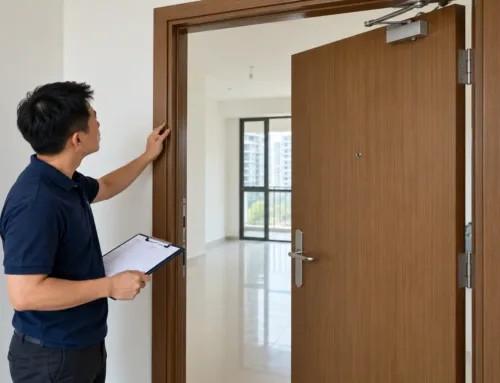
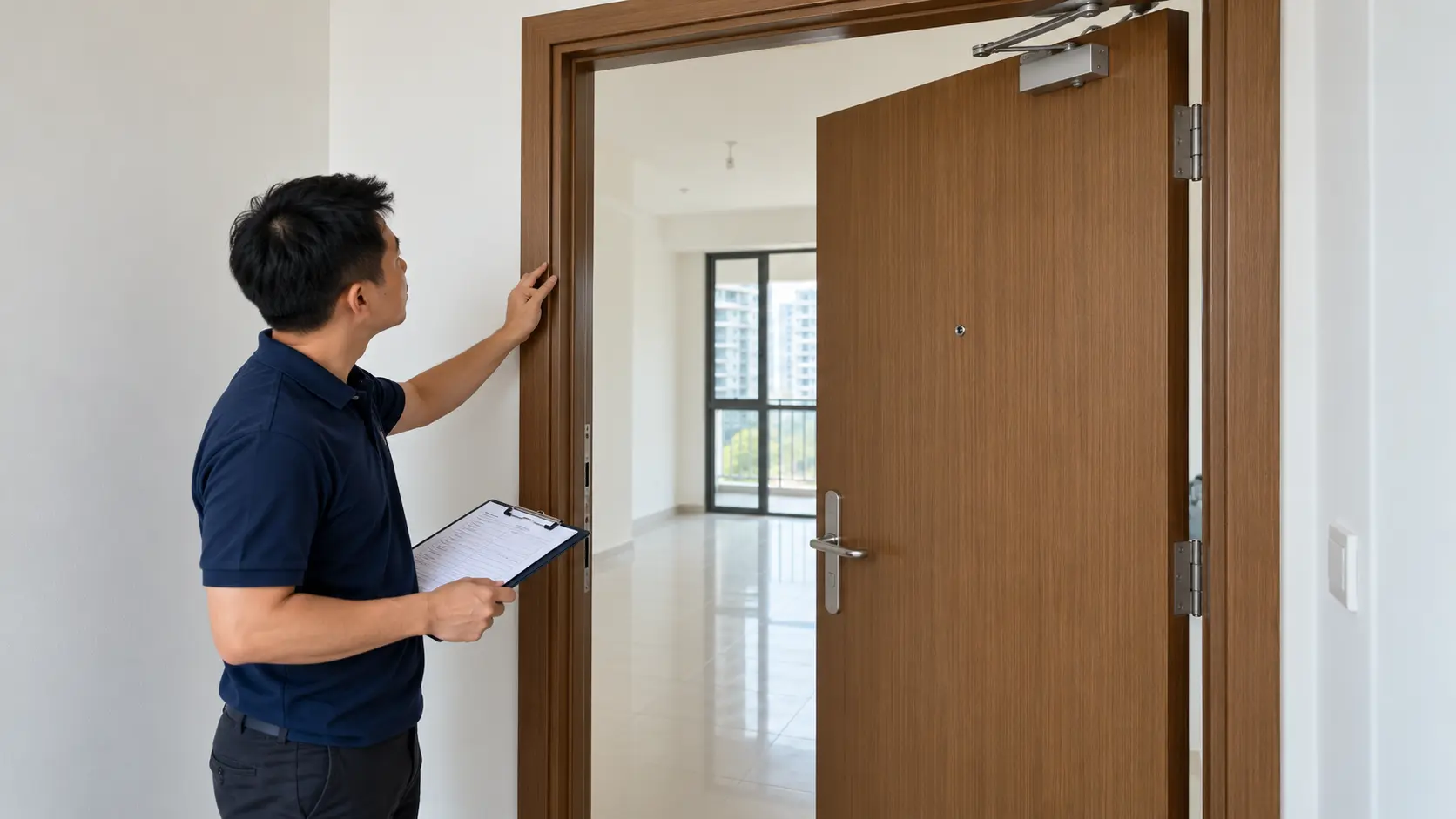
- Confirm the door's fire rating from its certification label, or with HDB or the MCST if the label is missing or unclear.
- Select a digital lock with a CoC matching or exceeding that rating, with documentation confirming a mechanical fail-safe.
- Check whether the chosen lock is already listed in the door's existing CoC, or whether it needs its own individual certification.
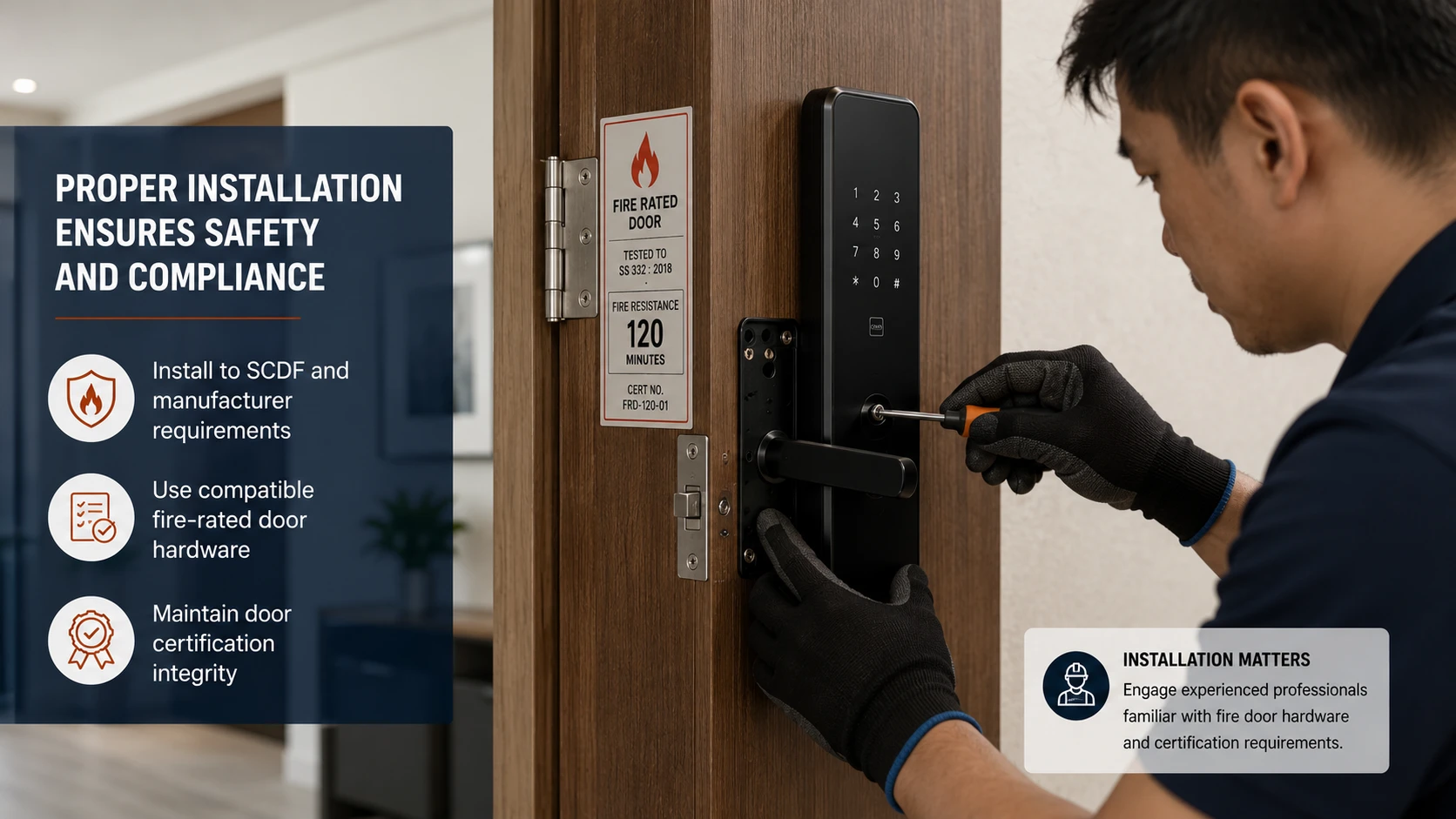
- Engage an installer familiar with fire door hardware, since incorrect drilling or cutting can affect the tested configuration even with a certified lock.
- Retain the CoC, installation records and any updated certification labels for future inspections, MCST records or resale.
- Test the manual override and the door's self-closing action after installation, before relying on the digital lock day to day.
Common Installation Mistakes to Avoid
Project teams and homeowners tend to run into a similar set of issues, including:
- Fitting a general digital lock bought online without checking whether it has a CoC for fire-rated doors.
- Assuming a lock is compliant because it is marketed as "fire-rated," without checking the certificate against the door's specific rating.
- Removing or disabling the door's self-closing device during installation and not reinstating it afterwards.
- Drilling additional holes, or enlarging existing ones, beyond what the certified configuration allows.
- Mismatching the lock's fire-rating duration with the door's, for example fitting a lock without confirmed fire resistance to a 60-minute door.
- Not keeping a copy of the CoC, which can cause delays during MCST checks, HDB enquiries or resale.
- Treating a staircase or riser door the same as a residential unit's main door, when exit-facility doors may need separate SCDF approval for locking devices.
Maintenance and Inspection Guidance
Routine checks help confirm a fire-rated door and its digital lock continue to perform as tested. This is general maintenance guidance, not a substitute for a professional fire safety inspection.
- Confirm the door closes fully into the frame and latches every time, without needing to be pushed.
- Check that the self-closing device operates smoothly and has not been removed or disconnected; HDB advises this device should not be removed from fire-rated main doors.
- Inspect the door leaf and frame for warping, damage or gaps that could affect the seal.
- Test the digital lock's manual or mechanical override regularly, not only once the battery is already low.
- Replace batteries before they run out completely, and confirm the backup access method still works.
- Check that the fire-rating label near the hinges is still present and legible.
- Keep the lock's CoC and installation records together with other unit or property documents.
For broader timber door care in Singapore's humidity, see HongRui's guide to maintaining a timber fire-rated door.
When Replacement or Reassessment May Be Needed
A digital lock or fire-rated door may need replacement or reassessment, rather than routine maintenance, in situations such as: the door leaf or frame is damaged, warped or no longer closes and latches properly; the certification label is missing or illegible and cannot be verified with HDB or the original supplier; the existing digital lock has no traceable CoC and was installed before 1 March 2024, where SCDF encourages, though does not strictly require, replacement with a certified DDL; the unit is undergoing a main door replacement as part of renovation, BTO move-in fit-out or an HDB upgrading programme, a natural point to review current compliance; or a different lock model is being considered than the one originally listed in the door's CoC. HongRui's overview of HDB main door replacement rules covers the related approval process.
Questions to Ask Before Specifying a Digital Lock for a Fire-Rated Door
Before specification or purchase, it helps to ask:
- What is the confirmed fire-rating duration of the door, and where is this documented?
- Will the digital lock be supplied and tested with the door, or fitted as a separate retrofit?
- Does the lock have a current CoC, with brand, model and fire-rating duration matching the product being installed?
- Does the documentation confirm a mechanical fail-safe for manual exit if the battery fails?
- Which certification body issued the CoC, and is it currently recognised for digital locksets?
- Will installation involve drilling, cutting or hardware changes beyond the door's tested configuration?
- Who is responsible for retaining the CoC and related documentation after installation?
Frequently Asked Questions
Can I install a digital lock on a fire-rated door in Singapore?
Yes, provided it meets SCDF's certification requirements. Since 1 March 2024, any digital door lock fitted to a fire-rated door must be certified for fire resistance, either through the door's original CoC or its own individual certification. Installing an uncertified lock, or altering the door beyond its tested configuration, may affect how the door performs in a fire. Always ask the supplier to show the lock's current CoC first.
Do all HDB or BTO main doors need to be fire-rated?
No. Whether a flat needs a fire-rated main door depends on the building's design and the SCDF Fire Code requirements that apply to that specific unit; HDB determines this on a flat-by-flat basis, including when assessing eligibility under upgrading programmes. If you are unsure, check with HDB directly or look for a certification label near the door's hinges. HongRui's BTO main door guide covers related planning considerations.
How can I check if my main door is fire-rated?
Look for a serial label, usually a sticker or small plate, near the hinges of the door or door frame, stating the fire-rating duration, such as 30 or 60 minutes. If the label is missing, damaged or unclear, check with HDB for public housing, or your MCST for condominiums and other strata-titled properties.
What does a Certificate of Conformity (CoC) for a digital lock confirm?
A CoC confirms that a specific digital lock model has been tested and certified to a recognised fire-resistance standard, such as SS 332 or EN 1634-1. When checking one, confirm the brand and model match the product being installed, the fire-rating duration is equal to or greater than the door's, and the documentation includes a mechanical fail-safe for manual unlocking. Only a small number of accredited bodies are authorised to issue these certificates.
Do I need to replace a digital lock that was installed before March 2024?
Not automatically. SCDF guidance indicates that locks installed on residential fire-rated doors before 1 March 2024 do not need to be retroactively replaced, though homeowners are encouraged to replace uncertified locks with a certified DDL where practical, since fire performance cannot be confirmed without testing. This is a recommendation rather than a strict requirement for existing installations, but it is worth reviewing during any main door renovation.
Does installing a digital lock affect my fire-rated door's certification?
It can, if the lock is uncertified or the installation goes beyond the door's tested configuration. A fire-rated door is certified as a complete assembly, so fitting hardware that was not tested with it, or drilling outside the original specification, may affect how the door performs in a fire. Using a properly certified DDL, installed according to its documentation, helps keep the assembly within its tested performance.
Who can I contact to confirm project-specific fire door and digital lock requirements?
SCDF's published Fire Code guidance is the primary regulatory reference, while HDB or your MCST can confirm whether a specific flat or building requires a fire-rated door. For product-level compatibility, your door supplier, installer or a Qualified Person engaged on the project can advise on suitable certified options. This article provides general information only, not project-specific advice.
Conclusion
Digital locks and fire-rated doors can work well together in Singapore homes and commercial buildings, but compatibility depends on certification, not just product features. The lock should either be supplied and tested with the door as one assembly, or carry its own CoC matching the door's fire-rating duration, with a mechanical fail-safe for manual exit. Installation and maintenance matter just as much as product choice: drilling outside the tested configuration, removing a self-closing device, or losing track of CoC documentation can all affect how the assembly performs over time. Because requirements can vary by flat, building and project, and may be updated by SCDF or HDB, confirm current requirements before specification rather than relying on general guidance alone.
Leave A Comment